

An asteroid that had been observed for nearly three decades deviated from its predicted orbit last summer by an amount that could not be explained by gravity alone. Later, images revealed a gaseous envelope and a tail around it. This is the first confirmed case in which the cometary nature of an object was established through its anomalous motion.
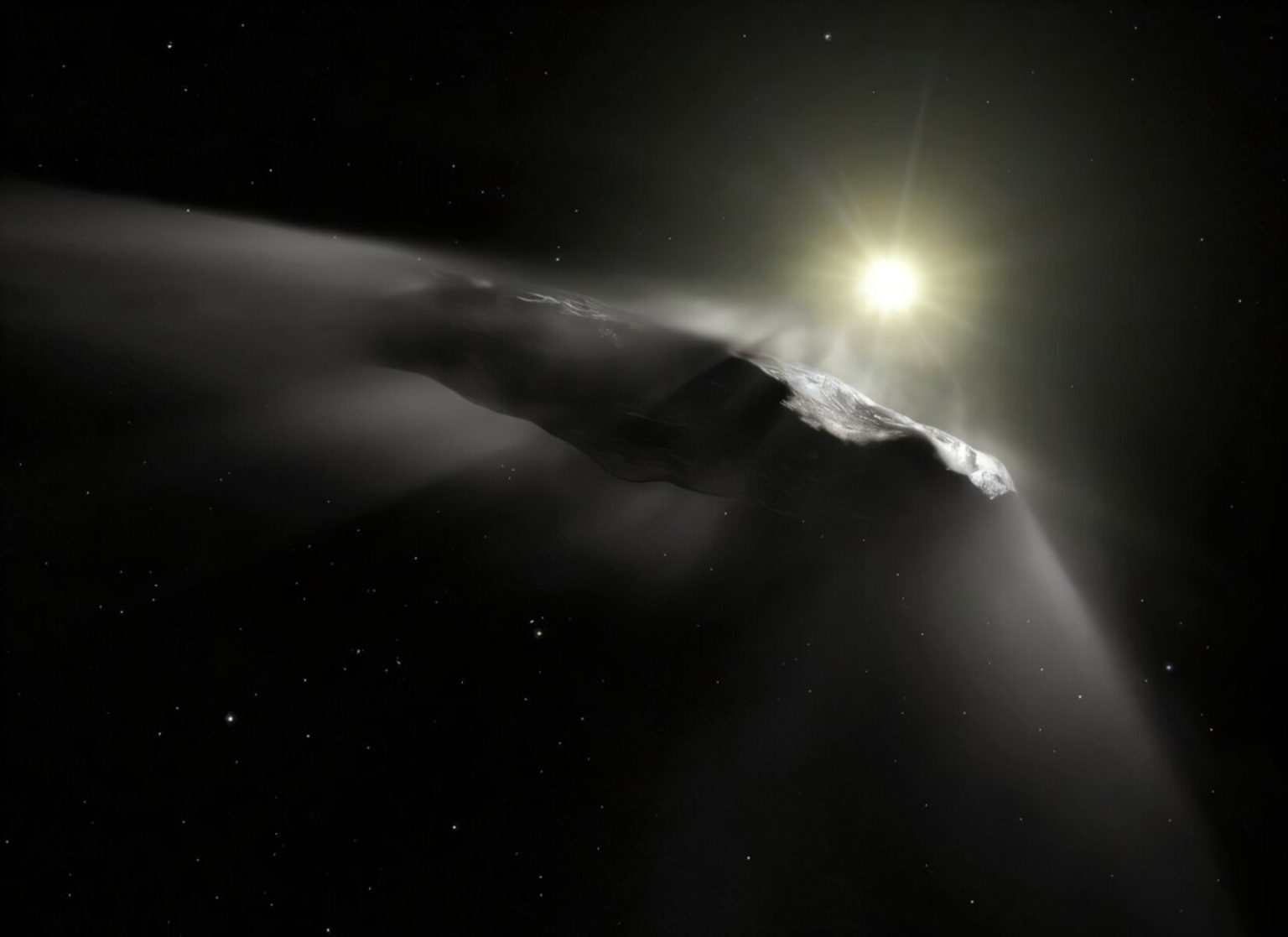
Between a Comet and an Asteroid
The Solar System contains a separate category of objects that outwardly resemble asteroids but exhibit unexplained orbital changes characteristic of comets. They show no visible signs of activity. Such bodies have been named “dark comets,” and their true nature remains a subject of research.
A classical comet is usually easy to recognize. Solar heat causes its ice to sublimate, forming a gaseous envelope and a dusty tail. Escaping gases act like a tiny thruster and alter the trajectory of the nucleus. In dark comets, this process is invisible, although changes in their orbits indicate that it is taking place.
Significant Deviation
The object 1998 SH2 has been tracked for 27 years, and the positional measurements accumulated over that time gave researchers reason to consider its orbit well understood. They were confident in the accuracy of their calculations until August 2025.
During its close approach to Earth, radar observations failed to detect the object where it was expected to be. In late August, the Serra da Piedade Observatory in Brazil finally located 1998 SH2.
The analysis revealed a discrepancy of 19 standard deviations from the calculated position, effectively ruling out measurement error as an explanation. Put simply, the probability that the asteroid had ended up so far from the predicted location by chance was extremely small. Such a value indicated the presence of additional acceleration unrelated to gravity.
The Tail Confirms Its Nature
To search for barely visible dust, researchers used deep stacked images obtained with powerful telescopes in Chile and Hawaii. The images revealed a faint coma and a narrow tail extending more than 20 arcseconds.
According to phys.org, the study was published in the peer-reviewed journal Nature Astronomy. The authors note that dust was emitted continuously from late August until late September 2025. This points to cometary activity driven by sublimation rather than a one-time impact or rotational shedding of material.
A Challenge for Planetary Defense
If some objects classified as potentially hazardous asteroids are actually comets, collision-risk assessments may need to be revised. Their trajectories may change unexpectedly, making long-term forecasting more difficult.
The authors of the study emphasize that the physical properties of comets, including their composition, directly affect the design of any mission intended to deflect a hazardous object. Among such missions, they mention the recent Double Asteroid Redirection Test, or DART, in which the orbit of Dimorphos was deliberately altered in 2022 through the impact of a spacecraft.
As for 1998 SH2 itself, scientists say it poses no threat to Earth in the foreseeable future. However, an increase in the proportion of unidentified comets among hazardous objects raises the relative risk associated specifically with them.
Water and ʻOumuamua
The discovery has broader implications. If dark comets are far more numerous in the Solar System than previously believed, a similar hidden population during the early stages of Earth’s formation may have played a role in delivering water to the planet.
Of particular interest is a possible connection with ʻOumuamua, the first confirmed interstellar object in the history of observations. It also exhibited unexplained acceleration with characteristics associated with dark comets. The new data may help explain this phenomenon.
