

It is generally believed that all tropical forests are affected by climate change in the same way. However, a new study based on the analysis of satellite data has shown that different factors affect forest conditions differently in different regions.
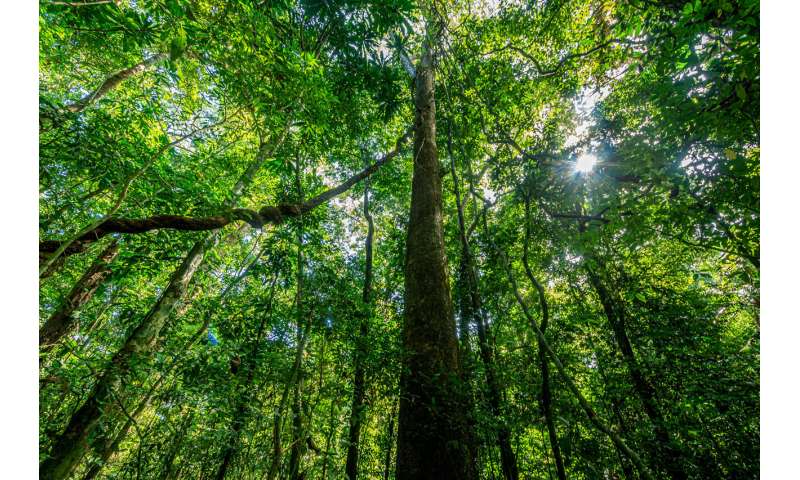
Tropical Forests
Recently, scientists from the Smithsonian Tropical Research Institute, with support from colleagues at the University of Maryland, NASA, and institutions in Brazil, conducted a study showing that tropical forests in different parts of the world respond differently to climate change factors. According to Phys.org, the study is based on satellite data.
The authors explain that the research was based on information about changes in three different regions of the planet that are usually grouped together under the term “tropical forests”: the Brazilian Amazon, tropical Africa, and the humid forests of Southeast Asia. However, as data from NASA’s GEDI satellite showed, grouping them together in this way is not entirely justified.
The reason is that even a simple look at the types of vegetation in these regions reveals clear differences. Some forests are actually not particularly dense, while the trees there are relatively tall. Others form a continuous canopy of leaves at heights of up to 70 meters. Satellites are able to observe all of these differences quite well.
Differences in the Changes
Traditionally, climate change is believed to affect tropical forests through the same mechanism. The air generally becomes hotter and drier, making it impossible for certain key plant and animal species to survive. However, the study showed that dense forests were sensitive to high temperatures only in Africa, while the sensitivity of Amazon forests to this factor was moderate, and in equatorial Asia it was low.
At the same time, it was the equatorial forests of Asia that proved to be extremely sensitive to changes in humidity. Amazon forests showed moderate sensitivity to this factor as well, while African forests were barely affected by it at all.
Scientists explain these differences by noting that it is necessary to consider not only general climate characteristics, but also factors such as soils, their chemical and mineralogical composition, and the landscape. These factors determine which plants grow in a particular region. It is also important to take into account not simply how often it rains, but how frequently intense downpours accompanied by thunderstorms occur.