

Astronomers very rarely manage to catch the moment of a star’s death at its very beginning. Usually, supernovae are noticed only when the explosion has already developed to full strength. However, the explosion of SN 2026gzf in a galaxy 500 million light-years away became an exception, allowing scientists to study the first minutes of stellar death in detail.
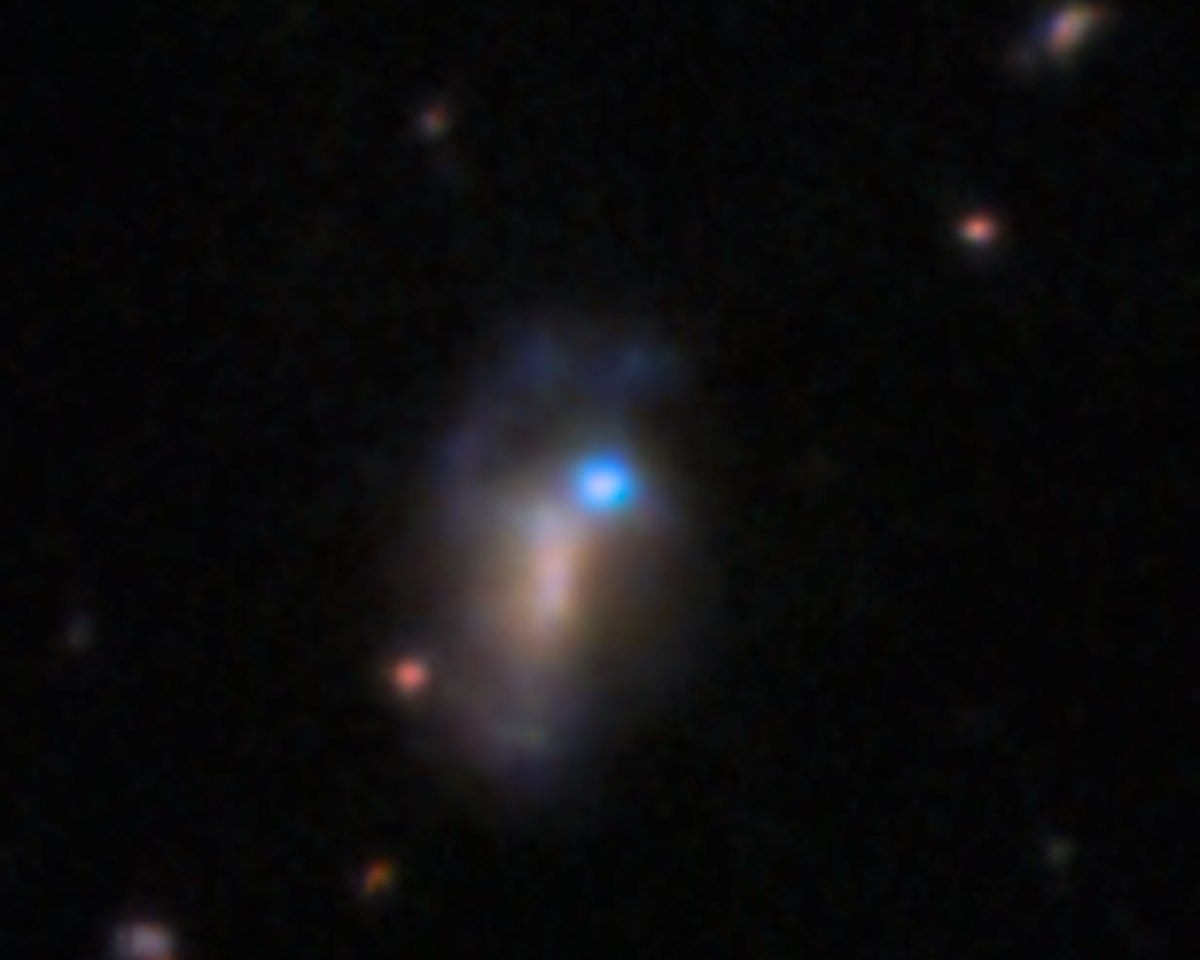
On March 21, 2026, the Einstein Probe space probe detected a brief X-ray pulse designated EP260321a. Less than an hour later, ground-based observatories pointed their mirrors toward the indicated location and confirmed that it was a shock breakout.
During the collapse of the core of a massive star, a powerful shock wave travels outward and, upon reaching the surface, releases the first bright light. The breakout itself lasts from several seconds to several hours, while a supernova can remain bright for months. Over the past 20 years, this is only the second reliably observed event of this kind in the X-ray range.
Powerful Explosion Without a Gamma-Ray Jet
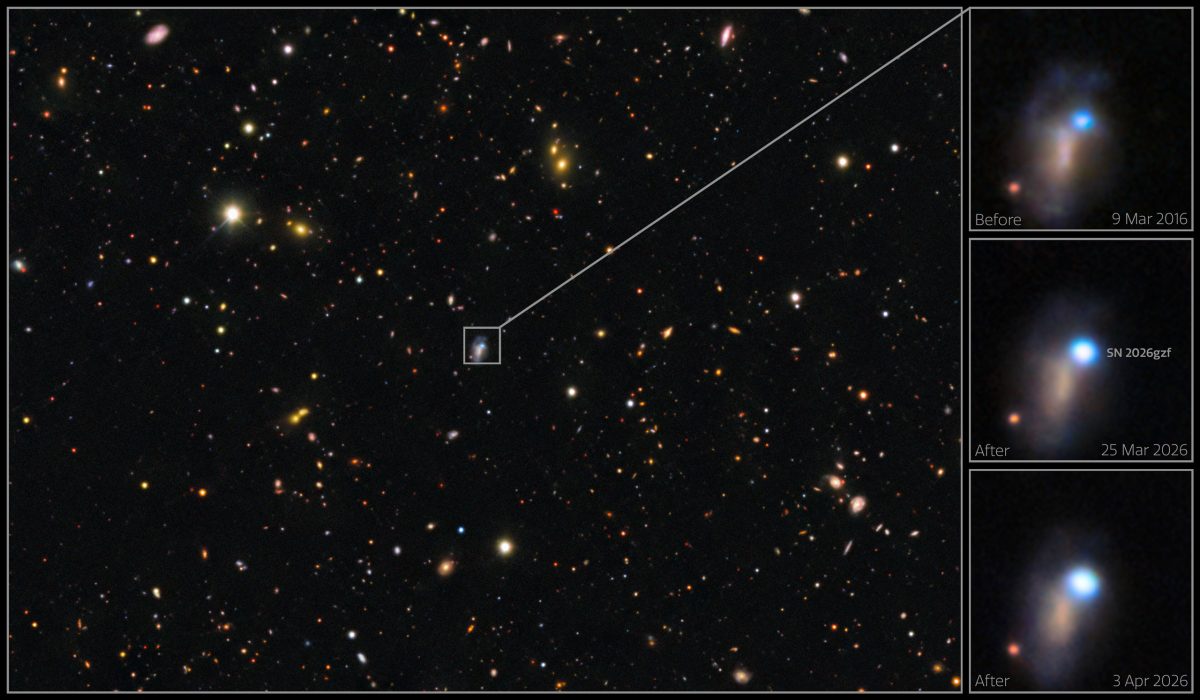
Classified as a Type Ic-BL supernova (Type Ic broad-lined supernova), SN 2026gzf originated from a star that had lost its outer layers of hydrogen and helium before the explosion. Events of this type are usually accompanied by brighter gamma-ray bursts and jets of matter traveling at nearly the speed of light.
However, observations by two independent groups of researchers revealed a strange anomaly: no gamma-ray signals or relativistic jets were detected. Scientists suggest that a jet may have formed deep inside the star but was “choked” by the dense material of the star itself or its surroundings.
According to scientists’ estimates, the progenitor was a Wolf–Rayet giant whose initial mass was 20 times that of the Sun. Near the end of its life, it underwent a series of powerful mass-loss episodes, leaving behind an exposed carbon-oxygen core.
The ejected material formed at least two shells around the star. The closer and lighter shell produced the initial X-ray flash, while the more distant, asymmetric shell contributed to the optical emission. These remnants became a kind of “fossilized” record of the giant star’s final years for astronomers.
Networked Astronomy in Action
The study of SN 2026gzf became possible thanks to the coordinated work of numerous observatories. Interestingly, in archival images from the Dark Energy Camera (DECam) taken 10 years before the explosion, scientists were able to identify a blue light source — the progenitor star itself.
The DESI spectroscopic instrument regularly tracked changes in the supernova’s spectrum using available fibers, while observations from Rubin, Chandra, VLA, SALT, and Gemini helped definitively rule out the presence of a relativistic jet. The SN 2026gzf event demonstrated that even extremely powerful stellar explosions can unfold according to previously unknown scenarios.
Earlier, we shared interesting facts about supernovae.
According to scitechdaily.com

