

Scientists continue to study coronal mass ejections. For the first time, they used observational data from as many as 17 spacecraft, and this revealed a detail that had previously been overlooked. Many eruptions have not one “lobe” spreading through space, but two, and this greatly affects assessments of their danger to Earth.
A Special Coronal Mass Ejection
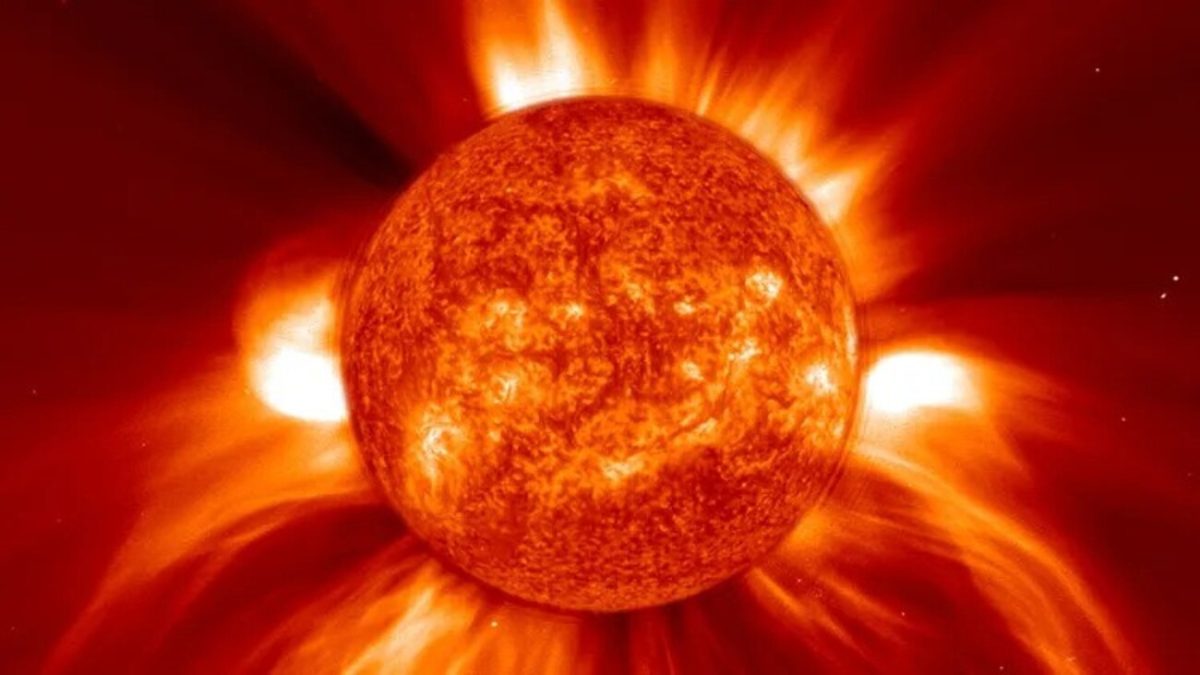
Measurements of the same coronal mass ejection (CME) from different points in the Solar System revealed the true scale of the solar eruption. An unpredictable coronal mass ejection that sent a hidden cloud of charged particles toward Earth was tracked by a record 17 spacecraft scattered throughout the Solar System, showing that the CME was surprisingly one-sided. This was reported by Space.com.
CMEs are the Sun’s “burps” — enormous clouds of magnetized plasma expelled from the Sun’s hot outer atmosphere, the corona, by energy released during a solar flare. The CME’s magnetic cloud then expands through the Solar System, while the charged particles contained within it pose a significant radiation hazard to astronauts, spacecraft, and even airline passengers. But they also have a beautiful side, as they can produce spectacular northern and southern auroras when they reach Earth.
CMEs occur regularly, but one that erupted from the Sun at 00:48 Universal Time (7:48 p.m. Eastern Time) on December 15, 2024, turned out to be quite unusual.
“We used observations from 17 spacecraft to track and characterize this coronal mass ejection,” said Adrienne Luspay-Kuti of the Johns Hopkins University Applied Physics Laboratory, who led the study combining all of the observations. “This is a record number of spacecraft used to track and characterize a single CME, and it gave us an exceptionally detailed view of how the eruption evolved.”
The previous record was 10 spacecraft, but they were mostly positioned approximately along a line extending from the Sun to Earth and beyond, making their measurements somewhat one-dimensional. This time, for the December 2024 CME, the spacecraft were widely dispersed, not only at different distances from the Sun but also significantly offset from the Earth–Sun line.
Two “Lobes” of the Eruption
They found that the CME had two asymmetric tails, one moving faster than the other. One of these tails, which was heading toward Earth and Mars, would have gone unnoticed, hidden behind the larger but slower tail that left the Sun at an angle, if the spacecraft had not been so widely distributed.
“Our observations showed that the fast tail was moving through the Earth–Mars sector, while the much slower tail was farther west in the direction of STEREO-A,” Luspay-Kuti said. STEREO-A is one of two NASA spacecraft for monitoring space weather known as the Solar Terrestrial Relations Observatory.
The beginning of the coronal mass ejection was recorded by the joint NASA–ESA Solar and Heliospheric Observatory (SOHO), which has continuously observed the Sun for more than 30 years. However, it detected only the slower left wing of the CME, which erupted at an angle to Earth; the faster wing directed toward our planet went unnoticed because it was hidden behind the slower, larger wing.
The CME was next detected at a distance of 0.35 astronomical units (AU) from the Sun on December 16, as it moved through space near Mercury and the European Space Agency’s BepiColombo mission, which will finally enter orbit around the innermost planet in November 2026.
An Asymmetric Solar Eruption
The next detection, on December 17, was of the “hidden” component that arrived at Earth, where it was recorded by numerous spacecraft. The CME was not strong enough to cause significant auroras. Interestingly, the European Solar Orbiter mission, on an elongated orbit around the Sun and at the time located 0.94 AU from the Sun and only 10 degrees from the Earth–Sun line, did not detect the CME. This non-detection was actually very important because it helped refine the shape of the CME.
Then, on December 18, the slower wing reached NASA’s STEREO-A spacecraft, which orbits the Sun at the same distance as Earth — 1 astronomical unit — but significantly ahead of Earth in its orbit. The wing that crossed Earth had an average speed of 522 miles (840 kilometers) per second, while the other wing trailed behind at an average speed of 332 miles (534 kilometers) per second as it moved away from the Sun and past BepiColombo and STEREO-A. In fact, by the time it reached STEREO-A, it had slowed to about 248.5 miles (400 kilometers) per second.
Both wings slowed because of friction with the regular solar wind that the CME was overtaking, and the range of speeds measured within the CME told researchers that the solar eruption was not moving as a single, coherent front.
A Major Step in Understanding CMEs
Beyond Earth, NASA’s Europa Clipper mission — on which Luspay-Kuti serves as principal investigator of the Plasma Instrument for Magnetic Sounding (PIMS) experiment — detected the faster-moving portion at a distance of 1.19 astronomical units as the spacecraft was flying toward Mars for a gravity assist on its journey to Jupiter. At the Red Planet, the former MAVEN mission also detected the CME from December 19 to 20.
Having not only so many spacecraft tracking the CME’s progress but also enough spacecraft located away from the Earth–Sun line to measure the CME’s shape in at least two dimensions represents a major step forward in understanding and predicting how these phenomena propagate.
“This is important for future human exploration because a missed CME could mean losing valuable warning time,” Luspay-Kuti said. “Fast CMEs can generate shock waves that accelerate high-energy particles, which can be dangerous for astronauts outside Earth’s protective magnetic field. That is why observations from different vantage points, including spacecraft located away from the Sun–Earth axis and planetary missions during their journeys, are becoming increasingly important for space-weather forecasting as humans explore farther from Earth.”
The asymmetric, two-lobed structure of this particular CME was certainly a surprise. The cause of the asymmetry remains unclear, although Luspay-Kuti said the researchers are investigating it. The main question is whether highly asymmetric CMEs are actually fairly common but go unrecognized because of insufficient observations, or whether they are truly rare.
A Record Number of Spacecraft Capturing the Eruption from Different Perspectives
The 17 spacecraft that detected or imaged the CME at different stages of its development — the shock front and turbulent sheath ahead of the magnetic cloud, the CME itself, and the turbulent wake left behind in the solar wind after its passage — were: SOHO (the first images), BepiColombo, NASA’s Solar Dynamics Observatory, STEREO-A, the four spacecraft of the Magnetospheric Multiscale (MMS) mission, the two spacecraft of the ARTEMIS mission (Acceleration, Reconnection, Turbulence and Electrodynamics of the Moon’s Interaction with the Sun), NASA’s Wind, ACE (Advanced Composition Explorer), GOES (Geostationary Operational Environmental Satellite), DSCOVR (Deep Space Climate Observatory), Europa Clipper, MAVEN, and Solar Orbiter, which made measurements but did not detect the CME.
In the future, these missions will be joined by the European Space Agency’s Vigil mission, which will monitor space weather after its launch in 2031 to the L5 Lagrange point between the Sun and Earth, located 60 degrees behind Earth in its orbit, thereby providing additional off-axis monitoring.
