

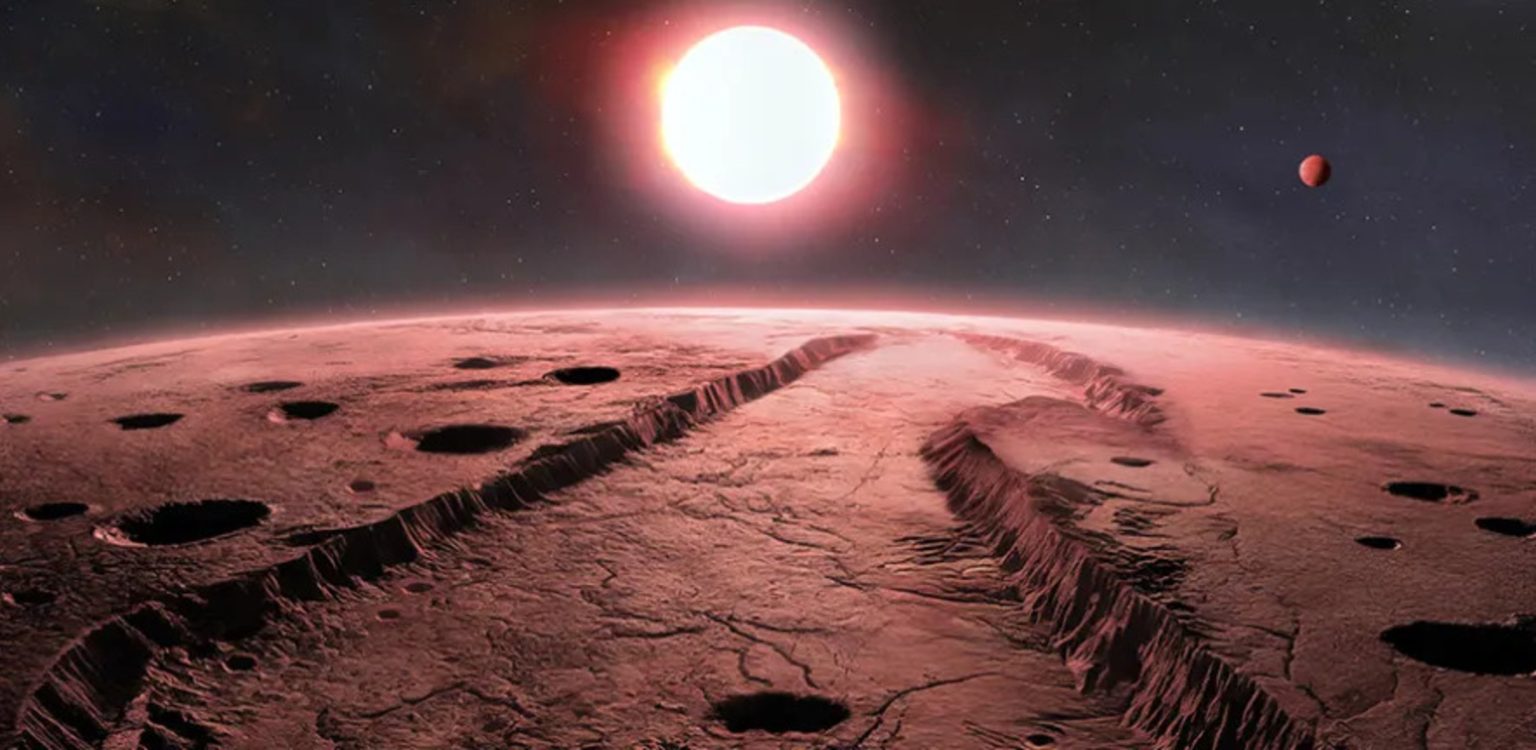
The planets orbiting one of the stars closest to us have turned out to be unsuitable for life. They orbit far too close to their host star and almost certainly lost their gaseous envelopes billions of years ago. In addition, their interiors are composed largely of a mineral that does not retain water well.
The Chemistry of Their Interiors
The chemical composition of the star itself can be used to roughly predict the composition of the planets that form around it. A team from the University of Cambridge analyzed the spectrum of Barnard’s Star and found an increased ratio of magnesium to silicon compared to the Sun.
Because of this, the planets’ mantles are likely to be composed mostly of olivine. This mineral holds less water than many other silicates, so even the internal water reservoirs on such planets may be much poorer.
Lead author Xander Byrne of the Institute of Astronomy in Cambridge explains that in the Earth’s mantle, magnesium is mostly found in silicate minerals, primarily olivine. These can bind some water in their crystal structure. However, when there is too much magnesium, some of it is converted to periclase, a magnesium oxide that has little ability to hold water. Periclase is found on Earth, but only a few hundred kilometres below the surface. However, planets orbiting Barnard’s Star appear to have a high amount of it because of the high magnesium content in the system. This means that the inner layers of planets near Barnard’s Star are likely to have much lower water holding capacity. The results were published in the peer-reviewed journal Monthly Notices of the Royal Astronomical Society.
Orbits That Are Too Close
All four worlds orbit at distances equal to only one to four percent of Earth’s orbital radius. Even the farthest of them is located ten times closer to the red dwarf than Mercury is to the Sun.
Under these conditions, all planets are likely to be tidally locked, always facing the same side of their star. For about 10 billion years, the age of Barnard’s star, their dayside hemisphere has been continuously exposed to its radiation and regular stellar flares.
Where Their Atmospheres Went
If atmospheres existed, they were most likely lost to the stellar wind over the course of two billion years., according to Universe Today. The weak gravity of these planets, which are less massive than Earth, was unable to retain the gas under the constant stream of particles emitted by the star.
Xander Byrne puts it simply: the planets were always likely to be hostile to life because their low gravity, combined with their close orbits, left their atmospheres with no chance of survival.
Stable Orbital Period Ratios
Compact planetary systems are often unstable because of the gravitational interactions between their planets. The planets may either collide with one another or be ejected from the system and become free-floating worlds.
Such an outcome is unlikely here because the three inner planets move in a stable orbital-period ratio of 9:12:16. A similar mechanism operates among Jupiter’s Galilean moons Io, Europa, and Ganymede, whose orbital periods follow a 1:2:4 ratio.
What Scientists Will Search for Next
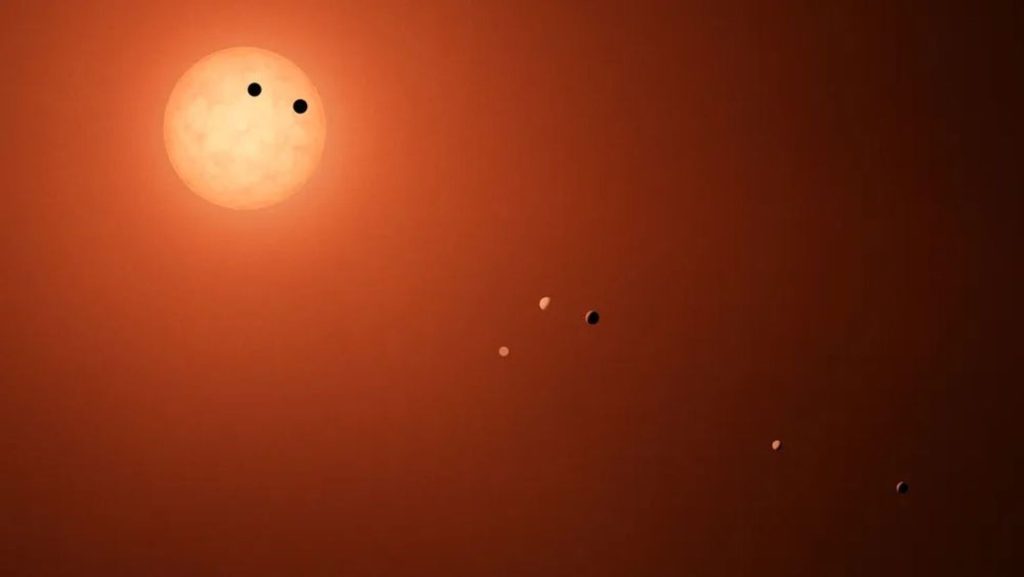
Until now, bodies of this size have largely escaped astronomers’ attention because larger worlds are much easier to detect. Xander Byrne expects the sensitivity of new instruments to reduce this observational bias, allowing rocky planets the size of Earth or smaller to be found increasingly often.
The next step will be the launch of PLATO, the European Space Agency’s telescope designed to search for planetary transits and stellar oscillations. The spacecraft will conduct long-term observations of bright stars and detect even the smallest variations in their brightness.
The paradox is that the first claimed discovery around this same star was announced as early as the 1960s and involved a supposed gas giant. Peter van de Kamp’s astrometric measurements were later explained as the result of an equipment defect, while the planets that actually exist turned out to be thousands of times smaller.
