

Virgin Galactic’s new suborbital spaceplane has flown from its factory in Arizona to its permanent base in New Mexico. On the same day, the spacecraft was named Apeiron. The new Delta-class vehicles are designed to fly more frequently and last longer than their predecessors. The company plans to take its first tourists to the edge of space next year.
Twice a Week
The company expects to launch each Delta-class spacecraft twice a week and use it for more than 500 flights. Its predecessor, VSS Unity, reached the edge of space seven times during a year of commercial operations, from June 2023 to June 2024. The new spaceplane is therefore expected to fly more often in a month than VSS Unity did in an entire year.
To support this pace, Virgin Galactic says the new spacecraft feature enhanced thermal protection to withstand the heat of atmospheric reentry, along with simpler manufacturing and maintenance procedures. The less work a vehicle needs after landing, the sooner it can be prepared for another launch.
A Boundless Name
The name Apeiron was chosen through an online contest with voters from more than 80 countries. The ancient Greek word translates as “the boundless.”
Video presentation of the Apeiron spaceplane, whose name was selected through a worldwide vote. Source: Virgin Galactic
In the sixth century BCE, the philosopher Anaximander used this term to describe the fundamental source from which everything arises. In his view, it had no limits and therefore remained inexhaustible, continually giving rise to new things.
How It Flies
As Universe Today notes, the new spacecraft follows the same flight concept as SpaceShipOne. In 2004, that privately developed vehicle, carrying a pilot, climbed above 100 kilometers twice within two weeks. This fulfilled the X Prize requirements, earning its creators $10 million. A carrier aircraft lifts the spaceplane to high altitude and releases it. The rocket engine then ignites, propelling the vehicle toward the edge of space.
During descent, the rear section of the wing and the tail booms rotate upward. This configuration dramatically increases drag, rapidly slowing the spacecraft, while the raised surfaces automatically keep its underside facing the airflow without pilot input. Before landing, the wing returns to its normal position, and the spaceplane glides to a runway.
Following this design, Virgin Galactic built two SpaceShipTwo vehicles. The first, VSS Enterprise, broke apart during testing in 2014, killing one of its pilots. The second, VSS Unity, carried more than 30 people to the edge of space, including company founder Richard Branson.
Transfer and Testing
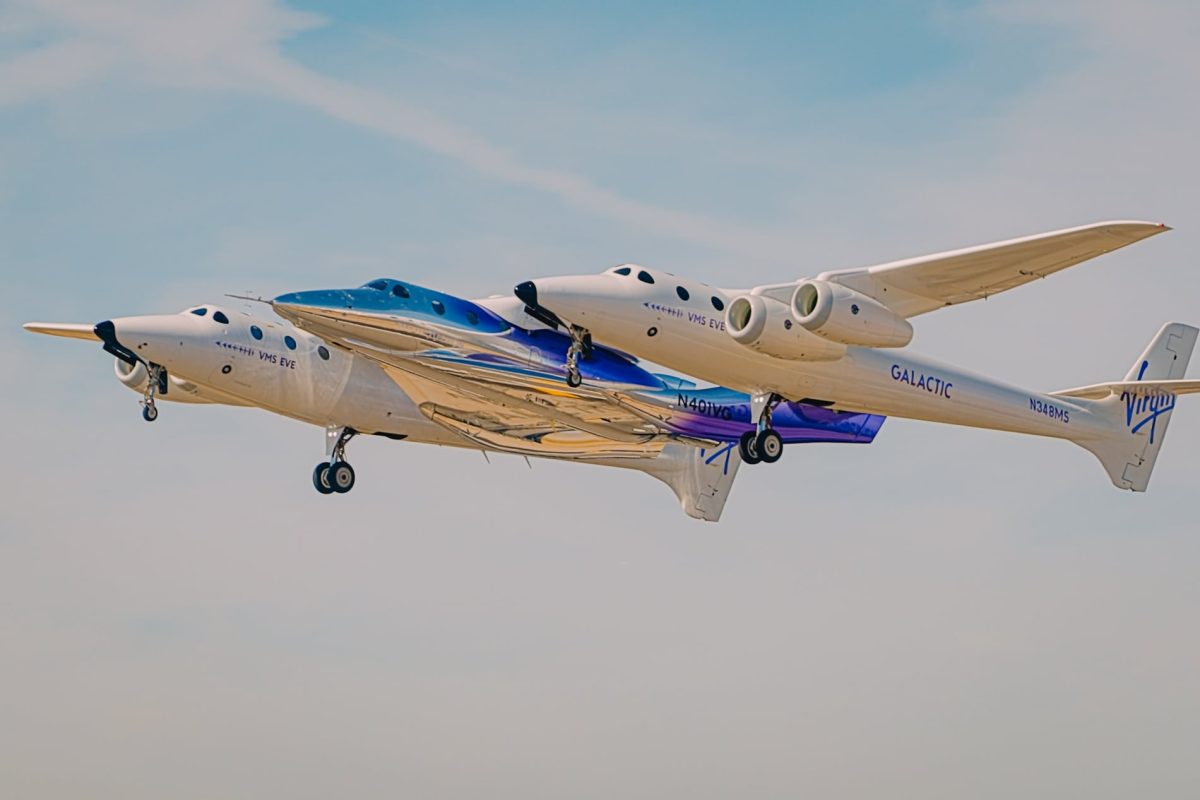
The spaceplane flew from the factory in Mesa to Spaceport America in an hour and a half, attached beneath the twin-fuselage carrier aircraft VMS Eve. Company CEO Michael Colglazier noted that the spacecraft received its name in the morning and arrived at its permanent base that afternoon.
Engineers will now complete software checks and prepare Apeiron for flight testing. Commercial flights are scheduled to begin by mid-2027, and some customers have already paid up to $750,000 for a ticket.
No Competitors for Now
If the schedule holds, Virgin Galactic will face no competition in suborbital tourism for a while. Blue Origin, founded by Jeff Bezos, has carried 92 people to the edge of space aboard New Shepard since 2021. But in January, following its 17th crewed flight, the program was suspended for at least two years.
Meanwhile, a second Delta-class spacecraft, which has yet to be named, is being assembled at the same Mesa factory. Its commercial flights are expected to begin in the second half of 2027.
