

Research indicates that at least two separate asteroid belts orbit the white dwarf J1328−1450, each containing at least one large body. Scientists have also found that the belts differ somewhat in their chemical composition.
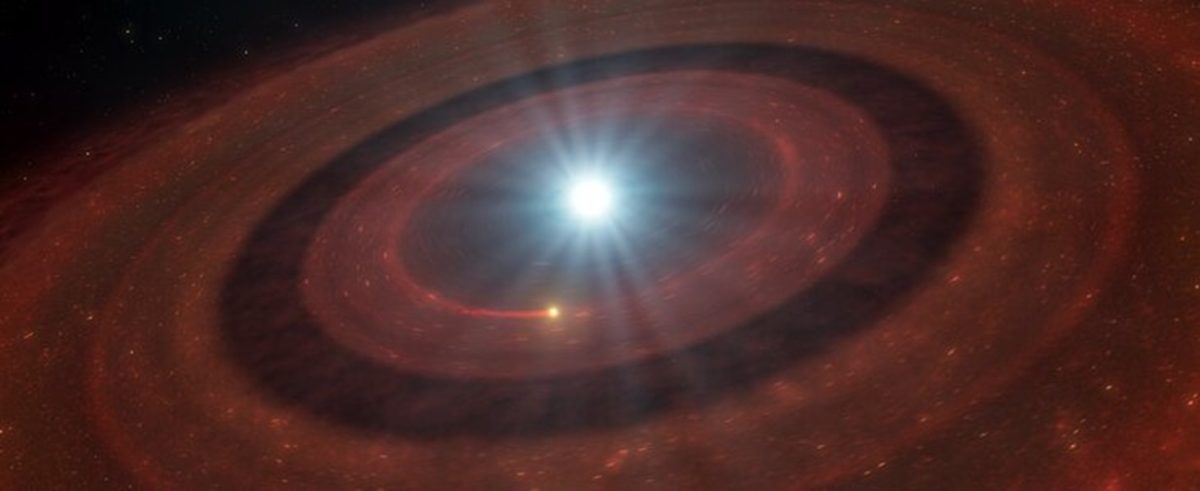
Rings Around a White Dwarf
The European Southern Observatory reports the discovery of two ring-shaped structures around a white dwarf. The data were obtained using the Very Large Telescope (VLT) and an attached spectrograph. The findings were published in Nature Astronomy.
White dwarfs are the cores of stars that once passed through the red giant stage before shedding their outer layers, leaving only a dense central region where nuclear fusion no longer occurs. This means that any object orbiting a white dwarf must either have survived the shedding of those layers or formed after the star became “dead.”
J1328−1450, the object studied by the researchers, was once a star similar to the Sun in mass and size. It exhausted its hydrogen fuel, passed through the red giant stage, and is now slowly cooling. Earlier research suggested that it had a relatively uniform disk, like those around most white dwarfs.
Two Bodies
However, the new study has revised this picture. It revealed two debris disks at different distances from the star, separated by empty space. In this respect, J1328−1450 is an exception to the general pattern observed among white dwarfs.
The researchers also identified at least one large body in each debris disk. The inner disk contains an object with a diameter of a few kilometers, typical of asteroids in the Solar System. The more distant disk apparently contains a body the size of Pluto or even the Moon.
The scientists also determined the chemical composition of both debris belts. They contain oxygen, calcium, magnesium, and iron. Moreover, their compositions differ significantly. The researchers suggest that the belts may have formed through the destruction of two different worlds. Alternatively, there may have been just one planet, with one debris layer originating from its crust and the other from its core.
