

The brown dwarf WISE 0855 lies 7.5 light-years away from us. Scientists recently discovered that clouds of water vapor are actively moving through the atmosphere of this “failed star.” The James Webb Space Telescope helped detect them.
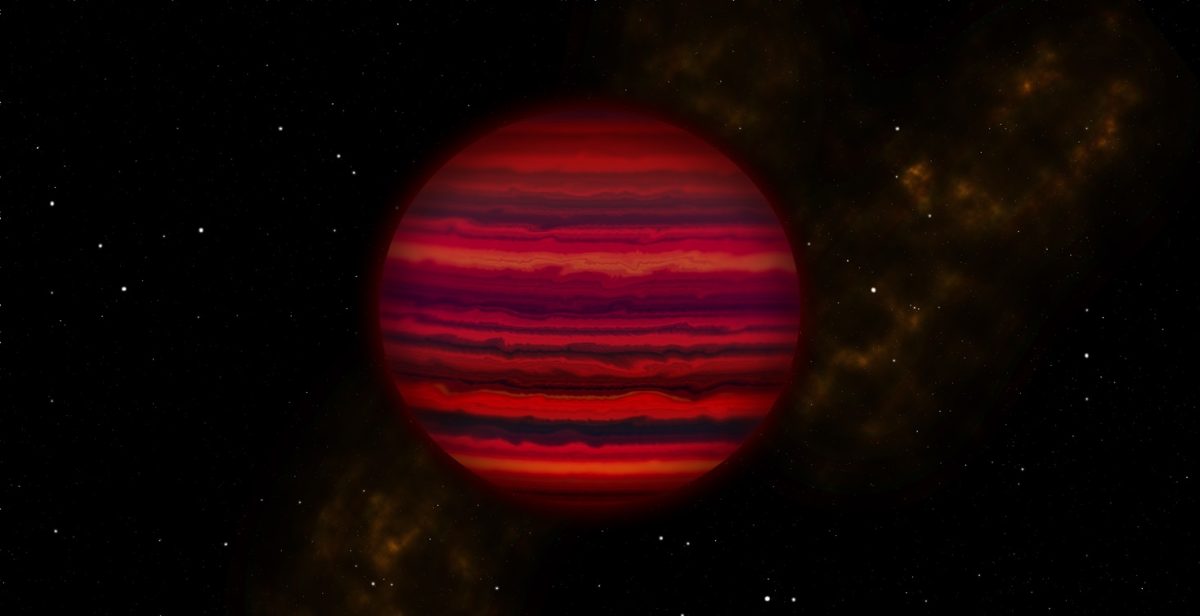
Two Effects in the Atmosphere of WISE 0855
A Jupiter-sized world just 7.5 light-years away is cloudy, chemically complex, and, as it turns out, more like our home planet than anyone expected. Using the James Webb Space Telescope, a team of scientists spent 11 hours observing WISE 0855, the coldest known brown dwarf, collecting a spectrum of its light every 15 minutes. The result is the most detailed time-series portrait ever obtained of this cold world—and the first direct confirmation that water clouds on another body change thickness over time, much like weather on Earth. The findings are described by phys.org.
The study shows that WISE 0855’s atmosphere is shaped by at least two distinct processes occurring simultaneously: high-altitude water clouds that thicken and thin as the object rotates, and gases brought upward by convection from deep within its atmosphere. Separating these two signals—previously impossible with older telescopes—is what makes the James Webb data so powerful.
“This is the first time we have been able to confirm that water clouds become thinner and thicker on a neighboring world,” said Brittany Miles, a graduate researcher at Steward Observatory and the team’s leader. “Before the James Webb Space Telescope, we had only photometric data, which blended the effects of clouds, chemistry, and temperature together. Now we can actually distinguish between them.”
James Webb Reads a Brown Dwarf’s Atmosphere
They therefore glow faintly from the heat left over after their formation. With a temperature of around 265 K (−8°C)—colder than Earth’s surface—WISE 0855 lies at the lower end of the brown dwarf temperature range, further blurring the boundary between these objects and planets. It has roughly twice Jupiter’s mass and is nearly the same size. In many respects, WISE 0855 resembles a gas giant that does not orbit a star.
Understanding its atmosphere requires looking at the world through what co-author Mark Marley, director and department head of the University of Arizona’s Lunar and Planetary Laboratory, describes as a kind of “screen door.” The screen filters some of the light, allowing us to learn about the world on either side of it. But we also need to understand the screen itself.
In this case, the screen is constantly changing. As WISE 0855 rotates, different regions of its surface come into view, each with slightly different cloud cover and temperatures—like watching a slowly rotating patchwork quilt of warmer and cooler regions.
The James Webb Space Telescope’s medium-resolution spectrograph was sensitive enough to track these differences in individual molecular features—something no other observatory had previously achieved for such a cold object.
Convection Brings Deep Gases Up on Jupiter
In addition to temperatures that varied as the brown dwarf rotated, the spectrograph detected a rhythmic, wave-like signal associated with specific gases: carbon monoxide and phosphine. These chemicals move through the atmosphere because heat from the brown dwarf’s interior continually carries them into the upper layers. A similar process occurs in a pot of hot soup, where warmer liquid rises from the bottom.
This chemical signal is familiar to planetary scientists. On Jupiter, convective mixing brings gases from deep, hot layers into the visible atmosphere. The same process, known as disequilibrium chemistry, has previously been observed in brown dwarfs, but watching it in real time, molecule by molecule, is a new capability.
“We see water clouds thickening and thinning, and gases from deep below rising and falling, and we can actually watch them change in real time,” Miles said.
Planet-Like Weather on Distant Worlds
Miles emphasizes that the discovery’s main value lies not only in what it reveals about WISE 0855, but also in how it helps us understand planetary atmospheres in general. The same basic physics of convection, clouds, and chemistry that governs Jupiter also governs this cold, free-floating world more than seven light-years away. If this physics is universal, it also applies to gas giant exoplanets, which astronomers are now beginning to study in depth with the James Webb Space Telescope.
“Although brown dwarfs are not planets, they exhibit planet-like behavior,” Miles said. “There is a whole spectrum of possible behavior, and no clear boundary between brown dwarfs and planets. Jupiter and this object differ significantly, but their weather processes are similar. There are fundamental physical and chemical principles shared by all these worlds.”
The scientist plans to conduct more hours of baseline observations with James Webb to refine the details of WISE 0855’s rotation and the three-dimensional intricacies of its atmospheric motion. For now, the message is clear: weather happens everywhere, and the skies of some of our nearest neighbors are worth watching.
