

At the outer reaches of our Solar System, beyond Pluto’s orbit, the NSF–DOE Vera C. Rubin Observatory has discovered a large, bright trans-Neptunian object, 2026 ED138, which scientists have identified as a potential dwarf planet.
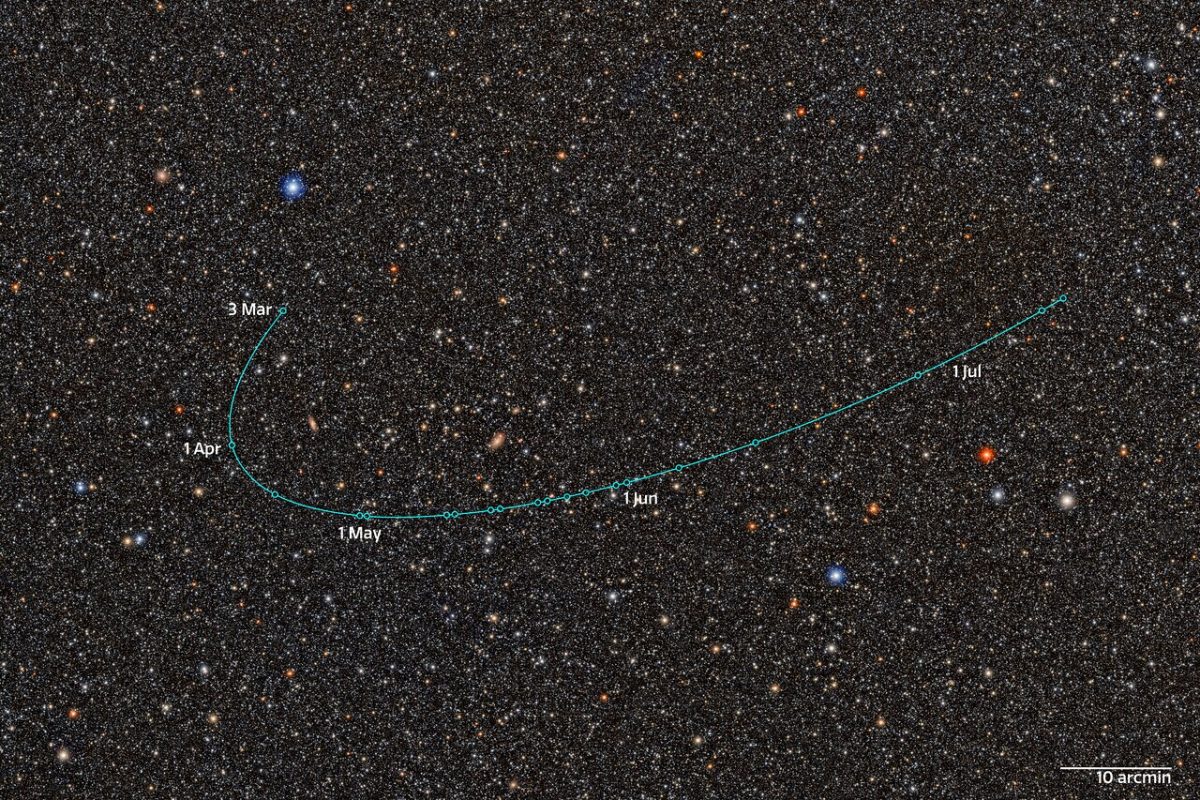
Discovery Using a Unique Ground-Based Observatory
Through observations conducted in preparation for the Legacy Survey of Space and Time (LSST), the NSF–DOE Vera C. Rubin Observatory has discovered a new object in our Solar System that may be a dwarf planet. The object, provisionally designated 2026 ED138 (ED138), was discovered by Matthew Holman of the Center for Astrophysics | Harvard & Smithsonian, a member of Rubin Observatory’s operations team and a participant in its in-kind programme. The discovery was reported by NOIRLab.edu.
The object’s distance from the Sun places it beyond Pluto’s orbit. Preliminary analysis suggests that it may be one of the largest and brightest bodies scientists have ever discovered in this region of the Solar System.
Rubin Observatory is jointly funded by the U.S. National Science Foundation and the U.S. Department of Energy’s Office of Science.
“The observatory’s greatest strength is its ability to clearly detect motion and changes among vast numbers of objects and phenomena that people have never seen before,” says Edward Ajhar, the National Science Foundation’s programme director for Rubin Observatory. “This capability greatly expands our ability to discover and understand new facts about our Solar System, the Milky Way, and billions of other galaxies in the Universe.”
An Unexpected Discovery During Data Processing
On the evening of October 13, Holman was processing data collected by Rubin in 2026 using search code he had developed with his colleague Kevin Napier. The code is designed to analyse billions of observations of moving objects, compare them, and identify those corresponding to the same object. Using this method, Holman discovered ED138 and immediately noticed that its brightness and distance indicated an exceptionally large object.
“My first reaction was excited surprise,” says Holman. “Objects like this are very rare, so I immediately began checking whether I or the code had made a mistake.”
To dispel any doubts, a detailed analysis of the data began in the hope of finding more observations of ED138. Mario Jurić, the observatory’s lead scientist, examined Rubin’s catalogues and images and found another 20 observations dating back to March 4, 2026. In total, Rubin’s Simonyi Survey Telescope observed ED138 30 times over 20 nights between March 4 and July 11. Additional archival images taken with the DOE-built Dark Energy Camera (DECam) and identified by the Asteroid Institute’s ADAM Precovery service provided data dating back to 2016. These data allowed the team to trace ED138’s orbit over a period of more than 10 years. DECam is mounted on the NSF’s 4-metre Victor M. Blanco Telescope at Cerro Tololo Inter-American Observatory (CTIO).
Features of ED138’s Orbit
ED138 is currently approximately 46 astronomical units (AU) away, where 1 AU is the average distance between Earth and the Sun. By comparison, the dwarf planet Pluto’s average distance is 40 AU. This places ED138 in the class of trans-Neptunian objects (TNOs)—bodies that orbit the Sun at distances greater than Neptune’s.
Scientists study the sizes, compositions, and orbits of trans-Neptunian objects to understand how the Solar System formed, how the giant planets migrated over time, and how smaller bodies were scattered throughout the Solar System during this evolution. ED138’s orbit is tilted by nearly 25° relative to the plane of the Solar System, allowing it to be classified as a “hot classical” TNO and suggesting that its original orbit was disrupted by gravitational interactions with Neptune.
The Largest Dwarf Planet Candidate
Not all TNOs are considered dwarf planet candidates; the distinction lies in an object’s size and shape. To qualify as a dwarf planet, an object must have enough mass for its own gravity to pull it into a rounded shape. Based on ED138’s distance, brightness, and estimated surface reflectivity, or albedo, the scientific team estimates its size to be between 600 and 1,500 km. Icy bodies of this size generally have a rounded shape.
This preliminary analysis places ED138 among the largest dwarf planet candidates ever discovered beyond Neptune, although infrared observations are needed to determine its precise size and confirm its dwarf planet status. If confirmed, ED138 would join the five dwarf planets recognised by the International Astronomical Union (IAU): Pluto, Ceres, Eris, Haumea, and Makemake.
Vera C. Rubin Observatory Looks Towards Future Discoveries
ED138 was discovered in a patch of sky near the plane of the Milky Way—a densely populated region filled with millions of stars. For most telescopes, ED138 was lost among the multitude of background sources, which is likely why it had not been detected earlier. Rubin Observatory’s regular, continuous monitoring of the entire Southern Hemisphere sky, combined with powerful algorithms that sift through millions and billions of points of light to identify those corresponding to small moving objects, enabled the team to spot ED138 in this crowded field.
“Rubin Observatory gives us unprecedented opportunities to explore the sky through its combination of speed, depth, and precision,” says Mario Jurić. “And this discovery is just the beginning: once we detect a new object, we can analyse data from recent months, and sometimes even decades, finding it in images that nobody had previously noticed. This ability both to discover objects and to identify them retrospectively fundamentally changes how quickly and accurately we can determine their orbits and understand the distant Solar System.”
ED138 adds to the collection of Solar System objects discovered by Rubin since it began collecting preliminary data in preparation for the launch of LSST in June 2026. In April, even before LSST’s official launch, Rubin’s Solar System team submitted observations of more than 11,000 new asteroids, including approximately 380 new trans-Neptunian objects, to the International Astronomical Union’s Minor Planet Center (MPC). At the time, the team described this large data submission as the tip of the iceberg and expressed excitement about the discoveries that would follow once LSST began. With the discovery of ED138, those hopes are beginning to materialise.
Now that Rubin has identified ED138, scientists around the world can arrange follow-up observations to learn even more about the nature of this object.
