

Astronomers at the Vera C. Rubin Observatory successfully tested new equipment by pointing an experimental digital camera at the nebula IC 2177 in the constellation Monoceros. The resulting image revealed remarkable clarity and detail in the distant cosmic object.
Anatomy of a Glowing Bird
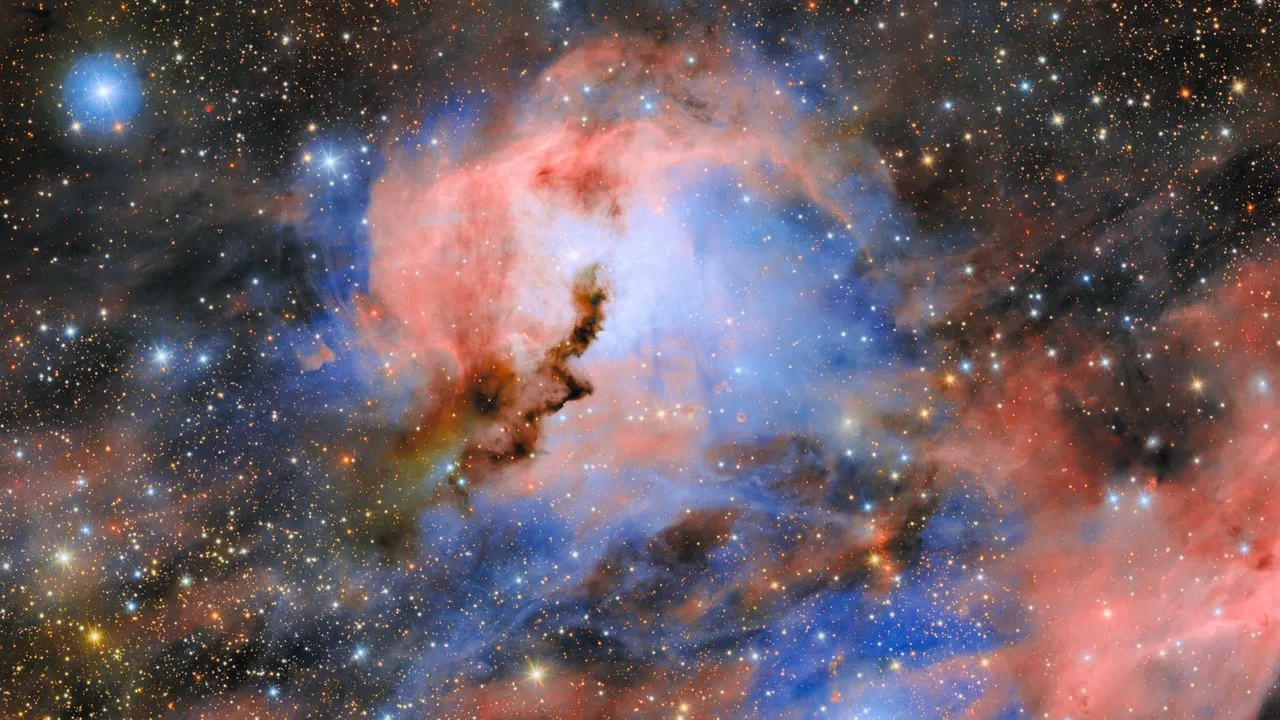
The pink hue of its “plumage” comes from hydrogen glowing brightly under the ionizing radiation of young stars at the cloud’s center. This appearance earned it the name “Seagull Nebula.” Meanwhile, the blue features are dust clouds reflecting light from nearby blue stars. The bird’s mysterious “eye,” which gives the impression of a watchful gaze, is actually the triple star system HD 53367. It consists of very young, energetic stars actively shaping the surrounding gas.
Initial Tests and a Technological Leap

The image was captured using the 144-megapixel ComCam test camera. It is just one of approximately 16,000 exposures of the night sky taken during a testing campaign to evaluate the hardware, software algorithms, and data-processing systems. The project is jointly managed by the U.S. National Science Foundation and the U.S. Department of Energy.
Despite the image’s high quality, this was only the first step. The observatory is now equipped with a much more powerful instrument: the Legacy Survey of Space and Time (LSST) digital camera, installed on the Simonyi Survey Telescope. This instrument has a field of view 20 times larger and captures 3,200-megapixel images every 30 seconds.
A Ten-Year Movie of the Universe
Once the LSST program begins full operations, the Vera C. Rubin Observatory will photograph the night sky every night. Every few days, the telescope will complete a scan of the entire southern sky.
The main goal of the ten-year mission is to create an extensive time-lapse movie of the Universe. Scientists expect the project to uncover millions of new cosmic objects and phenomena, from supernova explosions to previously unknown comets and exoplanets.
We previously showcased the first images from the Vera C. Rubin Observatory.
Based on material from Live Science.
