

In the center of a distant galaxy, a dense disk of young stars has been spotted, rotating and continuing to grow. The light from this structure traveled to Earth for more than 9 billion years, so we are looking at the most distant known example of such a formation. The discovery suggests that complex internal structures appeared in star systems much earlier than astronomers had predicted.
A record-old structure
A team from Durham University in the United Kingdom analyzed images from the James Webb telescope and, as phys.org reports, found a nuclear disk in the galaxy CEERS4031. This term refers to a dense rotating structure at the very center, where new stars are actively forming. We see CEERS4031 as it was only 4.5 billion years after the Big Bang.
Similar formations are well known in mature star systems near us, but they had never before been traced so far back into the past. The researchers published the results of their work in the peer-reviewed journal Monthly Notices of the Royal Astronomical Society.
The work of a stellar bar
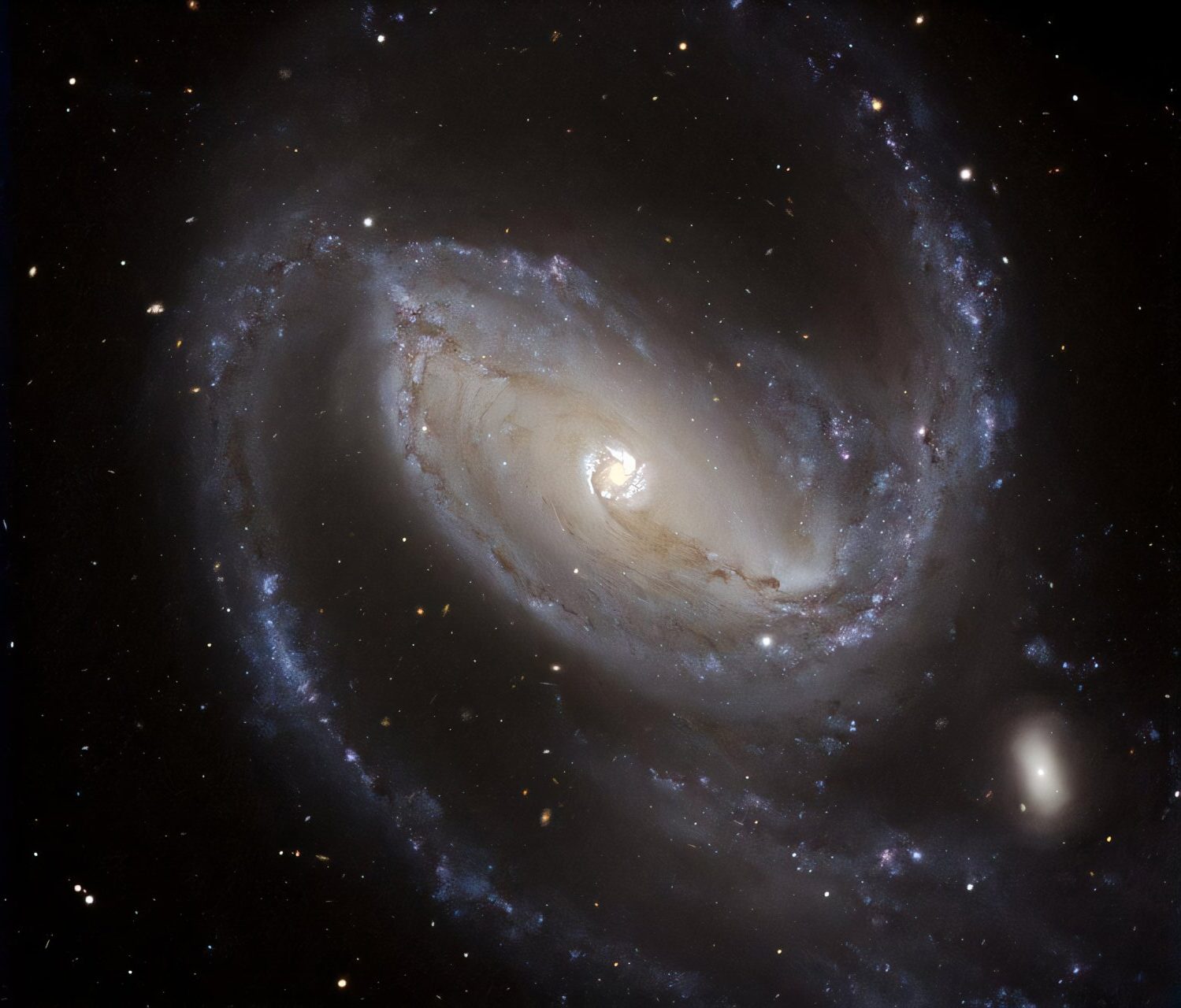
A key role in the formation of this disk is likely played by a long stellar bar that extends across the galaxy. Such elongated structures are characteristic of many modern spiral galaxies. They funnel gas and stars toward the central regions, where the accreted material supports intense star formation and participates in the formation of compact nuclear structures.
Previous studies had shown that bars could form early. However, direct evidence of their influence on galaxy evolution in that era had been lacking until now, and the new paper provides it.
Rapid evolution
Study author Zoe Le Conte of Durham University called the discovery unexpected and noted that it will force scientists to reconsider ideas about the role of stellar bars in the early Universe. According to her, James Webb images continue to show that mature galaxies existed much earlier than scientists had believed.
Despite the enormous distance, the newly found disk has the same properties as its counterparts in nearby star systems. It is compact, rich in young stars, and shows signs of orderly growth. This means that the path toward modern forms was not a slow drift, but rapid development according to similar scenarios over billions of years.
Connection with black holes
The significance of the discovery goes beyond the theory of galaxy formation. Nuclear disks are considered reservoirs of gas from which supermassive black holes at the centers of most star systems gain mass. Therefore, the study will help scientists understand how these objects grew during the most active era of the Universe.
A similar structure also exists in our Galaxy. The Milky Way’s nuclear stellar disk has a radius of only a few hundred light-years, and its formation is likewise associated with the influence of the bar.
The next step will be observations of the motion of stars and gas inside CEERS4031. They will help determine exactly how the disk formed and how efficiently the bar channels matter into it.
