
From school we know the classic scenario of black hole formation: black holes form after the death of massive stars. When a star runs out of fusion fuel, its core collapses under its own gravity. The outer layers are often ejected in a supernova explosion, and the compressed core becomes a black hole.
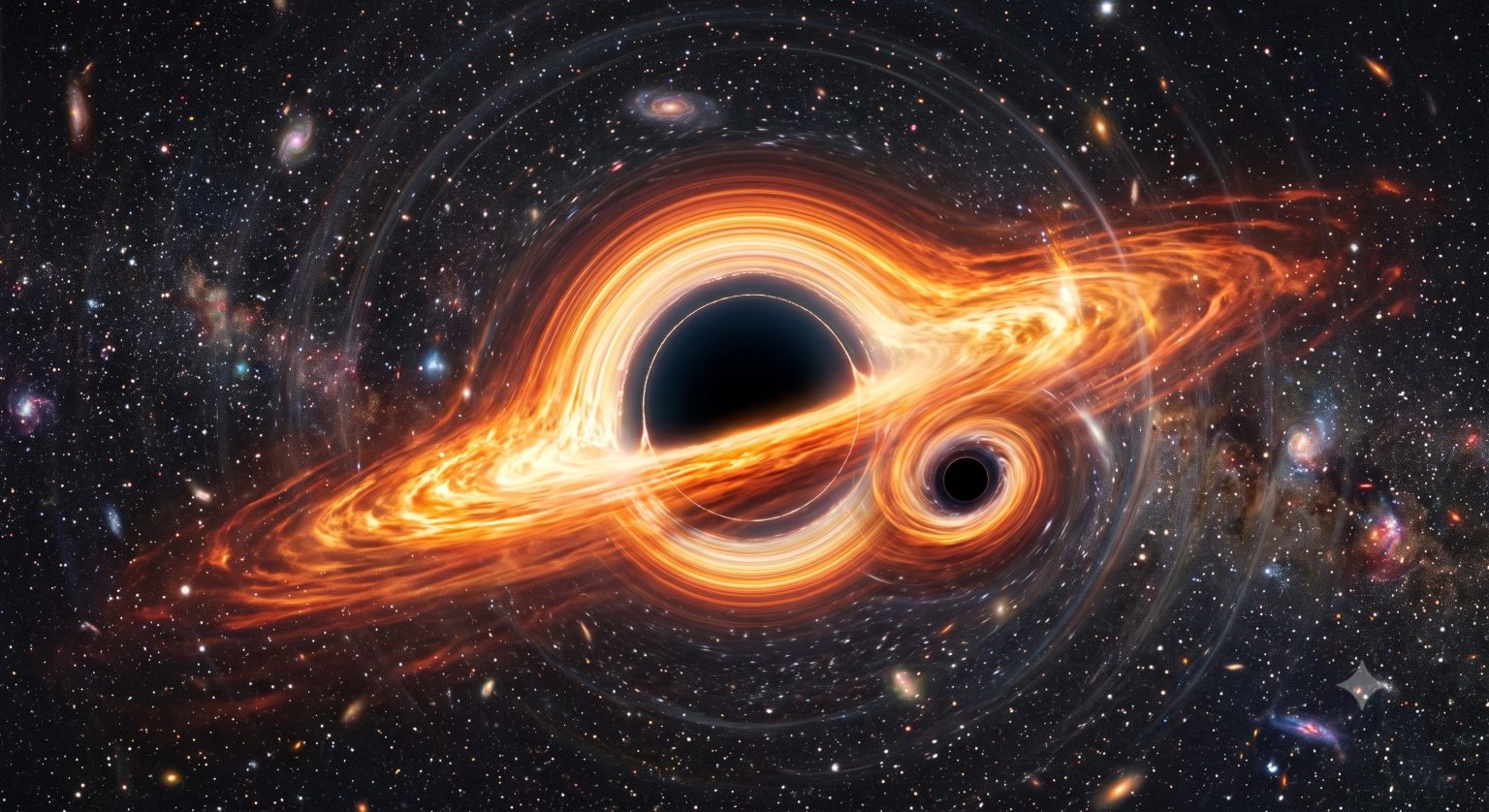
Thanks to modern gravitational-wave detectors, astrophysicists Hundreds of black hole mergers have already been recorded in various parts of the Universe. For a long time, most of these objects were thought to be the direct descendants of dead stars. However, it has turned out that another scenario is possible. The products of previous collisions can merge again, creating even more massive gravitational monsters. This alternative pathway is known as a “hierarchical merger.”
Recently, a team of scientists from the Massachusetts Institute of Technology (MIT) published a groundbreaking study in the authoritative journal Physical Review Letters. They analyzed data from 155 binary black hole pairs and found that about 14% of such objects in our Universe are actually second-generation black holes.
“We see that for some of these black holes, this is not their first merger. Now we have a clear picture that a significant fraction of black holes form through precisely this repeated pathway,” said the study’s lead author, MIT physics graduate student Kaylin Plunkett. The study was also supported by co-authors Salvatore Vitale of MIT, Thomas Callister of Williams College, and Michael Zevin of the Adler Planetarium and Northwestern University.
How to Recognize a Second-Generation Black Hole
When an ordinary massive star collapses, the newly formed black hole has minimal spin, because a significant fraction of the mass and rotational energy is lost during the supernova explosion. By contrast, an object born from the collision of two black holes begins spinning wildly — its speed reaches about 70% of the maximum possible limit.
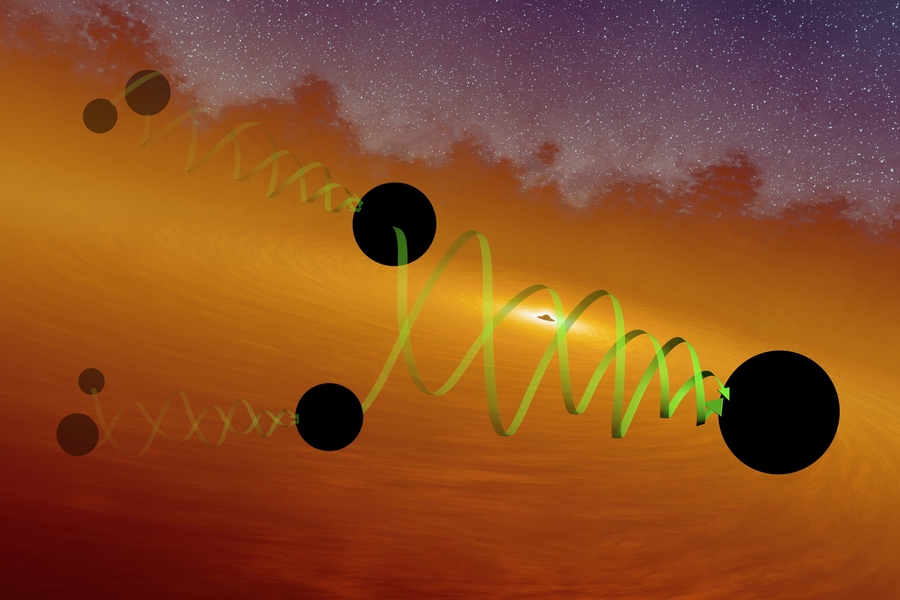
Ideal conditions for such cosmic “billiards” arise in extremely dense star clusters. There, many stars are packed so closely together that after turning into black holes, they continue to interact gravitationally, capture one another, and merge in a reusable cycle.
The main marker of a hierarchical merger is asymmetry. If, during the merger of a pair of black holes, one of them has a much greater mass and a higher spin, this is a significant sign that this “heavyweight” is already the product of a previous collision.
In 2024, such anomalous duos were recorded by the LIGO, Virgo, and KAGRA observatories, which detect gravitational waves — tiny ripples in the fabric of spacetime. They registered the signals GW241011 and GW241110. Analysis showed that in each of these pairs, one hole was spinning much faster than its companion.
The Solution to the Impossible-Mass Mystery
Inspired by these data, Plunkett and Vitale expanded the search. They analyzed the GWTC-4.0 Gravitational-Wave Transient Catalog. The scientists were looking not simply for individual anomalies, but for a general physical pattern — orbital precession, or specific “wobbling.”
Immediately before collision, black holes spiral around one another in a common plane resembling a disk. If their spin axes are perpendicular to this plane, the system is stable. But if even one axis is tilted, the orbit begins to wobble. The degree of this precession allows scientists to calculate the balance of masses and spins of both objects.
Analysis of the GWTC-4.0 catalog data confirmed that the wobbling characteristic of encounters between first- and second-generation black holes is indeed a widespread phenomenon. But the most interesting result turned out to be the mass distribution.
Ordinary black holes of stellar origin usually have a mass of a few to a few tens of solar masses. However, among the new second-generation objects, much more massive objects are increasingly common. Their existence has long puzzled astrophysicists. According to standard models of the evolution of massive stars, black holes with masses greater than about 45–60 solar masses should not form immediately after a supernova explosion. Such stars become unstable and lose too much matter or even completely collapse in a pair-unstable explosion, leaving no compact remnant behind.
But if such ultra-heavy objects could not have been born from a single star, where did they come from? A new study offers a compelling explanation for this mystery. A significant fraction of such massive black holes are likely not born directly from stars, but formed through successive mergers of smaller black holes. This is not definitive confirmation of the hierarchical scenario, but it is one of the strongest statistical lines of evidence in its favor. The study, partly supported by the National Science Foundation and the Brinson Foundation, opens a new chapter in our understanding of the evolution of the Universe.
Earlier, we explained the paradoxes of black holes in simple terms.
According to MIT
