

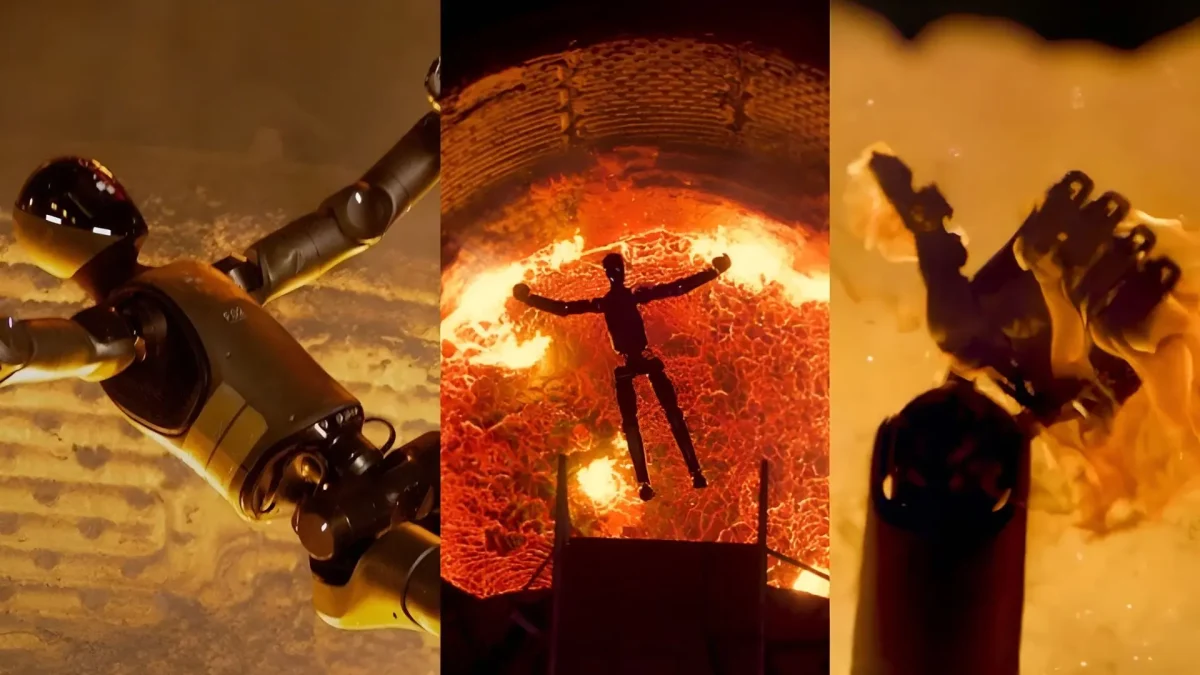
Decommissioned humanoid robots made by the American company Figure were melted down in a steelmaking furnace in Finland. The machines jumped into it on their own using a trained control model. Disassembling each robot would have taken too much time and could have exposed proprietary technologies. The spectacular disposal was filmed in the spirit of the finale of the Terminator movie, and even Arnold Schwarzenegger took part in the project.
Six Melting Cycles in One Day
The F.02 robots were sent to a foundry in Imatra. It operates a 75-ton electric arc steelmaking furnace. An electric arc forms between three large graphite electrodes and scrap metal, melting the steel.
There was very little time for the operation. Figure had only six melting cycles over the course of one day. Each lasted about 20 minutes, after which the molten steel cooled and a solid crust formed on its surface.
Molten steel in such furnaces has a temperature of about 1,600 degrees Celsius. This is more than a thousand degrees hotter than the surface of Venus, where the temperature is about 465 degrees.
Why the Robots Were Not Disassembled
The need to dispose of the F.02 arose after the appearance of the new F.03 generation. According to Interesting Engineering, the company considered it impractical to keep the older machines operational. Disassembly would have taken engineers’ time that was needed for the next F.04 model.
The equipment had to be destroyed in a way that would not expose original components and intellectual property. Facilities in the United States and Mexico rejected the idea because of the lithium-ion batteries inside the robots. When heated, such batteries can catch fire or explode due to thermal runaway, meaning uncontrolled self-heating.
The company even asked former participants of the TV show MythBusters for help. Arnold Schwarzenegger eventually suggested melting the robots, and a Finnish plant agreed to accept the machines.
The idea mirrors the ending of Terminator 2, where the T-800 cyborg played by Arnold Schwarzenegger is lowered into molten steel. The characters in the film had to destroy its processor so that the technology could not be reproduced, meaning the motive was almost identical to Figure’s task. The actor later joined the project, and the disposal was turned into a spectacular video with behind-the-scenes footage.
Video of the disposal of F.02 humanoid robots in an electric arc steelmaking furnace at the plant in Imatra. Source: Figure
A Leap into the Unknown
First, the F.02 robots had to be taught how to jump. Large inflatable cushions were installed at the company’s headquarters in San Jose. The machines practiced jumping from the second floor of the building.
Stunt performers demonstrated the reference movements for training. Based on them, engineers created a control model in simulation that was supposed to guide each robot precisely into the landing zone at an unfamiliar plant. Before being sent to Finland, the team had never tested the robots at that facility.
Another problem arose near the furnace. Electromagnetic fields disrupted the equipment, causing cameras and other electronics to fail. According to the developers, the robots nevertheless continued to perform the learned movements. Footage of the jumps was published on YouTube, while Figure founder Brett Adcock emphasized in a post on X that the robots had indeed been trained to jump autonomously and were sent to Finland.
What Remained of the Robots
The metal produced from the F.02 robots was not left in Finland. The ingots were sent back to the United States, where they will be used to make a limited series of commemorative items. Most F.02 robots have already been destroyed, while several are kept at the company’s headquarters.
The F.03 model, which replaced the F.02, was unveiled in October 2025. The robot received updated sensors and hands designed specifically for Helix. This is Figure’s proprietary system combining computer vision, language understanding, and motion control. For home use, the F.03 has softer exterior materials, wireless charging, and safer batteries.
