

At the center of our galaxy lies a gigantic object — the supermassive black hole Sagittarius A*, whose mass is approximately 4 million times that of the Sun. Because of their nature, black holes do not emit even light, making them extremely difficult to study directly. However, scientists have found a unique cosmic “assistant.”
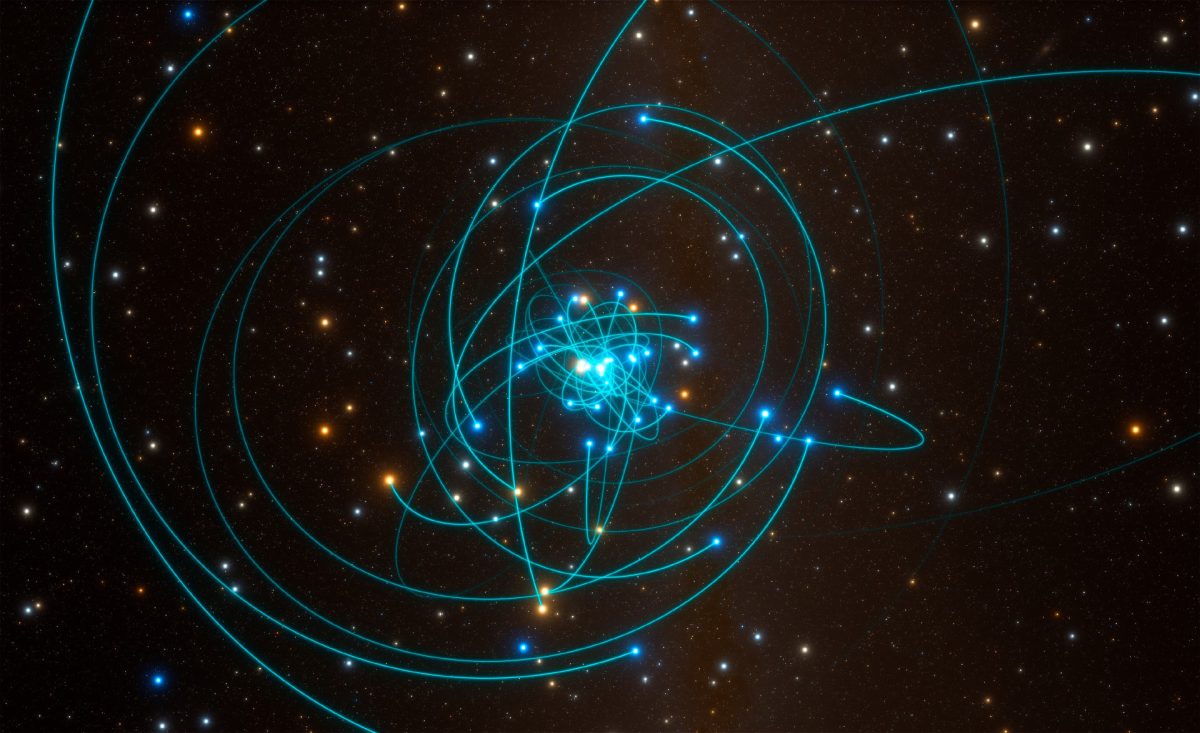
In a new study published in the journal Nature, astronomers from the Max Planck Institute for Extraterrestrial Physics (Germany) described the results of observations of the star S301. It turned out to be the fastest of all known stars in the Milky Way moving in the immediate vicinity of the central black hole.
An Infrared View
It is impossible to study the center of the Milky Way with ordinary optical instruments because of dense clouds of cosmic dust and gas. To look into the very core of the galaxy, an international team of researchers used four infrared telescopes of the European Southern Observatory in Chile, the Very Large Telescope complex.
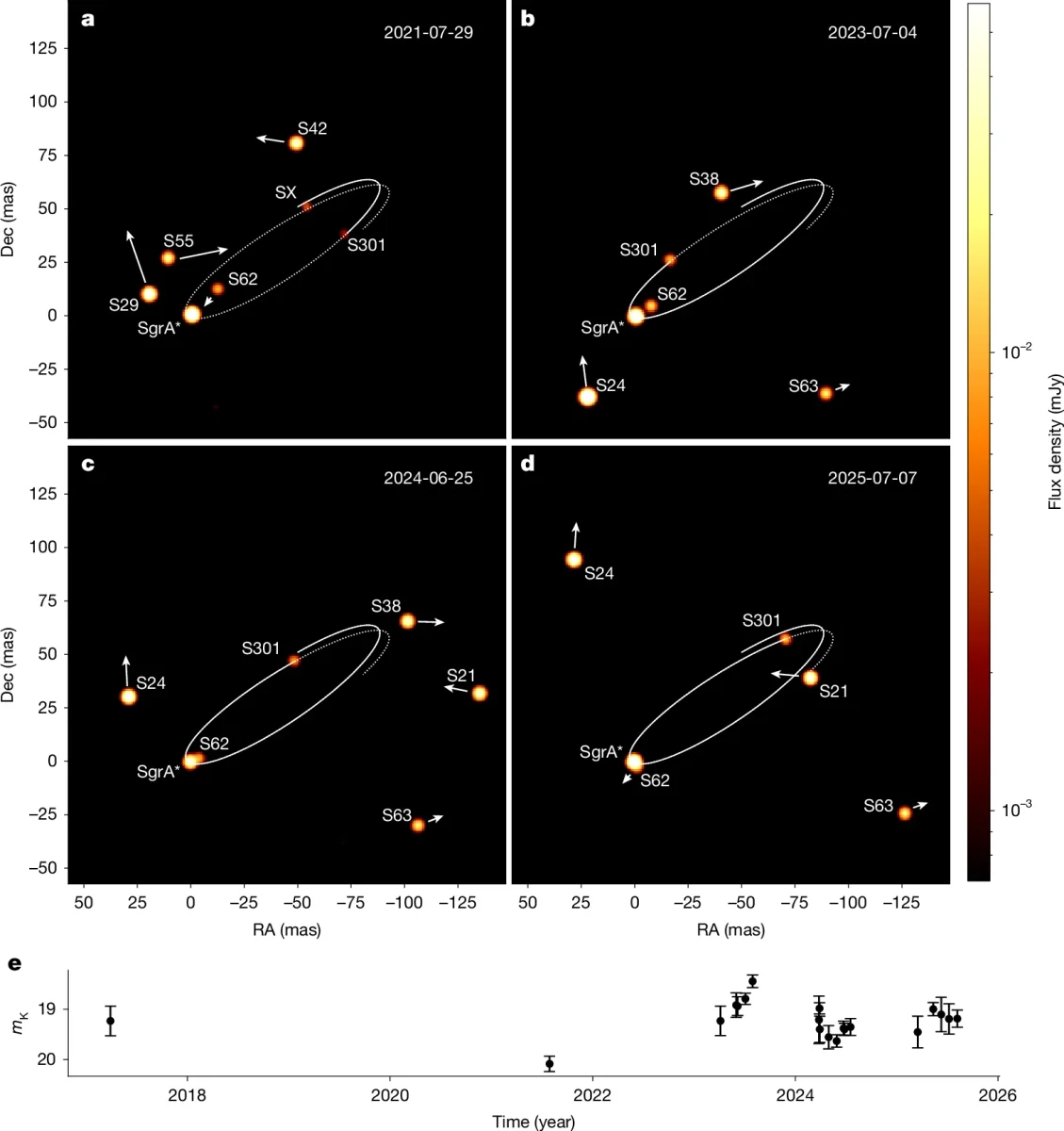
While analyzing the data, scientists noticed a small flicker — an extremely faint object moving at an enormous speed. After tracking the trajectory of S301, astronomers found that its orbit has the shape of an extremely elongated ellipse with an orbital period of 8.7 years.
Impressive Speed
Moving along this oval, the star gradually approaches Sagittarius A*, accelerating to unimaginable speeds. As it approaches the black hole, S301 makes a sharp turn and reaches its maximum speed — more than 24,000 km/s, which is almost 8% of the speed of light.
The southern maneuver and the star’s subsequent departure occur according to a precise “schedule” that is fully consistent with Newton’s laws and the corrections of Einstein’s General Theory of Relativity.
According to the scientists, the key aspect of this discovery is not only the record-breaking speed but also the star’s proximity to the event horizon. S301 serves as a unique natural probe that directly experiences how colossal gravity distorts space and time.
A Laboratory on Our Doorstep
Astrophysicists note that this discovery lays the foundation for scientific research over the next decade. Using S301, scientists expect to measure the rotation rate of Sagittarius A*.
While similar parameters were previously calculated only for active black holes in other galaxies, there is now an opportunity to do so for a “quiet” black hole right in our neighborhood. These data will help scientists understand how our galaxy formed and evolved over billions of years.
Previously, we reported on how neutron-star jets accelerate to a speed of 114,000 km/s.
According to NPR
