

Most space games depict spacecraft maneuvering like fighter jets in the atmosphere, explosions reverberating through a vacuum, and planets that can be reached within minutes. Developers are entirely justified in taking this approach: games must be entertaining. However, some projects are created by developers who have studied textbooks on celestial mechanics and astrophysics in depth. Which of these games are worth playing for those who seek not only entertainment but also a better understanding of how the universe truly works?
Kerbal Space Program: Orbital mechanics for everyone
The Mexican studio Squad launched Kerbal Space Program in early access in 2011 and released version 1.0 in 2015. The game introduced thousands of people to the concept of delta-v (the change in velocity provided by rocket fuel). Players manage the space program of amusing little green characters known as Kerbals and construct rockets from individual modules. The game features very little plot, centering instead on the planet Kerbin, its moon, and several other worlds for players to explore.
The initial attempt to reach orbit challenges the intuition shaped by films. A rocket traveling straight upward will eventually fall back to the planet. To remain in space, it must attain substantial horizontal velocity and effectively fly past the planet. This is how every satellite in Earth orbit operates, and KSP teaches this lesson through experience.
Even more surprising is the approach to another spacecraft. To catch up with a station traveling ahead in the same orbit, firing the engine forward is ineffective: the spacecraft will enter a higher orbit and begin to fall even farther behind. Instead, it must slow down, descend to a lower orbit, and take advantage of the fact that lower orbits are shorter. This counterintuitive principle has been understood since the 1960s, when American astronauts in the Gemini program conducted their first in-orbit rendezvous exercises.
Interplanetary flights in the game adhere to the same principles as real-world missions. The Hohmann transfer orbit — an elliptical orbit that intersects the orbits of the departure and destination planets — is the most efficient option. Gravitational maneuvers provide velocity at no additional fuel cost, while the Oberth effect indicates that engines should be fired as close as possible to a massive body, where the spacecraft is traveling fastest. The player learns Tsiolkovsky’s equation without using formulas, simply by observing how each additional metric ton of cargo requires a disproportionately larger rocket.
There are several conventions here that are also worth understanding. Kerbal has a radius of only 600 km—ten times smaller than Earth’s—yet its surface gravity is equivalent to Earth’s. For this to be physically plausible, the planet would need to be denser than osmium. Conversely, a velocity of approximately 2.3 km/s is sufficient to reach orbit, rather than 7.8 km/s, preventing the game from becoming overly difficult. KSP calculates gravity using a simplified model: each spacecraft is affected by the gravitational pull of only one body at any given time. Consequently, the standard version does not include Lagrange points.
NASA was sufficiently impressed with the game that, in 2014, the agency partnered with Squad to release an expansion centered on an asteroid-deflection mission. Many members of the space industry openly acknowledge that KSP inspired them to pursue their career paths.
Orbiter and Reentry: A cabin rather than a construction set
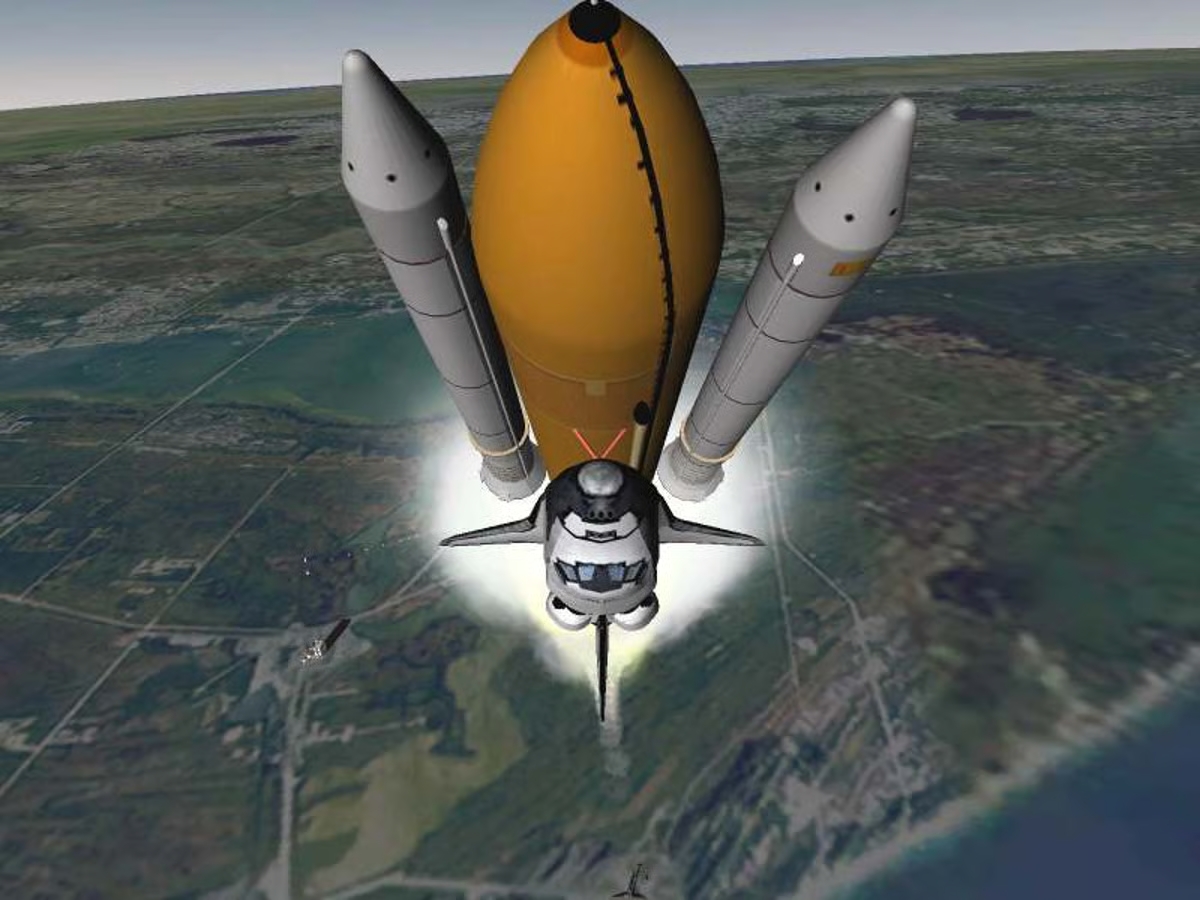
When Kerbal Space Program begins to feel too restrictive, you may wish to consider Orbiter. This free simulator was developed in 2000 by Martin Schweiger, a researcher at University College London. The simulation is true to scale: Earth is represented with its actual radius, the planets move according to ephemerides (tables of their precise positions), and calculations of Earth’s gravity account for the fact that our planet is flattened at the poles.
The graphics in Orbiter have long been surpassed by those of modern games, and the simulation does not include a storyline. Players are provided with a Space Shuttle and the International Space Station, as well as the ability to plan their own flight to Mars using the same principles employed by ballistics experts at space agencies. Over the past quarter-century, the community has created thousands of add-ons, ranging from the Apollo capsule to spacecraft that do not yet exist. In 2021, the author released the source code.
Reentry: An Orbital Simulator, developed by Wilhelmsen Studios, offers a distinctive experience. Players occupy the cockpits of the American Mercury, Gemini, and Apollo spacecraft, which are meticulously recreated down to every switch. Before launch, players must complete an authentic pre-launch checklist. Returning to Earth requires orienting the capsule correctly, with its heat shield facing forward. Even a deviation of a few degrees can cause the spacecraft either to burn up or to bounce off the atmosphere and return to space.
This game effectively illustrates the significant limitations of astronauts’ computing resources in the 1960s. The Apollo onboard computer had approximately 4 KB of RAM, and in Reentry, users can interact with it through the same DSKY keyboard that pilots used to enter commands as “verb–noun” pairs.
Outer Wilds: A solar system that lasts 22 minutes
Outer Wilds, a space-themed game developed by Mobius Digital, was released in 2019. The game is set within a small star system, where each planet serves as a distinct physics experiment. Twenty-two minutes after the game begins, the local star explodes in a supernova, resetting the world. The player’s primary objective is to uncover the cause of this phenomenon.
All celestial bodies in this system orbit one another, and the player’s spacecraft follows Newton’s laws of motion. It is possible to enter orbit around any planet; when landing on a rapidly moving satellite, the spacecraft must match its velocity, as it would during an actual docking maneuver.
The two planets known as the Hourglass Twins orbit one another so closely that sand flows between them in a dense column. Within 22 minutes, one planet is almost entirely buried by the other. Astronomers observe a comparable phenomenon in close binary star systems, where material from one star escapes beyond the boundaries of its Roche lobe — the region in which its gravity predominates — and flows onto its companion.
Brittle Hollow is gradually disintegrating, with its fragments falling into a black hole at the planet’s center. The comet’s ice begins to melt and evaporate as soon as it approaches the Sun. On the ocean planet Giant’s Deep, tornadoes propel islands into the air, while a core hidden beneath the water’s surface proves difficult to reach. Some of the game’s mechanics are rooted in quantum physics; explaining them would spoil its most compelling moments.
The scale is deliberately modest: the planets are only a few hundred meters in diameter, and the Sun is just a few minutes away by flight. Few games encourage you to think as naturally as an astrophysicist — formulating hypotheses based on observations and testing them experimentally.
Universe Sandbox: What would happen if Jupiter were removed?
“Universe Sandbox” from Giant Army is more accurately described as a simulator; it has neither victories nor defeats. Instead, users can manipulate the Solar System as they wish: double the Sun’s mass, send the Moon crashing into Earth, or add another star to the system. The program calculates the gravitational interactions among all bodies simultaneously — in other words, it solves the same N-body problem that mathematicians have grappled with since Newton’s time.
Experimental results often prove unexpected. If Jupiter were removed, the orbits of the asteroids would gradually change, and some would migrate into the inner Solar System. If the Moon were brought too close to Earth, it would cross the Roche limit (the distance at which tidal forces would tear the moon apart) and disintegrate into a ring of debris. This is likely how Saturn’s rings formed.
The simulator accounts for surface temperature, atmospheric conditions, and the quantities of water and ice. Users can move Earth into Mars’s orbit and observe the oceans freeze, or direct an asteroid comparable in size to the one that caused the extinction of the dinosaurs toward Earth. The developers regularly update the models using scientific data, and this “sandbox” is widely used by astronomy educators.
Elite Dangerous and SpaceEngine: The galaxy on a 1:1 scale
In Elite Dangerous, released in 2014 by the British company Frontier Developments, players have access to the entire Milky Way. The developers state that the game features 400 billion star systems, most of which have yet to be visited by a player. Pilots engage in combat, trade, and fulfill contracts; however, our primary interest lies in the structure of this galaxy.
The Stellar Forge procedural generator creates stars and planets using models employed by astrophysicists. It accounts for the distribution of matter across different regions of the Galaxy, the abundance of heavy elements, and the relative prevalence of various types of stars. In the vicinity of the Sun, the model incorporates more than 160,000 real stars from astronomical catalogs, including known exoplanets. Consequently, Sirius, Alpha Centauri, and TRAPPIST-1 appear in the game at the same locations they occupy in the sky.
In Elite, the journey to the center of the Galaxy — to the supermassive black hole Sagittarius A* — takes dozens of hours in real time, and players embark on joint expeditions, much like sailors of old. Along the way, they can observe planetary nebulae, neutron stars with jets, and Wolf-Rayet stars. The game also simulates gravitational lensing near black holes. Faster-than-light travel remains fictional; without it, reaching the nearest star would take millennia.
SpaceEngine goes even further by simulating the entire observable universe. Galaxies, stars, and exoplanets from real-world catalogs are supplemented by billions of procedurally generated objects. Within seconds, a player can travel from the surface of Mars to a galaxy cluster and back. The game offers few mechanics. For amateur astronomers, however, it serves as a useful interactive atlas, allowing them to view a familiar star from anywhere in the Galaxy.
Children of a Dead Earth and Terra Invicta: What might warfare in space look like?
Released in 2016, Children of a Dead Earth remains, perhaps, the most realistic space combat simulator to date. Its creator eschewed science-fiction-style technology. Every engine, armor plate, and cannon in the game is characterized by real-world parameters, including specific impulse, material strength, thermal conductivity, and laser beam diffraction.
Combat in this game bears little resemblance to cinematic battles. Ships approach one another in accordance with the laws of orbital mechanics over the course of hours or days, then engage each other from distances of hundreds of kilometers. Hiding in space is virtually impossible: a red-hot engine is detectable in the infrared spectrum from a considerable distance. A laser loses power as its beam diverges, and its effectiveness depends on the mirror’s diameter. A railgun accelerates a projectile to several kilometers per second; however, the process generates so much heat that massive heat sinks are required for sustained firing. Players quickly realize that excess heat is the primary adversary in space.
Terra Invicta by Pavonis Interactive (2022) combines global strategy with a similarly grounded perspective on space. Aliens have already arrived on Earth, and human factions are competing to determine the most effective response. Reaching Mars or the asteroid belt requires waiting for a launch window and calculating the delta-v budget. Propulsion systems advance gradually, from chemical rockets to nuclear and thermonuclear engines, with each new stage significantly reshaping the map of the Solar System. By the end of the campaign, players gain a thorough understanding of why specific impulse is more important than thrust for long-distance flights.
No Man’s Sky and Starfield: Beauty beyond physics
Hello Games’ No Man’s Sky (2016) and Bethesda’s Starfield (2023) frequently appear on lists of space games, despite their lack of scientific accuracy. In No Man’s Sky, the planets within a single system are only a few minutes’ flight apart and appear in the sky as enormous discs. Nearly every planet supports life, and a spacecraft in a vacuum decelerates and turns much like an airplane in the atmosphere.
Starfield’s star map more closely reflects reality: the Sun, Alpha Centauri, Barnard’s Star, and other nearby stars appear in their actual positions. However, the game does not include orbital mechanics. Ships remain stationary in space, and planetary landings are presented through cutscenes. Both games effectively convey a sense of scale and solitude; however, the games discussed in the previous sections are better suited to illustrating the physics of space.
Mars Horizon, Plan B: Terraform, and The Planet Crafter: Manage an agency and transform planets
In Mars Horizon, developed by the British studio Auroch Digital in 2020, players lead a national space agency from the launch of its first satellite to the landing of humans on Mars. The game was developed in consultation with the European Space Agency, a collaboration reflected in its finer details. Missions require carefully timed launch windows, rockets have limited payload capacities, and scientific credits for exploring Venus or Jupiter must be earned by deploying actual probes. The game conveys a straightforward and candid message: space exploration involves budgets, compromises, and failed launches far more often than heroic successes.
Plan B: Terraform challenges players to transform a lifeless planet into one capable of sustaining life. Players extract carbon dioxide to strengthen the greenhouse effect, melt ice, seed the surface with microorganisms, and subsequently introduce plants, which gradually increase the atmospheric oxygen levels. This sequence closely reflects terraforming scenarios for Mars that scientists have discussed for several decades. In the game, the process takes only a few hours; on Mars itself, it would take centuries.
The Planet Crafter, developed by the French studio Miju Games and released in its full version in 2024, portrays terraforming from the perspective of a single individual. The player arrives on a cold, airless planet similar to Mars and must make it habitable. Progress is measured by a terraforming index comprising temperature, atmospheric pressure, oxygen levels, and biomass. Heaters increase the temperature, drills release gases from beneath the planet’s surface, and, over time, lakes, moss, trees, and insects emerge.
The physics of the process is greatly simplified here. Mars’ atmosphere weighs approximately 25 trillion metric tons, and achieving Earth-like pressure would require expanding it by a factor of approximately 150. In the game, this is accomplished by several dozen machines over the course of dozens of hours. The sequence of stages is accurately represented: heat and pressure are required first, as water would not remain liquid on the surface without them; oxygen is then produced by plants, and only afterward do more complex forms of life emerge.
The number of space-themed games is increasing each year, and developers are increasingly consulting astronomers and engineers. Teenagers are now designing Hohmann transfer orbits in games, and some later pursue careers with space companies. Perhaps one of the people who first sent a Kerbal into orbit will someday calculate the trajectory for an actual mission to Mars.
