

Researchers from Italy’s National Institute for Astrophysics have studied how planetary systems depend on the metallicity and mass of their stars. They appear to form two groups that differ markedly from one another.
Planetary Systems
Scientists have already discovered an enormous number of exoplanets and even entire planetary systems around other stars. The time has therefore come to understand the patterns behind their formation. Researchers from Italy’s National Institute for Astrophysics now report that they have concluded that planetary systems fall into two broad groups.
In a paper published in Nature Astronomy, the researchers analyzed more than 300 of the best-studied planetary systems, out of over 1,000 currently known. They concluded that a star’s mass and metallicity strongly influence how compact its system is, whether it contains large planets, and how stable their orbits are.
The researchers found that planets form two distinctly different groups. It is therefore entirely possible that a system’s overall fate is determined while it is still forming from a cold interstellar cloud.
Two Groups of Planets
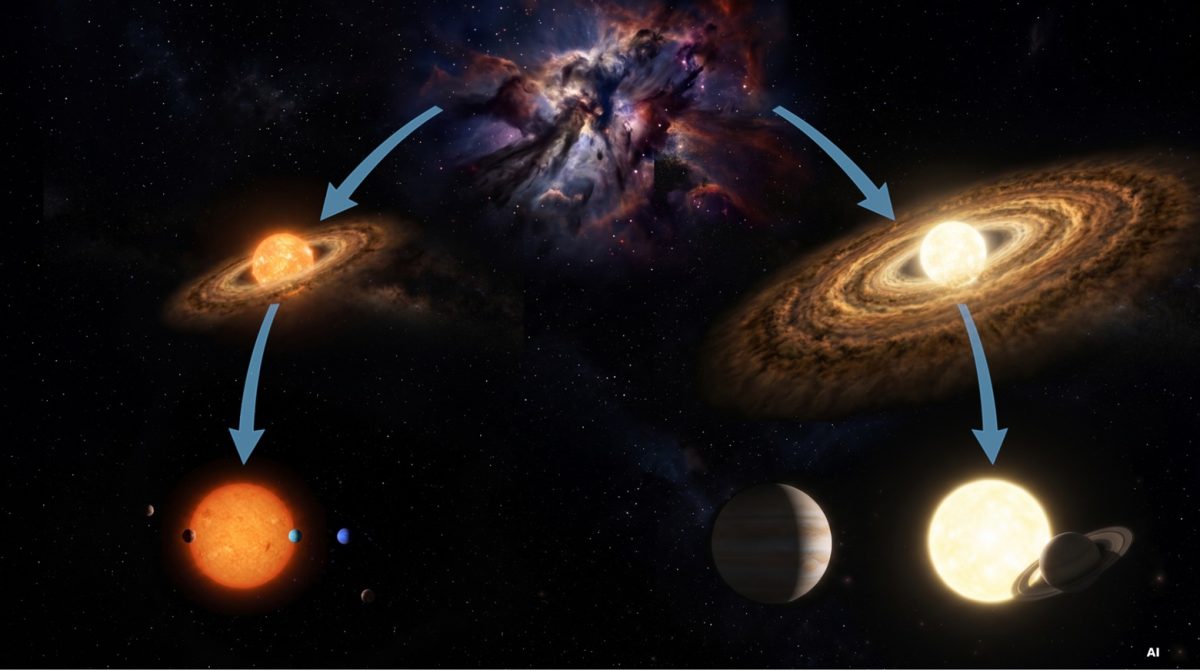
According to the published study, the first group consists of planetary systems around stars with metallicities lower than or comparable to the Sun’s. In most cases, these are predominantly yellow, orange, and red dwarfs several billion years old. Their systems are relatively compact, exhibit less turbulence—in other words, calmer orbital motion—and contain more small celestial bodies.
The second group mainly includes systems around stars more massive and hotter than the Sun. Their ages are generally measured in tens or hundreds of millions of years. These stars also have higher metallicities, meaning a greater abundance of elements heavier than helium. Such systems are more spread out and chaotic, and contain many large, massive planets, some of which may eventually be ejected from the system altogether.
The researchers also highlight a property known as “dynamical temperature.” This measures how much a planet’s actual position differs from its theoretically predicted position because of chaotic events in the past. It is considerably higher in systems belonging to the second group.
But the most interesting question is what all of this actually means. Even the study’s authors wonder whether these two groups are real or merely an artifact of data processing. If the distinction is genuine, it could indicate that the conditions for planet formation change over time, along with metallicity. Alternatively, it might simply mean that the Sun lies near the upper mass limit beyond which planetary systems begin to become unstable.
