

A collapse pit on the Moon’s near side may turn out to be an entrance to an ancient lava tube. NASA has selected a project whose team will investigate this directly from the surface. If a large cavity exists beneath the pit, it could provide natural shelter for astronauts.

An Opening in the Roof of a Lava Tube
The Marius Hills pit was first spotted in 2009 in images taken by Japan’s Kaguya probe. According to later measurements from the Lunar Reconnaissance Orbiter, its opening measures between 49 and 57 meters across. It is approximately 44 meters deep from the rim and 51 meters deep from the surrounding plain.

Scientists consider such collapse pits to be openings in the roofs of lava tubes—underground channels through which molten rock once flowed beneath an already solidified crust. A NASA release emphasizes that the layer of rock above such a cavity would protect astronauts from radiation, micrometeoroids, and extreme temperature fluctuations.
Instruments for Subsurface Exploration
The Geophysical Investigation of the Marius Lunar Pit (GIMLI) instrument suite combines ground-penetrating radar, seismic sensors, a gravimeter, and cameras. Together, they will determine whether the pit extends into an underground cavity and, if so, how large it is.
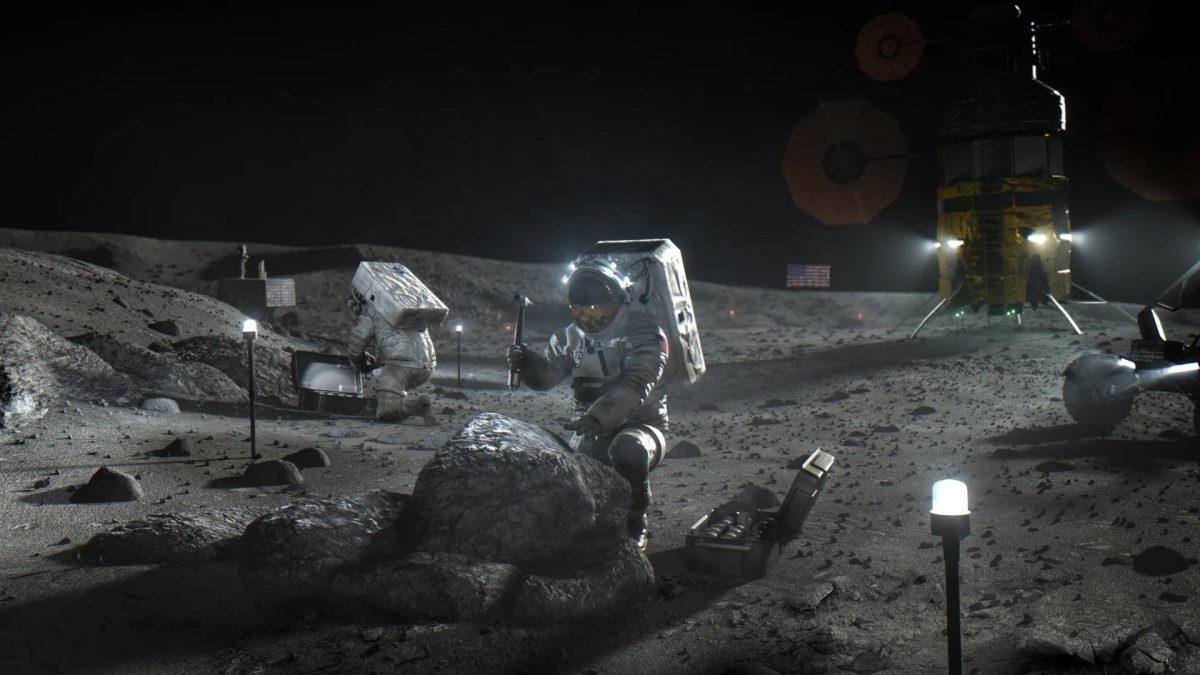
Project leader Nathaniel Putzig has long wanted to bring active seismic surveying, in which vibrations are deliberately generated in the ground, back into planetary science. Since the Apollo astronauts conducted the first seismic investigations on the Moon, this method has rarely been used beyond Earth.
According to the Planetary Science Institute, the seismic system, gravimeter, and cameras will be built by Honeybee Robotics, which is owned by Blue Origin. The Norwegian Space Agency will provide the ground-penetrating radar.
A Name from the History of Astronomy
The Marius Hills lie in the Ocean of Storms and are among the Moon’s most diverse regions in terms of volcanic history. According to Universe Today, such lava tubes may have formed between 3.8 and 3 billion years ago, when the Moon was still geologically active.

The region takes its name from the nearby Marius impact crater, named after the German astronomer Simon Marius. Between 1609 and 1610, Simon Marius discovered Jupiter’s four largest moons at almost the same time as Galileo Galilei. He proposed the names Io, Europa, Ganymede, and Callisto on the advice of Johannes Kepler.
Results Even Without a Cave
Even if no large cavity is found, the measurements will help explain how the collapse pit itself formed. Its walls expose layers of regolith and solidified lava that can reveal how lava flows spread and whether long pauses separated the eruptions.
The project was one of three selected by NASA under its PRISM program for lunar surface investigations. The launch date and budget have not yet been announced, nor has the company that will provide the lander and rover through the Commercial Lunar Payload Services (CLPS) initiative.