

Deep inside the Solar System’s ice giants — Uranus and Neptune — water exists in a form that is difficult to imagine on Earth. Since it is impossible to obtain samples from these distant worlds, researchers from the French Alternative Energies and Atomic Energy Commission (CEA) artificially recreated similar extreme conditions in the laboratory. The results of the study have already been published in the scientific journal Physical Review Letters.
What Is Superionic Ice?
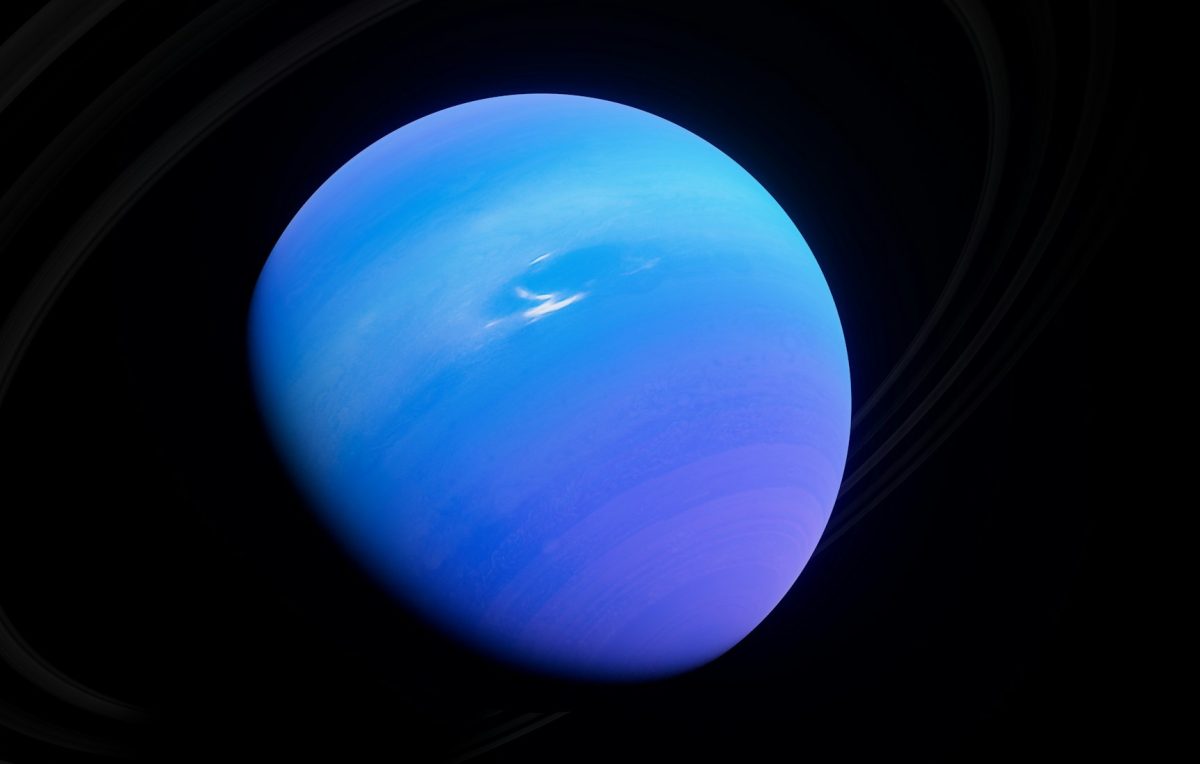
Under the enormous temperatures and pressures in the interiors of planets, ordinary ice transitions into the so-called superionic state. This is an exotic phase of matter in which oxygen atoms arrange themselves into a rigid crystal lattice, while hydrogen nuclei move freely within it.
As a result, a hot, electrically conductive material is formed that combines the properties of a solid and a liquid conductor. Until now, scientists lacked data on exactly which crystal structures such ice forms under the highest pressures.
Laboratory Extremes
To determine the structure of superionic ice, physicists compressed tiny water samples between two diamond anvils and heated them with lasers to temperatures above 1,526°C. The pressure inside the cell reached 230 GPa, more than 2 million times standard atmospheric pressure on Earth.
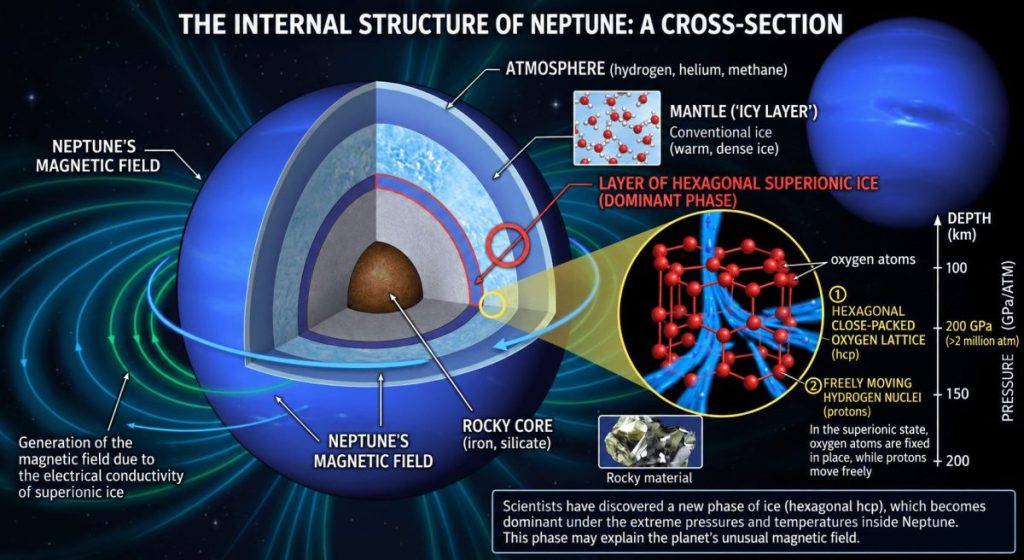
To analyze the structural changes, the scientists used X-ray diffraction at the European Synchrotron Radiation Facility. They found that at pressures above 200 GPa, oxygen atoms form a hexagonal close-packed lattice (hcp). This phase proved more stable and completely displaced the previously known face-centered cubic structure (fcc).
A New View of Planetary Magnetic Fields
The discovery of the hexagonal phase of superionic ice is of fundamental importance to astrophysics. It is believed that the pronounced superionic layer deep inside Uranus and Neptune generates their strange and symmetrically shifted magnetic fields.
Because the hcp phase has electrical and mechanical properties different from those of the cubic phase, scientists will have to revise existing theoretical models and describe more precisely the processes taking place inside the ice giants.
Previously, we reported on how Uranus and Neptune turned out to be rocky worlds.
According to phys.org
