

On the night of October 5–6, millions of astronomy enthusiasts around the world witnessed a spectacular celestial display: a thin crescent Moon passed directly in front of Jupiter, temporarily hiding the largest planet in the Solar System. This phenomenon, known in astronomy as an occultation, is a vivid demonstration of orbital mechanics in action.
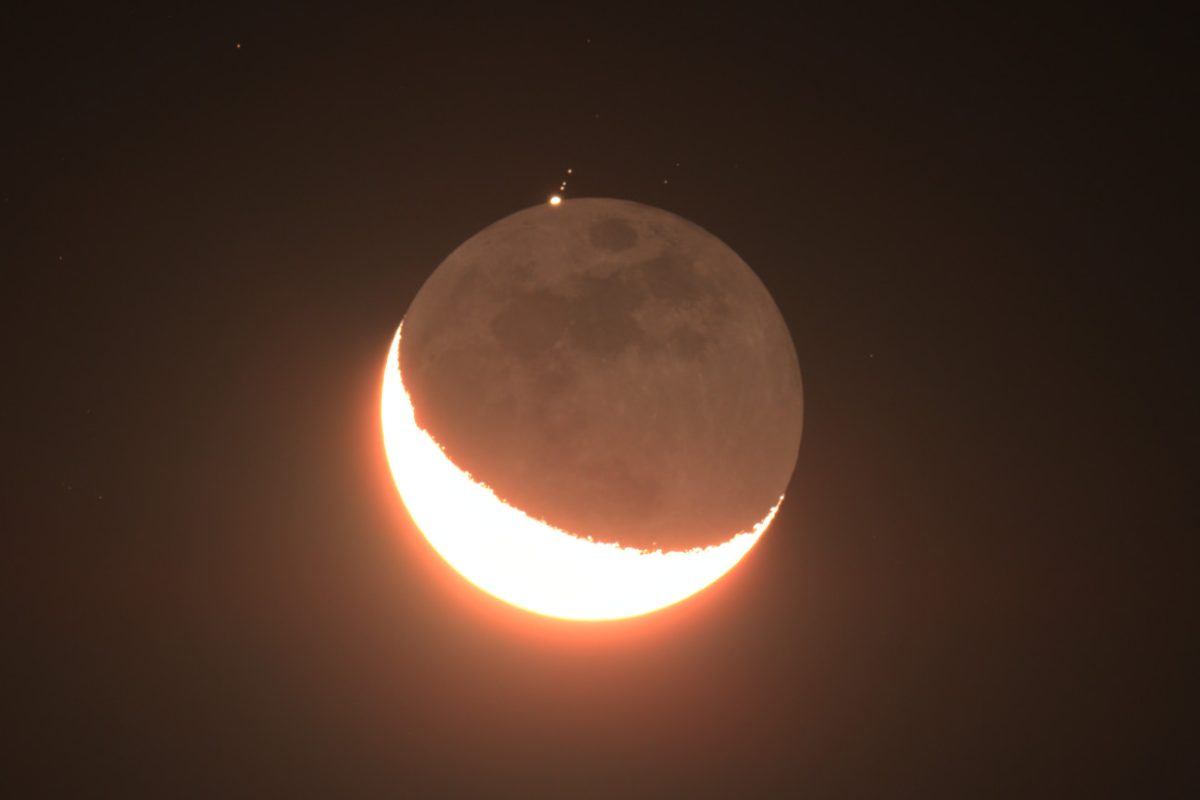
The full occultation was visible to observers in North America, West Africa, and the Atlantic Ocean region.
The Illusion of Displacement and the Parallax Effect
Those outside the path of the occultation witnessed an equally captivating sight. The slender Moon, with just 20% of its surface illuminated by the Sun, appeared only a few degrees away from the gas giant.
To put this into perspective, a clenched fist held at arm’s length covers approximately 10° of the night sky. The difference in the apparent path seen from different parts of the planet is explained by the parallax effect—the apparent displacement of an object depending on the observer’s location on Earth.
The Art of Capturing the Moment
Photographing such phenomena requires meticulous planning. Photojournalist Peter Zay, who captured the event in North Carolina, notes that astrophotography leaves no room for error.
Some more images from the lunar occultation of Jupiter this morning. https://t.co/U1rn32dCv6
— EricTheCat 🇺🇸 (@EricTheSpaceCat) October 6, 2026
“As a photojournalist, I work exclusively with authentic images and do not use multiple exposures or compositing. The key to success is preparation: equipment, weather, precise location, and timing. The main challenge was balancing the brightness of the Moon’s sunlit edge with Jupiter’s much fainter moons.”
Zay managed to find an exposure that captured the lunar craters, the soft earthshine on the Moon’s darkened side, and all four Galilean moons—Io, Europa, Ganymede, and Callisto—in a single frame.
Emerging from the Shadows
Equally impressive images were captured by Josh McCollum from Pennsylvania, who used Skywatcher 400P Flextube and Celestron C11 telescopes. According to him, although atmospheric conditions were far from ideal, watching the planet emerge from behind the Moon’s silhouette was incredible.
Time-lapse of the lunar occultation of Jupiter this morning. https://t.co/UXBtNPXA5p
— EricTheCat 🇺🇸 (@EricTheSpaceCat) October 6, 2026
- The approach. As Jupiter approached the Moon’s edge, Ganymede—the largest moon in the Solar System—stood out clearly above the planet’s disk.
- The return. Europa and Io were the first to emerge from behind the Moon’s dark side, signaling that the occultation was coming to an end.
- The finale. Following its moons, Jupiter itself reappeared in the night sky, sharply outlining the lunar disk.
Images of the Jupiter/Lunar occultation this morning! https://t.co/3gWsSawxjG
— Josh McCollum Astro (@joshstelescope) October 6, 2026
Astronomy forums and social media were quickly flooded with images from amateur astronomers. An observer from Minnesota, posting under the account name EricTheCat, said the event took place low above the horizon—between 6 and 15 degrees—so he chose to prioritize exposure time to bring out as much detail as possible in the Moon’s darkened portion and the giant planet’s moons.
When Is the Next Event?
The occultation of Jupiter on October 6, 2026, was part of a larger series of eight consecutive lunar occultations of the gas giant, continuing until May 2027.
The next occultation of Jupiter: November 2, 2026
The event will be visible from parts of Southeast Asia (Indonesia and Malaysia), southern India, and Australia. In these regions, the Moon will once again pass directly in front of Jupiter’s disk. For observers in Europe and North America, the event will be visible only as a close conjunction—Jupiter will pass near the Moon in the night sky.
Upcoming lunar occultations of Jupiter in 2026–2027:
- November 30, 2026: visible primarily from southern South America and parts of the Pacific and Atlantic oceans.
- February 20, 2027: the lunar occultation of Jupiter will take place shortly after Jupiter’s opposition on February 10–11, 2027, when the planet reaches its maximum brightness.
- March 19 and April 15, 2027: the final phase of the Jupiter occultation series.
We previously reported on how a passing asteroid blocked the light of Betelgeuse.
Based on material from Space.
