

What was the Universe like before the appearance of the first stars, planets, and even simple atoms? During the first millionth of a second after the Big Bang, all of space was filled with quark-gluon plasma — an extremely hot “soup” in which quarks and gluons moved freely, before combining into protons and neutrons.

Researchers from the Niels Bohr Institute at the University of Copenhagen, as part of the international ALICE collaboration at CERN (Switzerland), have taken an important step in studying this state. Previously, it was believed that recreating primordial matter required collisions of very heavy atomic nuclei, such as lead. However, physicists have demonstrated that this extreme state can be generated using much smaller nuclei — oxygen-16 and neon-20. This discovery has significantly expanded our understanding of the fundamental conditions required for the emergence of the primordial state of matter.
The Geometric “Shadow” of Atomic Nuclei
When nuclei collide at speeds close to the speed of light, a tiny droplet of plasma is created. It exists for only a fraction of a second before expanding and decaying into a stream of new particles. Because the plasma itself cannot be observed directly, scientists analyze the trajectories and characteristics of these outgoing particles.
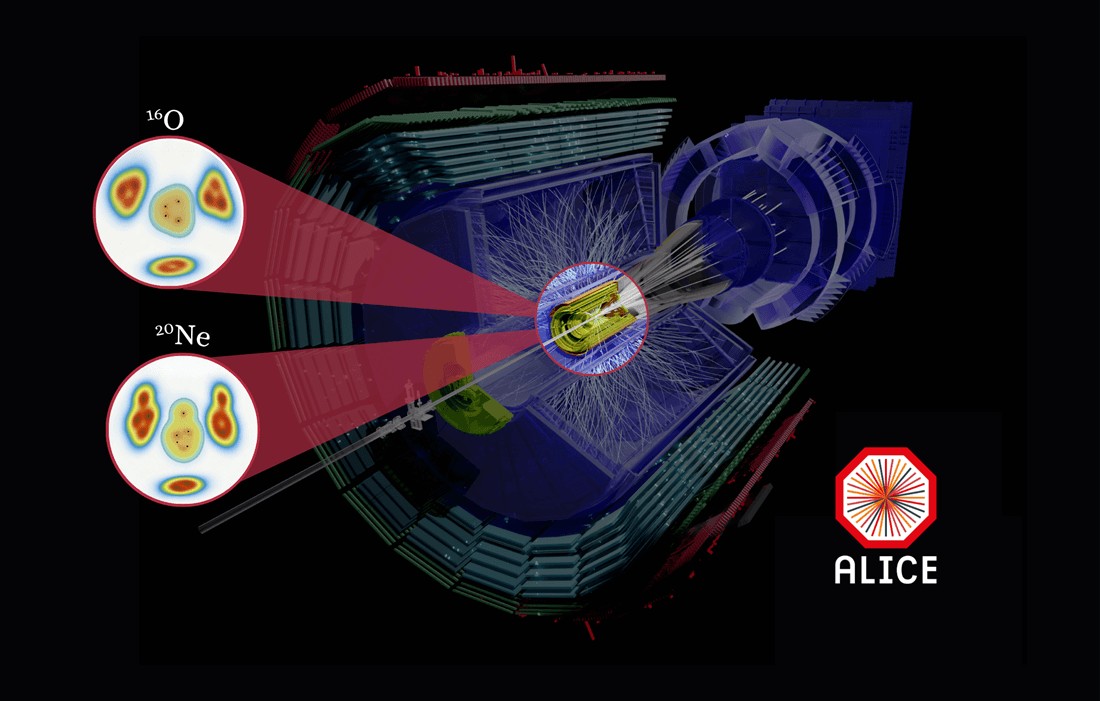
It turned out that the pattern of particle motion precisely reflects the initial shape of the colliding nuclei. Collisions of spherical oxygen nuclei produce a relatively round trace, while neon nuclei, which have an elongated shape, leave an outline resembling a bowling pin. Scientists compare this effect to the shadow of an object: even without seeing the object itself, its geometry can be accurately determined from its shadow.
A New View of the Strong Interaction
For more than 70 years, physicists have studied the shape and internal structure of nuclei through low-energy experiments, measuring their rotations and oscillations. The new approach offers the opposite strategy: collide nuclei at the highest possible energies and reconstruct their internal structure from the imprints they leave behind.
This method could become a new breakthrough in nuclear physics. A precise understanding of nuclear shape reveals features of the arrangement of protons and neutrons, helping scientists gain deeper insight into the strong interaction — one of the four fundamental forces of nature.
Researchers now plan to determine how small nuclei can be while still producing plasma. Future experiments are expected to use even lighter elements, including helium-4, allowing scientists to study both the microstructure of atoms and the earliest moments in the existence of the Universe.
Previously, we tried to look into the period before the Big Bang.
According to news.ku.dk
