

We are used to thinking that the Sun’s influence weakens in proportion to the distance from it. However, a new study, the results of which were published in The Astrophysical Journal, suggests that the situation on the outskirts of our system is much more complex. It appears that the Sun “feels” the resistance of our galactic environment.
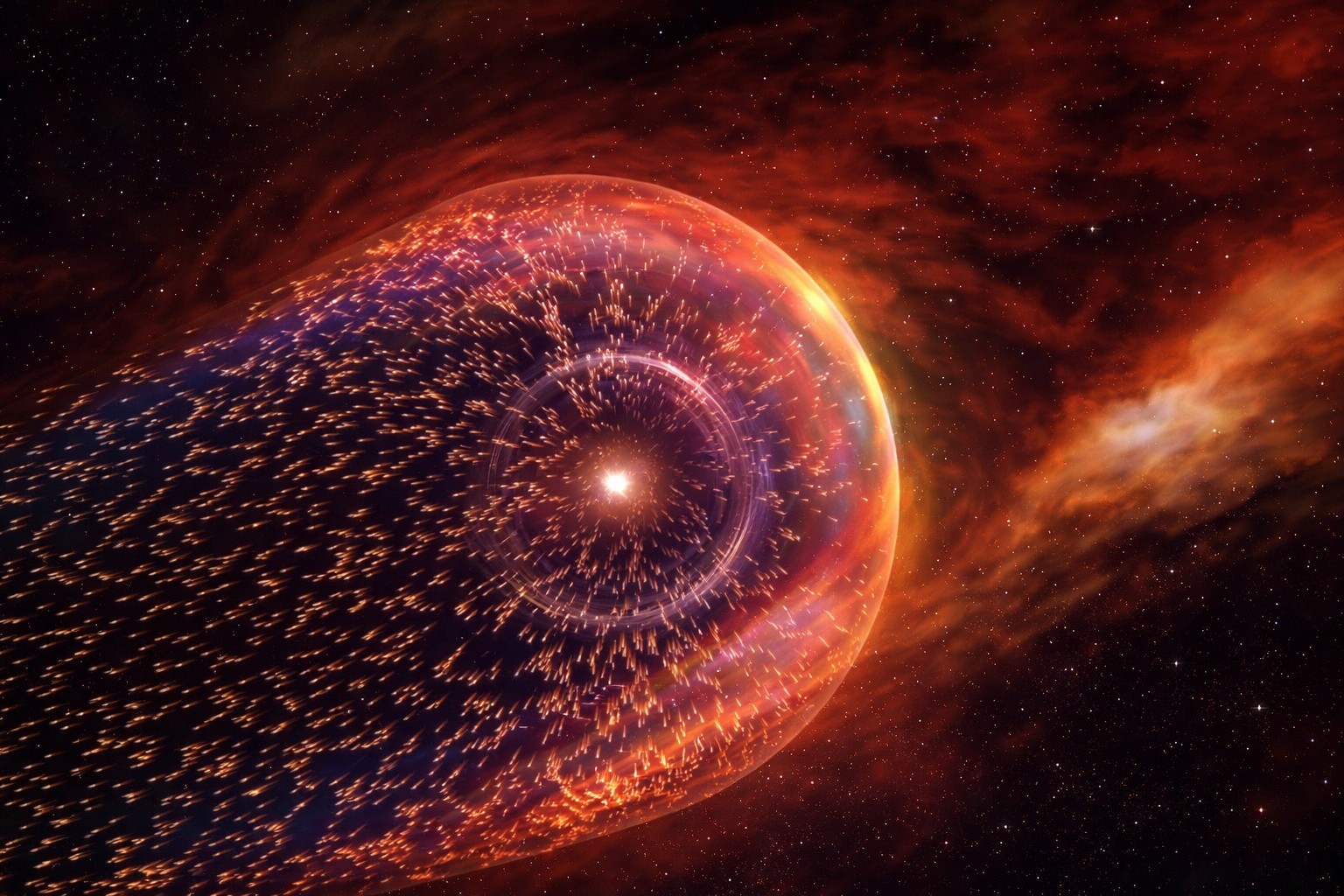
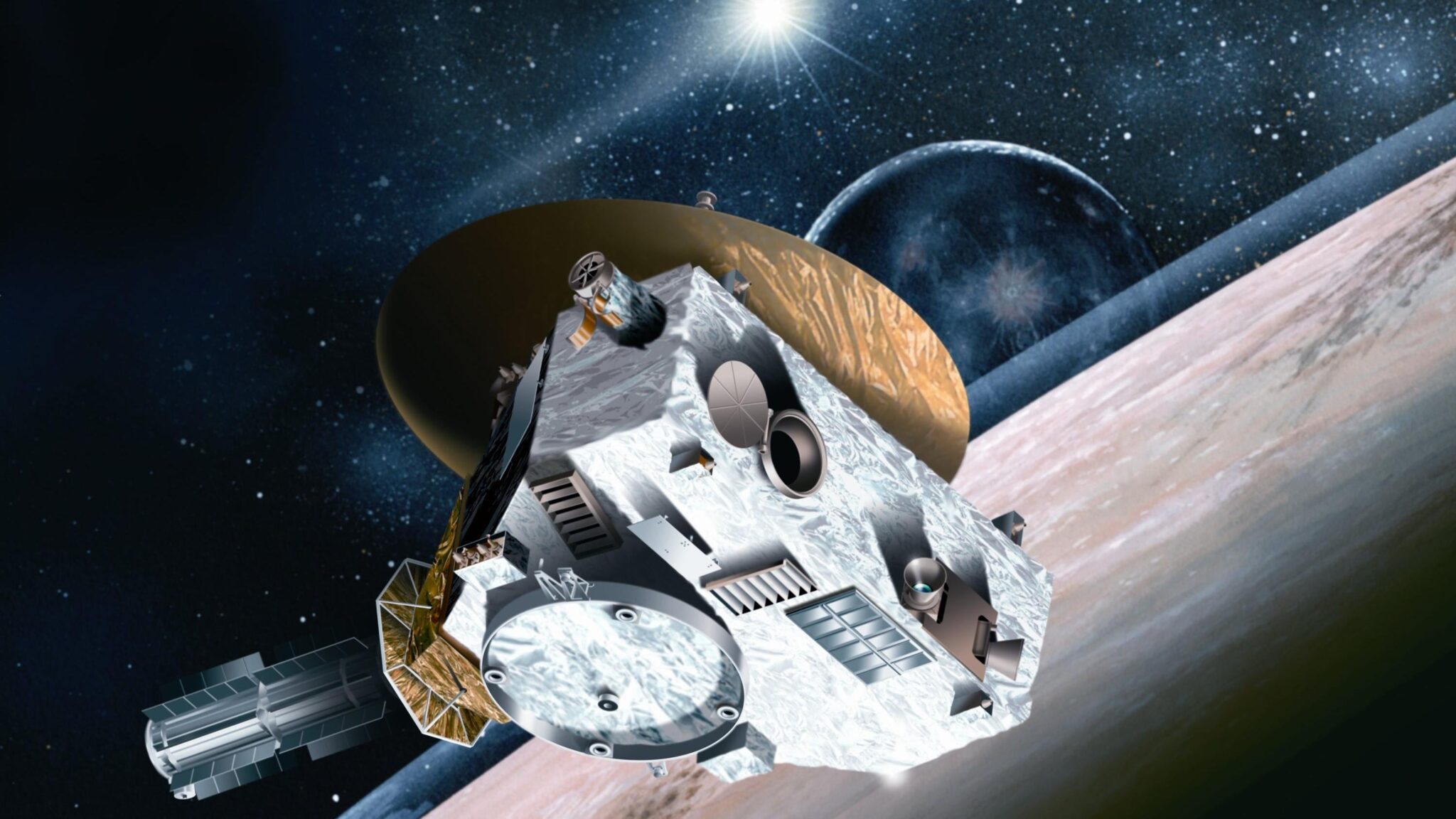
NASA’s New Horizons spacecraft, which is currently about 66 AU from the Sun, has given scientists a unique opportunity to look behind the scenes at what is happening at the edge of the heliosphere.
The conducted study allowed for a quantitative clarification of the already known effect: gradual slowing of the solar wind before the termination shock region is not caused solely by distance from the Sun. A significant role is played by interstellar neutral atoms penetrating the outer regions of the heliosphere. After ionization, they “embed” into the solar wind flow, increasing its mass and inertia, which creates a braking effect.
Comparing Voyager and New Horizons
Until now, the only sources of data about the boundaries of the heliosphere were Voyager 1 and Voyager 2. They crossed the termination shock — the boundary where the solar wind slows from supersonic to subsonic speeds — at distances of about 122 AU.
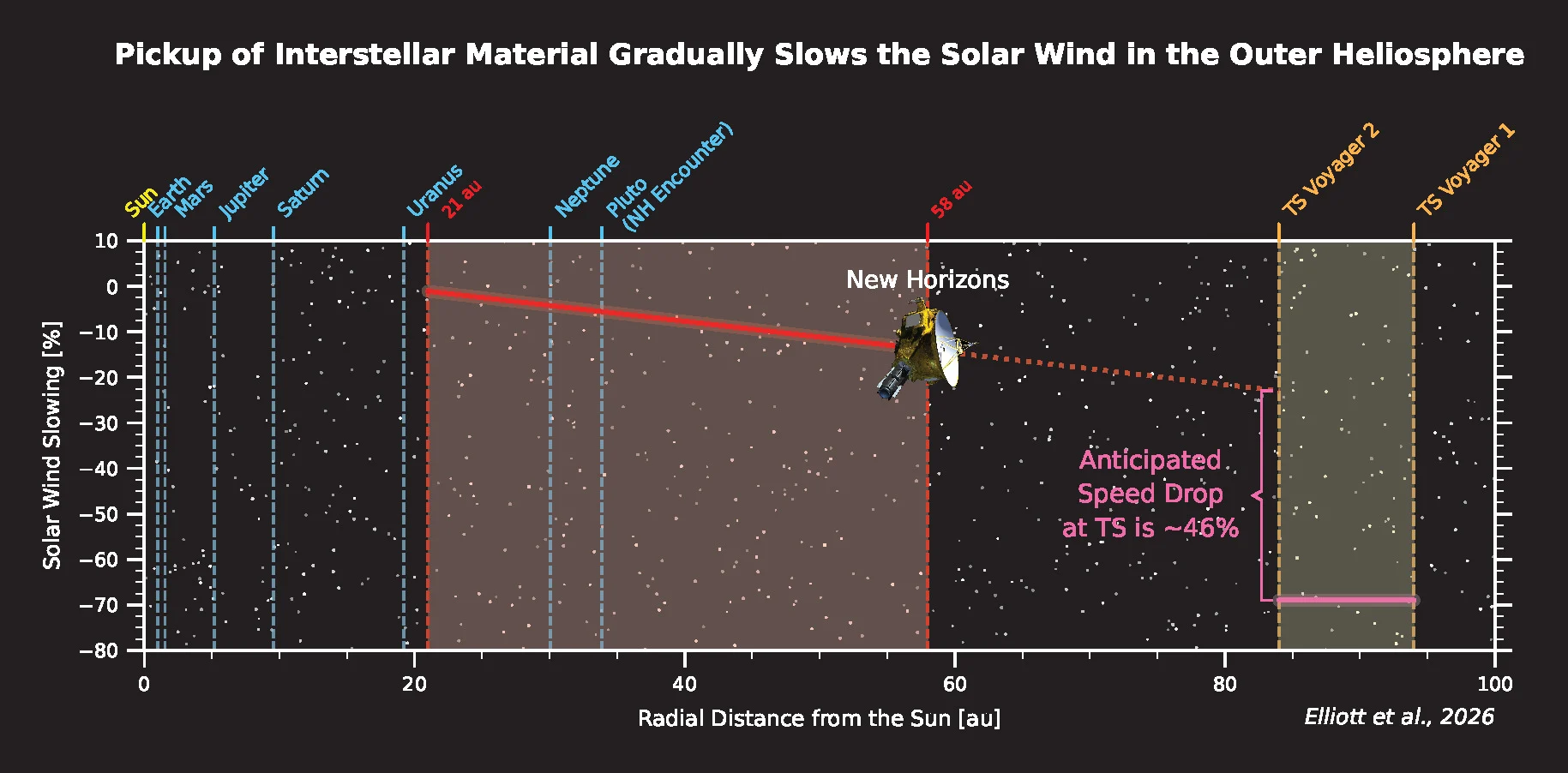
Although New Horizons has not yet reached this boundary, it has provided valuable comparative data. The analysis showed that at a distance of 58 AU, the speed of the solar wind was 13–15% lower than near Earth. Importantly, without accounting for the accumulation of interstellar matter in the models, the expected speed would have been higher. Thus, we are observing the direct influence of the galactic environment on our “cosmic bubble.”
Why does this matter?
Understanding exactly how the Sun interacts with interstellar space is not merely a theoretical task. It is critical for planning future missions beyond the Solar System:
Galactic cosmic rays pose a serious threat to astronauts’ health and to the reliability of electronics. Studying the boundaries of the heliosphere will help better assess the level of radiation that future explorers will face.
Scientists also need to learn how to distinguish “temporary fluctuations” in the solar wind from a real approach to the termination shock. For example, when Voyager 2 crossed this boundary, it was accompanied by a sharp 56% drop in wind speed.
As the study’s lead author, Heather Elliott, notes: “Studying the heliosphere is like solving a cosmic puzzle.” And every newly measured kilometer brings us closer to understanding exactly where the territory of our Sun ends and the mysterious interstellar space begins.
Earlier, we reported on how New Horizons showed us Pluto and the Kuiper Belt.
According to swri.org