

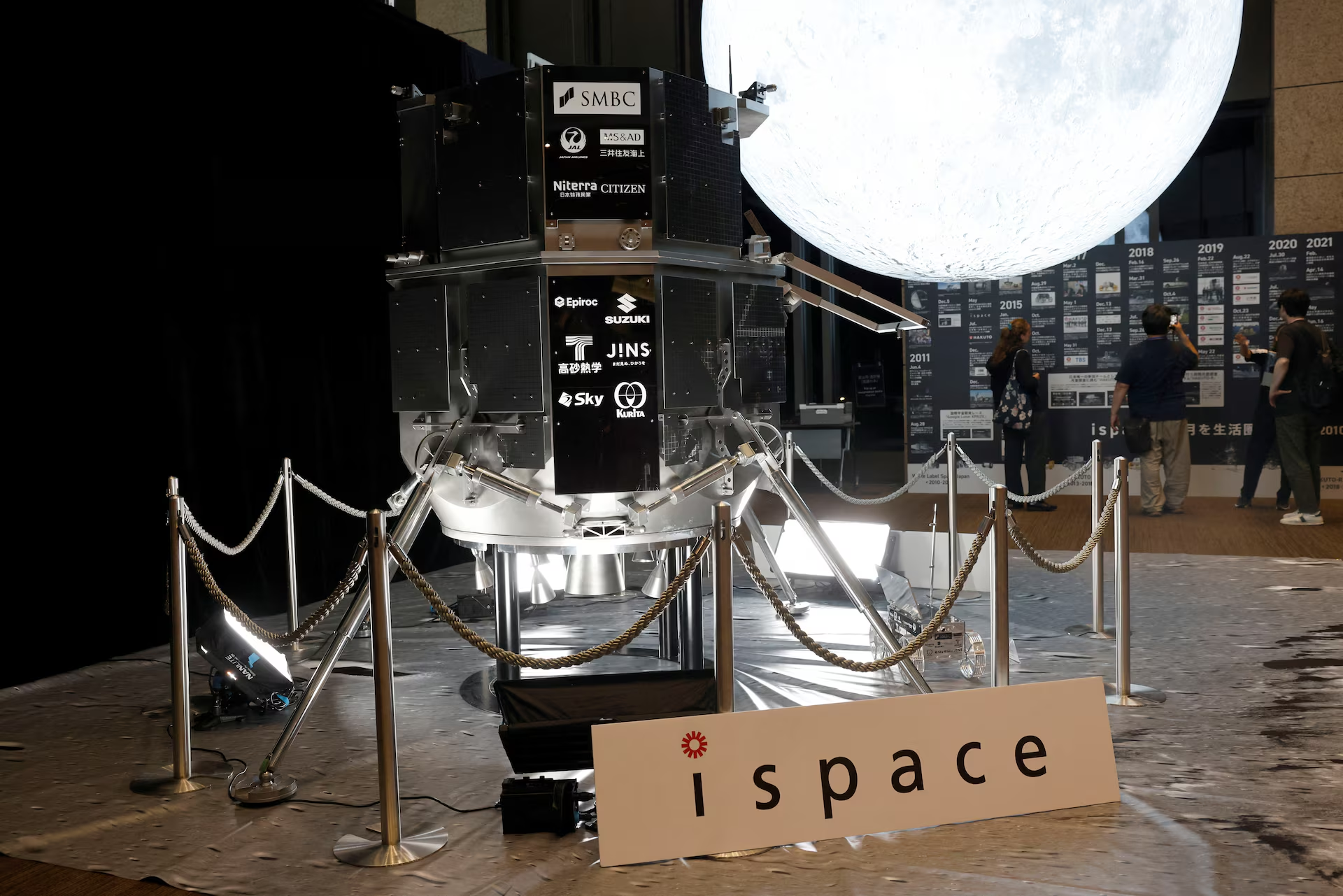
Japanese company ispace has announced the launch of a new cargo delivery service to the Moon. It will use SpaceX’s Starship as a transport platform, while its own lunar rover will distribute customers’ payloads across the surface after landing.
Cost of a Shared Flight
For $50 million, ispace purchased 500 kg of payload capacity on one of Starship’s future flights, which could take place as early as 2030. This works out to about $100,000 per kilogram delivered to the lunar surface.
Such a price became possible thanks to Starship itself. Unlike expendable lunar landers, this system is designed for reuse and is capable of delivering tens of tons of cargo in a single flight.
The large volume allows the launch cost to be distributed among many customers, something previous missions could not offer. By comparison, under current NASA Commercial Lunar Payload Services rates, delivery of a similar mass would cost 8 to 12 times more.
A Failed Start and a New Approach
So far, none of the company’s spacecraft has made a soft landing on the Moon, although both attempts provided critical engineering data. The first mission, in April 2023, ended in a crash when the altimeter incorrectly determined the altitude above the rim of a crater. The Hakuto-R lander ran out of fuel at an altitude of about 5 km, believing it was already on the surface.
The second mission, Resilience, lost contact in June 2025 one and a half minutes before the planned landing time. The cause was an anomaly in the laser rangefinder during the final descent phase. The engines and software were operating normally, but the spacecraft did not have time to slow down.
Despite this, the company is not abandoning its ambitions. By 2030, ispace has planned at least three missions using the new Ultra platform: M3 in 2028, M4 in 2029, and M5 in 2030. Each will be able to deliver up to 500 kg of payload to the surface.
Taxi and Bus
The company’s management divides its services into two categories. ispace calls its own landers “taxis,” performing individual missions for specific customers. The new Starship-based integration platform, meanwhile, plays the role of a “bus,” where ispace buys space and shares the flight among several customers.
After Starship lands on the Moon, the payloads will not remain next to the spacecraft. The company is building its own lunar rover, which will deliver customer equipment to distances of up to several kilometers. This approach makes it possible to serve customers whose projects are too small for a dedicated launch but require delivery to a specific location.
Seats on Starship
The partnership with the Japanese company is not the only direction for Starship. In 2028, NASA plans to use Starship HLS for a lunar landing under the Artemis program. This is a separate government contract unrelated to ispace’s commercial rideshare service. American startup Astrolab has also reserved space on a future flight for its lunar rover.
According to ispace CEO Takeshi Hakamada in an interview with Reuters, the proposal to create an integrator service came from SpaceX itself. Hakamada suggests that there will be few competitors in this niche, because simply finding customers is not enough. It is also necessary to ensure the operation of equipment after landing, and ispace plans to provide a full service cycle, including communications and navigation through a future partner satellite network.
Starship has not yet completed any commercial landing on the Moon. The stated cost of $100,000 per kilogram remains a target tied to the successful commissioning of the system, Reuters reports. Even so, ispace’s entry into the lunar rideshare market sets a new price level for lunar logistics, an order of magnitude lower than current CLPS rates. This makes the Moon more accessible for small private missions that previously could not afford a dedicated launch.