

Scientists have studied laser-heated plasma that came to resemble the material making up the solar corona and the layers beneath it. The findings reveal how the interplay between temperature and the movement of matter produces complex magnetic phenomena, which in turn trigger flares on our star.
Sudden “Nanoflares” in Solar Plasma
In a new study published in Physical Review Letters, a team led by Wei Sun of the China Institute of Atomic Energy recreated laboratory conditions resembling those in the solar corona. Their experiment demonstrates how sudden heating can be caused by plasma instabilities in the corona, triggering tiny bursts of energy known as “nanoflares,” according to phys.org.
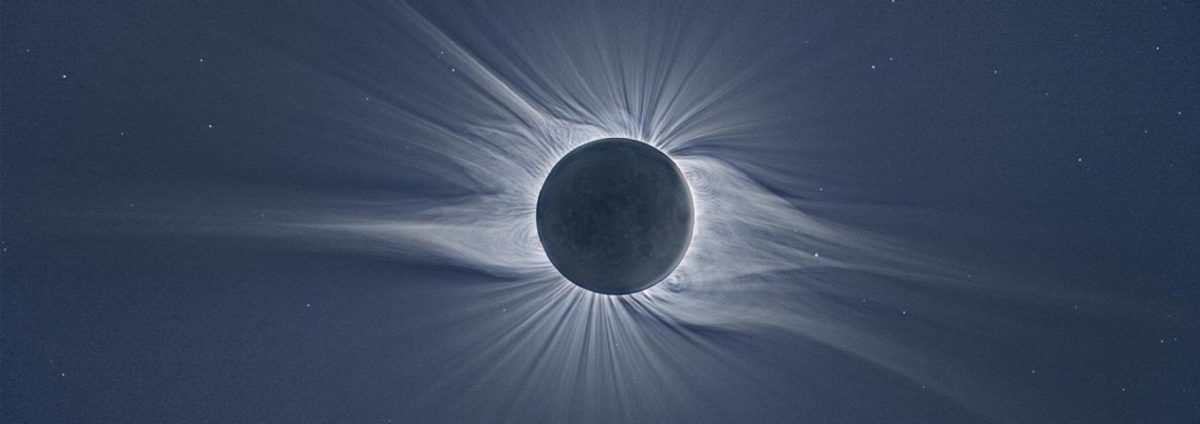
The Sun radiates heat from its visible surface at a relatively low temperature of 5,800 kelvins. Yet in the thin outer layer of its atmosphere, known as the corona, electron temperatures can reach millions of degrees. Astronomers still cannot fully explain why.
The leading theory of coronal heating begins at the Sun’s surface, where turbulent plasma slowly twists and stretches magnetic fields extending upward into the corona, storing energy in them.
Eventually, within thin electric current sheets, oppositely directed magnetic field lines can break and reconnect in a process called “magnetic reconnection,” suddenly releasing that energy. Each nanoflare is small by solar standards but can launch plasma jets and briefly heat its surroundings to extreme temperatures.
Separately, observations have revealed finger-like structures forming where dense blobs of cooler plasma sink through the more diffuse plasma around them—a process astronomers call “coronal rain.” Like a heavy fluid resting on top of a lighter one, this arrangement is unstable.
Simulations have shown that these “fingers” can compress magnetic fields, triggering reconnection and producing small plasma jets. Until now, however, there has been no direct evidence linking these effects to heating caused by nanoflares.
The Solar Corona in the Laboratory
To create an analogue of the solar corona, Sun’s team used China’s Shenguang-II laser facility. They directed powerful laser beams at tiny plastic targets with rippled surfaces. This produced plasma just a few millimeters across, with precisely controlled instabilities seeded within it.
Although this plasma was much smaller than anything on the Sun, it was configured to behave similarly to the plasma surrounding coronal rain. The researchers then tracked the plasma’s structure and magnetic fields using optical imaging and estimated its electron temperature by analyzing the X-rays it emitted. For comparison, they repeated the experiment using flat targets on which instabilities could not develop.
Magnetically Driven Nanoflares Raise the Temperature
The result was the first laboratory demonstration of a nanoflare triggered by plasma instability. Using the rippled targets, the team recreated the finger-like structures observed in the real corona. These brought oppositely directed magnetic fields together and triggered reconnection. This allowed electrons to reach temperatures of approximately 820,000 K—roughly twice the maximum temperature achieved with flat targets.
Accompanying computer simulations showed that electrical heating in the reconnection current sheets greatly exceeded heating caused by friction within the plasma. When magnetic field generation was suppressed in the simulations, most of the additional heating disappeared, strengthening the magnetic explanation.
The result could fill an important gap in our understanding of how the corona heats up. Sun’s team now hopes to expand the experiment using more fully three-dimensional plasmas and more precise measurements. This could help researchers answer remaining questions about how widely this mechanism operates and whether nanoflares occur frequently enough to account for a substantial share of the corona’s heat.
