

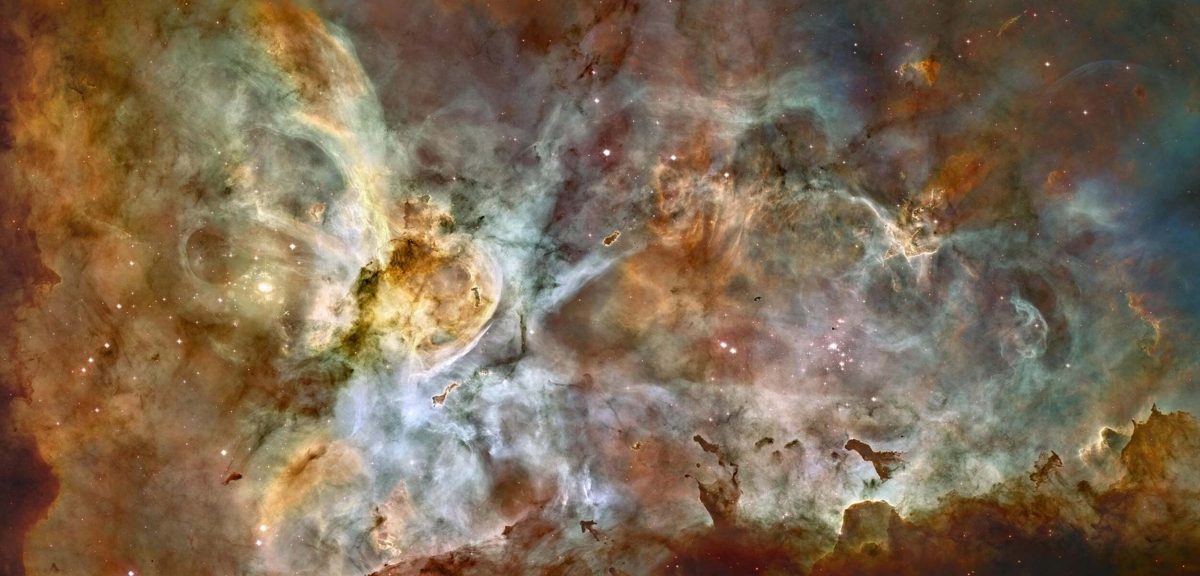
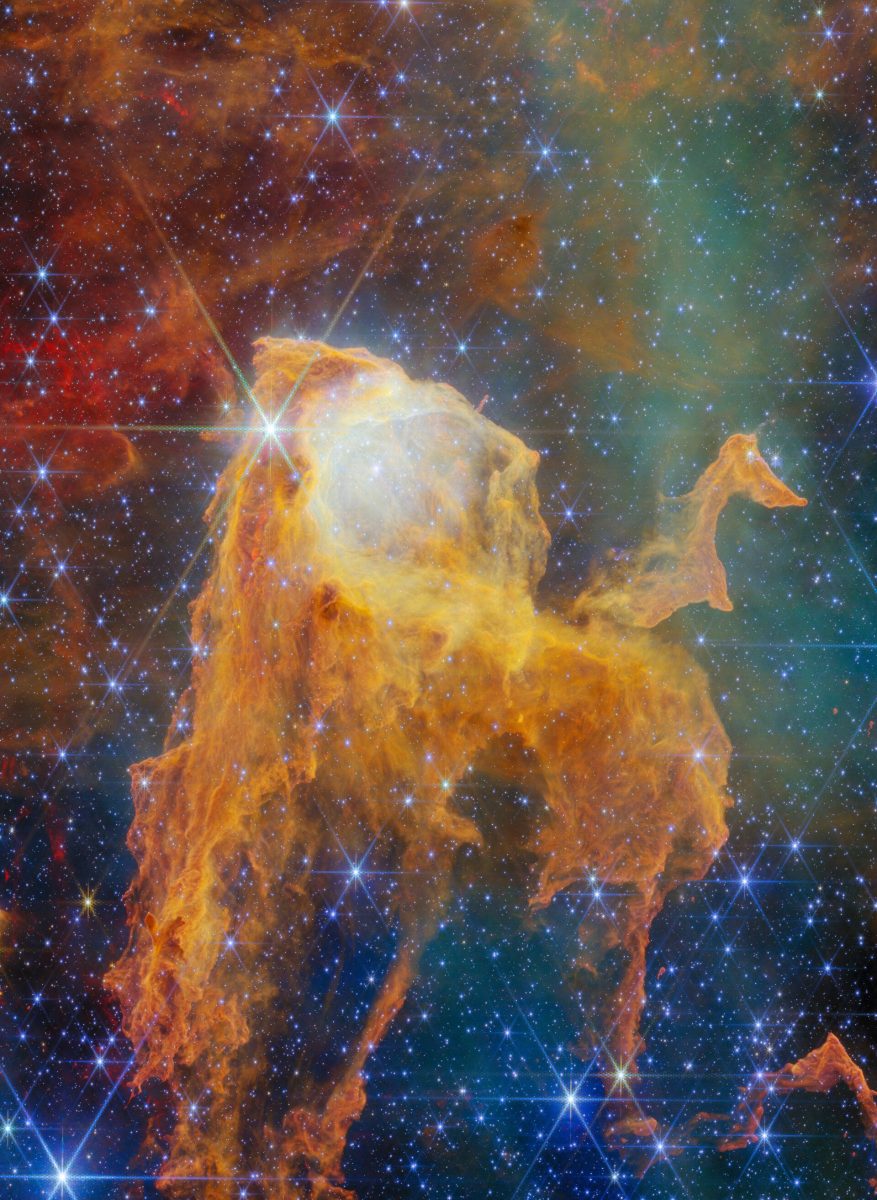
In the Carina Nebula, astronomers have discovered a compact cluster of young stars inside a dense cloud of gas and dust. The cloud itself resembles an open chest, which is why it was named the Treasure Chest. The image was obtained using the James Webb Space Telescope and was included in the monthly selection of images published by ESA/Webb.
Star Cluster Inside the Nebula
Inside the Treasure Chest gas-and-dust cloud is a cluster of approximately 70 young stars. The most massive of them belongs to the rare O class and is about 19 times more massive than the Sun.
These stars are responsible for the unusual glow that shines through the dusty envelope. It was captured by the near-infrared NIRCam instrument. The Carina Nebula extends for approximately 260 light-years and is the nearest region of massive star formation where astronomers can study the full range of stellar formation.
Age and Future of the Cluster
The cluster is approximately 1.3 million years old. Previous estimates suggested a much younger age of around 100,000 years, but new observations favor the higher value. Despite this, the object is still very young, so its stars remain deeply embedded in clouds of dust.
Around many of them, astronomers have detected signs of circumstellar disks. Over time, radiation from the young stars will disperse the surrounding cloud, and the group will become fully visible. For now, we can see only its internal glow through gaps in the dusty structure.
Influence of Neighboring Objects
The shape of the Treasure Chest was determined not only by its own radiation. About 39 light-years to the northwest lies the Eta Carinae system, the brightest object in the entire Carina Nebula. It contains at least two stars, one of which has a mass of about 100 Suns and shines five million times brighter than the Sun.
Additional radiation pressure is produced by the neighboring Trumpler 16 cluster, which also contains several extremely hot, massive stars. It was the external influence of these two objects that shaped the outline of the cometary globule. Without such external influence, the cloud would probably look different.
Why It Is Being Studied
The observations were carried out as part of program #5408 led by Megan Reiter. The goal is to trace how young stars in the Carina Nebula accrete gas from their surroundings and eject it back through jets.
The Carina Nebula is valuable to astronomers because it is the nearest region where the full cycle of star formation across different stellar masses can be observed. It contains tens of thousands of protostars as well as some of the most massive stars in our galaxy. The findings from the program will help scientists understand how young objects influence their own surroundings.
