

Scientists have discovered the multiple-star system TIC 433545934. It consists of two pairs of stars orbiting a common center of mass. At the same time, they perform a complex dance, and thanks to their favorable orientation, researchers on Earth can occasionally observe “triple eclipses.”
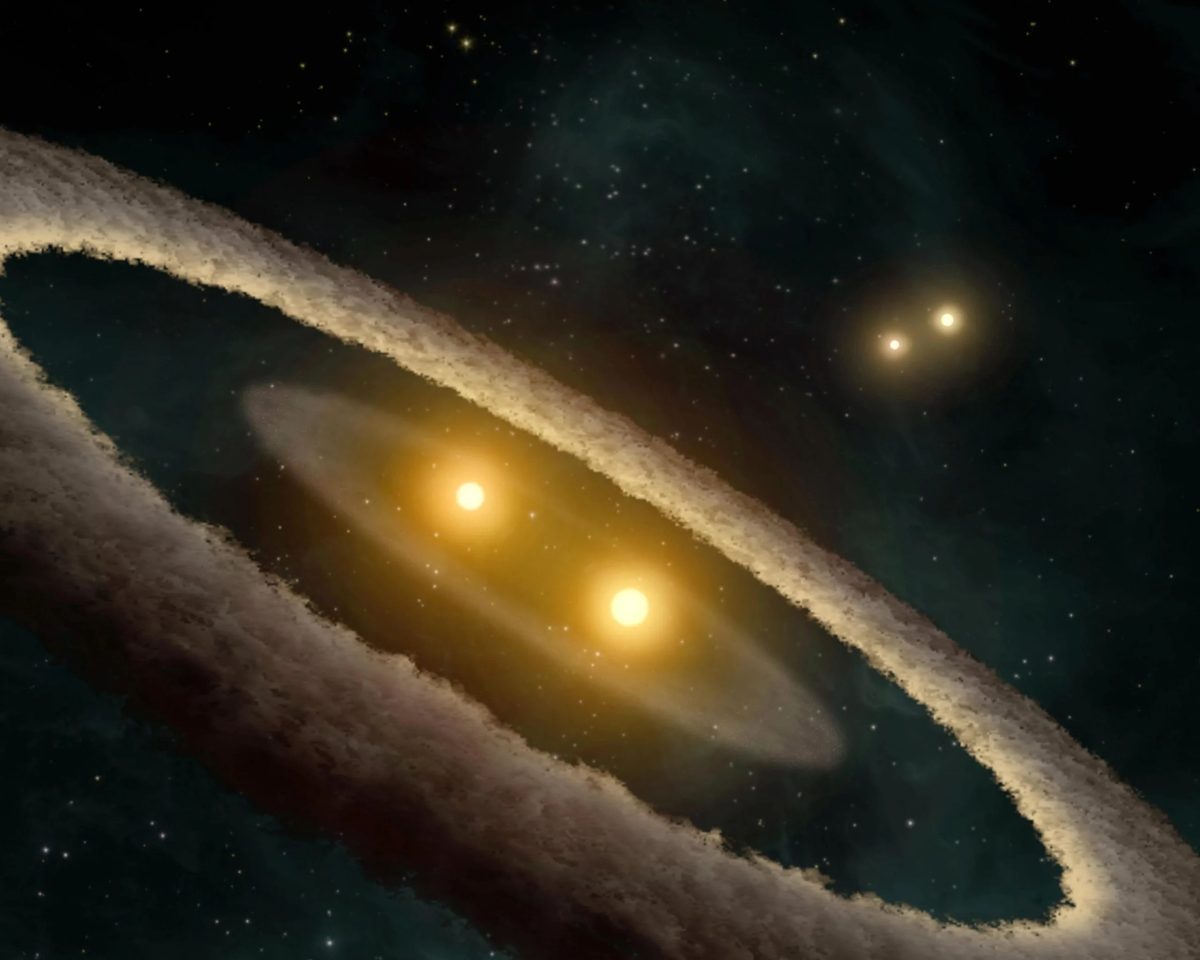
Four Stars in One System
The website phys.org reports that on August 13, a paper appeared on the arXiv preprint server, with the manuscript submitted to the journal Astronomy & Astrophysics. It describes the remarkable stellar system TIC 433545934 studied by astronomers. It is a multiple system consisting of four stars that behave in an extraordinarily beautiful way.
In general, four stars in a single system are not particularly rare in space. Scientists know of cases in which there are even more. What matters more is how their masses compare and how they move relative to one another. If one star weighs more than all the others combined, then everything will essentially orbit around it.
In addition, it is worth remembering that the three-body problem has no stable general solutions. Therefore, triple systems usually consist of a close pair around which, or around a common center of mass, a third star orbits. If a fourth body is added, it will most likely also orbit that pair.
The Multiple System TIC 433545934
This is what makes TIC 433545934 particularly interesting. Not only do the stars in it have approximately equal masses, but they are also arranged into two pairs. In the first pair, the stars orbit one another every 1.4 Earth days, while in the second pair the orbital period is 2.1 days. Both pairs, meanwhile, orbit their common center of mass every 224.5 days.
Such an arrangement became possible thanks to a fortunate set of circumstances that allowed the system to form in this particular configuration approximately 152 million years ago. And its geometry is even more remarkable than might be expected. The orbital planes of both pairs lie almost in the same plane as their mutual orbit. The difference is only about 2°.
Moreover, all of these orbits lie almost in the same plane as the line of sight of observers on Earth. This makes it possible to occasionally observe truly impressive events. For example, the system can display not only ordinary and double eclipses, but also triple eclipses.
This occurs when the two pairs line up along the same line as viewed from Earth, while the stars within each pair also line up with one another. As a result, the total brightness of the system decreases once, then a second time, and then a third time, before returning in the same sequence.
Until now, scientists had not observed anything quite like TIC 433545934, although the system KIC 5255552 may have a similar configuration, which still requires confirmation. Scientists suggest that in the future, as the stars age, mass transfer between the stars within the pairs may begin, or the stars may even merge.