

The gas between the stars has turned out to be far more complex than the classical two-phase model suggests. For the first time, astronomers have constructed a three-dimensional map of the thermal structure of the interstellar medium in the vicinity of the Sun and found that, near the galactic plane, approximately 41% of the gas by mass is in a thermally unstable state. This came as a surprise to scientists who had relied on the classical two-phase model.
How the Map Was Created
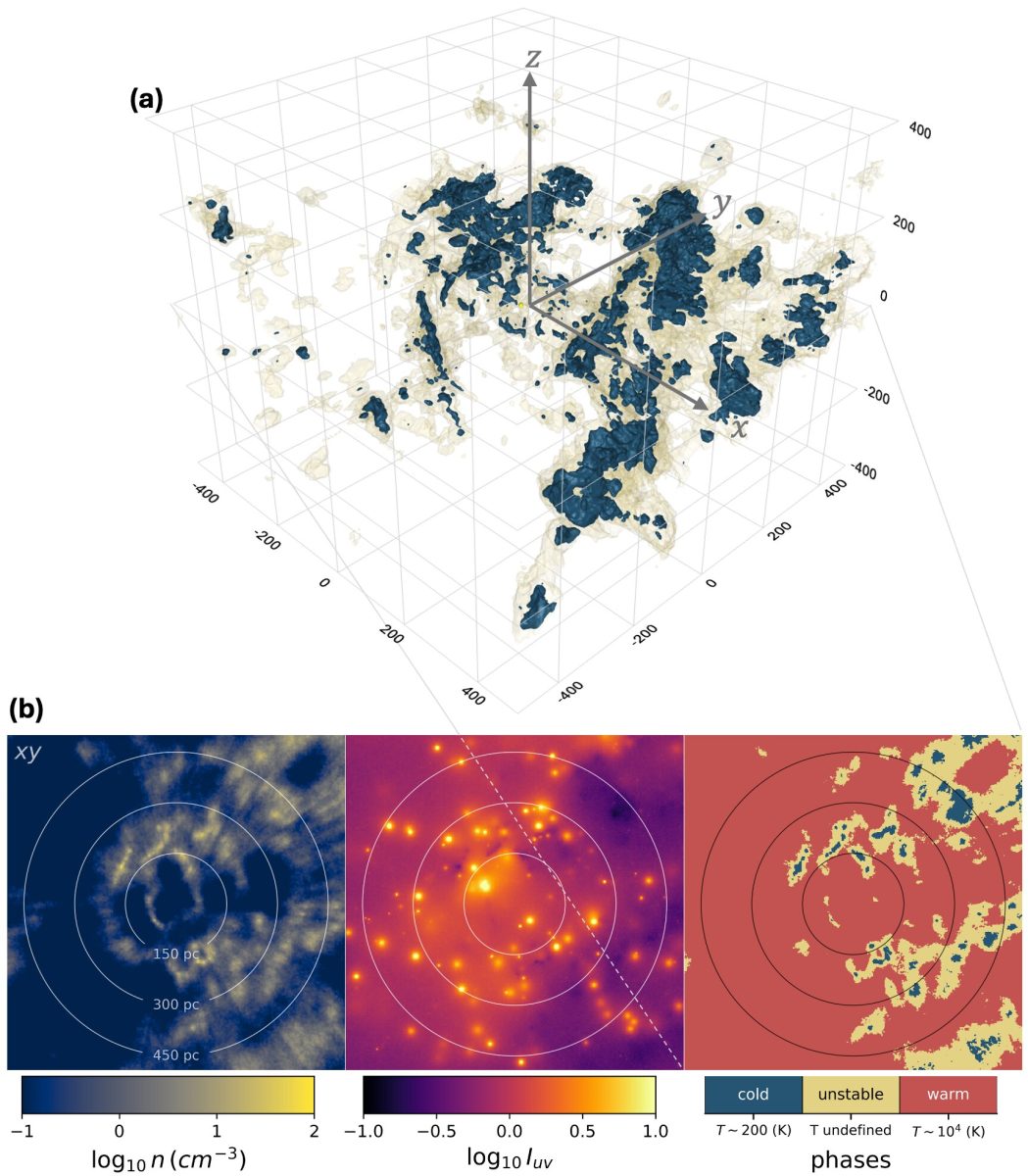
A team led by Jonathan Shelest of the Technion – Israel Institute of Technology developed a tool called 𝒫3D. It combines a three-dimensional map of interstellar dust, a new three-dimensional map of ultraviolet radiation from nearby massive stars, and a model that determines the thermal phase of the gas at each point in space. The results were published on arXiv and are undergoing peer review at the journal Nature Astronomy, according to Phys.org.
The resulting thermal map covers a region approximately one kiloparsec wide—more than 3,200 light-years—with the Sun at its center. For the first time, it shows not an averaged temperature along the line of sight, but the spatial distribution of cold, warm, and unstable regions.
The Unstable Majority
The classical view of interstellar gas is based on two stable phases: cold, dense clouds with temperatures of approximately 200 kelvins and a warm, diffuse medium with temperatures of around 7,000 kelvins. The map, however, revealed a different distribution. Near the galactic plane, unstable gas accounts for 41% of the mass, the cold phase for 27%, and the warm phase for 32%.
This proportion means that the gas is constantly circulating between warm and cold states. According to the researchers’ estimate, a complete transition cycle takes between 3 and 6 million years. The reason for this continuous mixing is turbulence, which prevents the interstellar medium from settling and separating into two clearly defined groups.
Cold Clouds from the Inside
On the map, cold clouds appear as dense cores surrounded by envelopes of unstable gas. The physics of this structure is understandable. Inside a cloud, the gas is dense enough to cool rapidly, while dust blocks external ultraviolet radiation. At the cloud’s boundary, the density decreases and cooling becomes weaker, but there is still not enough ultraviolet radiation to heat the gas fully, so the boundary remains unstable.
A surprise was found inside the cold cores themselves. Despite the turbulent surroundings, the gas within them proved to be remarkably calm. Their internal density changes very little, which contradicts many star-formation models that treat cold gas as an isolated and highly turbulent environment.
A New Picture for Future Models
The findings require a revision of the established approach. The cold gas from which new stars are born is not a closed reservoir. It constantly exchanges matter with a much larger and more turbulent multiphase system. It is this complex interaction, rather than the behavior of an isolated cold fragment, that should be taken into account in future simulations.
In Ukraine, the interstellar medium is also studied at the Astronomical Observatory of Ivan Franko National University of Lviv and at the Department of Astronomy and Space Physics of Taras Shevchenko National University of Kyiv.
