

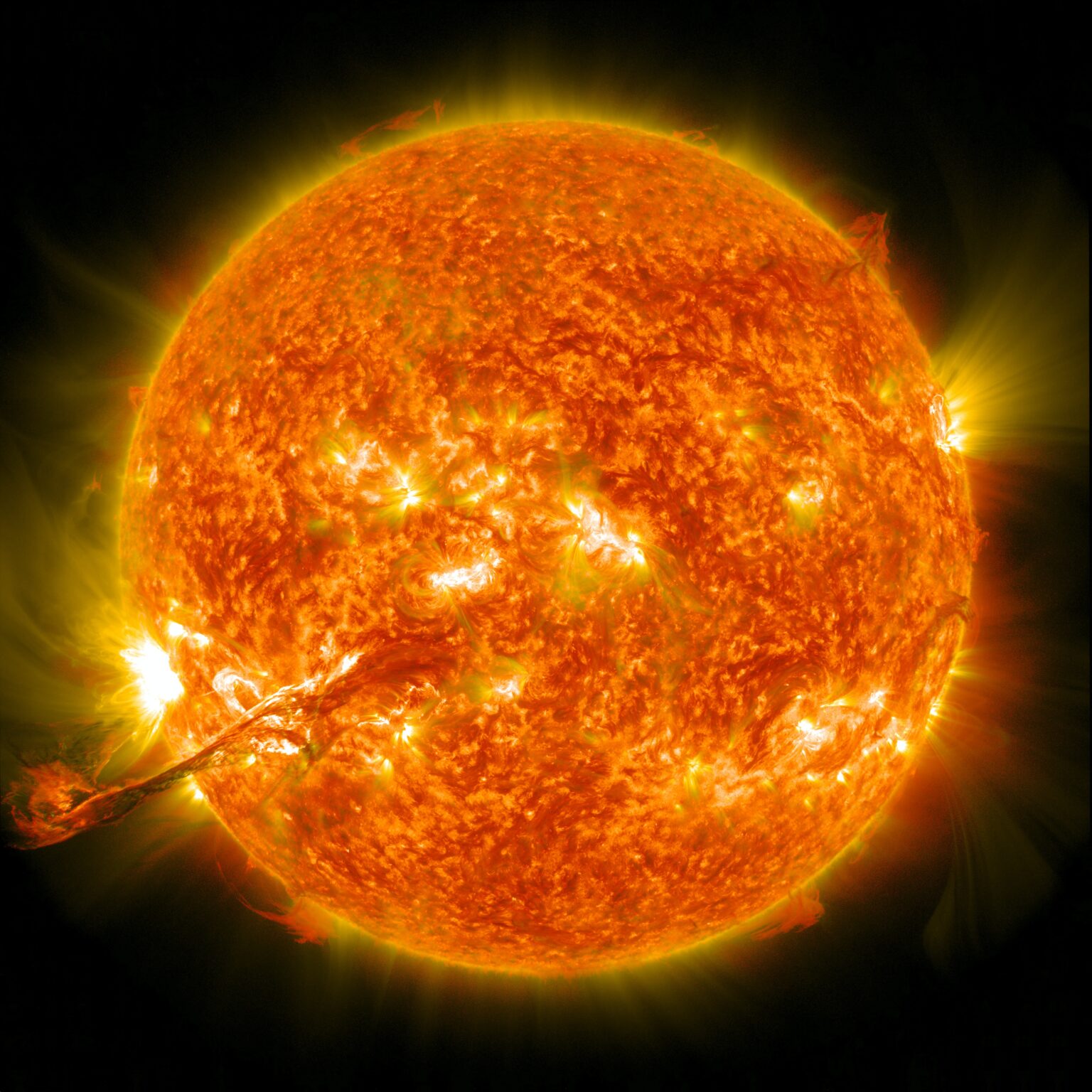
Above the Sun’s quiet regions, the magnetic field turned out to be much more tangled than astronomers had expected. Where it had been imagined as uniform, numerous thin threads were found. They were resolved with the help of a telescope carried into the stratosphere by a balloon. This discovery may help explain how energy from the surface of our star heats its atmosphere.
An Inhomogeneous Magnetic Field
The strongest concentrations of the magnetic field in the Sun’s quiet regions are located along the boundaries of enormous cells formed by plasma flows beneath the surface. Higher up, in the chromosphere — the layer of the atmosphere above the visible disk — the magnetic field lines spread out and cover the quiet regions from above. Astronomers call this structure a magnetic canopy and had previously imagined it as a uniform covering that smoothly expands with height.
The new observations revealed a different picture. The canopy is permeated by numerous thin threads, most of them narrower than one arcsecond. Astronomers use this unit to measure apparent sizes in the sky; one degree is divided into 3,600 arcseconds. At the distance of our star, one arcsecond corresponds to approximately 725 kilometers.
The field inside the threads is slightly weaker than the surrounding field and, in the clearest cases, points in the opposite direction. Beneath many of them, no magnetic structures are visible from which they could originate.
Why the Stratosphere Was Needed
Quiet regions cover most of the solar disk. The magnetic field there is much weaker than in sunspot regions, making it difficult to measure from the ground. Earth’s atmosphere blurs images, causing fine details to disappear.
To overcome this obstacle, an international team lifted the solar Sunrise-III observatory by balloon to an altitude of 35 kilometers. Passenger airliners usually fly 10–11 kilometers above the ground, meaning the balloon rose roughly three times higher. Only a thin layer of air remained above the instruments. Observations in the stratosphere continued for almost a week in July 2024.
Three instruments developed in different countries were installed on the gondola. One of them, a Japanese instrument, was developed under the leadership of the National Astronomical Observatory of Japan. It measures the magnetic field using infrared light in several layers at once, from the surface to the chromosphere.
Twisted Magnetic Field Lines
The resulting picture was compared with a computer model of the Sun’s atmosphere. The model reproduced similar thin structures and showed that they are associated with magnetic field lines twisted by plasma motions near the surface. The results were published in three papers in the peer-reviewed journal The Astrophysical Journal Letters. The stratospheric data were analyzed by a group led by Masahito Kubo of the National Astronomical Observatory of Japan, while the calculations were presented in a separate paper by Patrick Ondratschek and his colleagues.
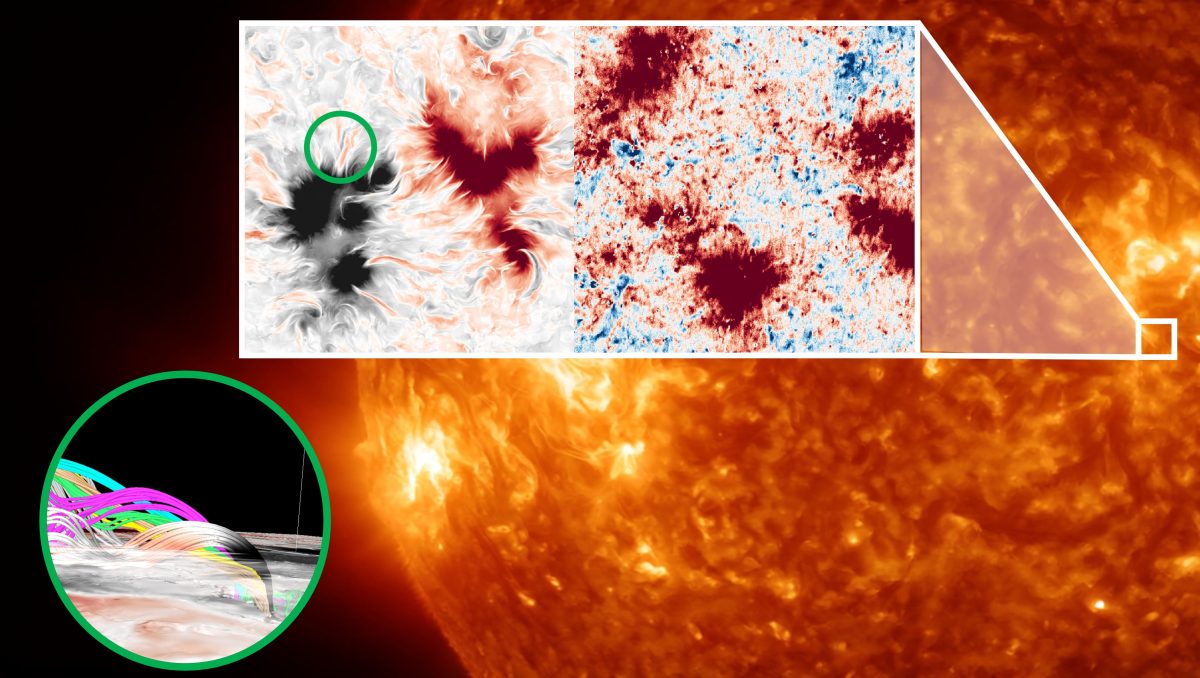
Near the edge of the canopy, stronger and weaker threads alternate with one another. A similar striped pattern has long been known in sunspots, in the brighter zone surrounding their dark center. There, however, it lies at the level of the visible surface, whereas here it appears higher up, in the chromosphere.
Spicules and Coronal Heating
During the flight, researchers also separately studied a quiet region near the edge of the Sun. There, they were able to create a magnetic map of spicules — narrow jets of plasma above the surface — and trace how the distribution of the field changes with height.
The problem of coronal heating has long puzzled astronomers. This outer layer of the atmosphere heats up to millions of degrees, while the temperature of the visible disk is only about six thousand degrees. Masahito Kubo and his co-authors suggest that oppositely directed magnetic field lines meet along the sides of the threads. There, they may reconnect in a new configuration and release energy in the form of heat.
The existing data do not make it possible to see how such processes develop, because a single scan took almost two hours and was too slow to capture rapid changes. The answer should come from future observations with more frequent imaging, which will show whether the threads are connected with spicules and other eruptions at the edge of the canopy.