

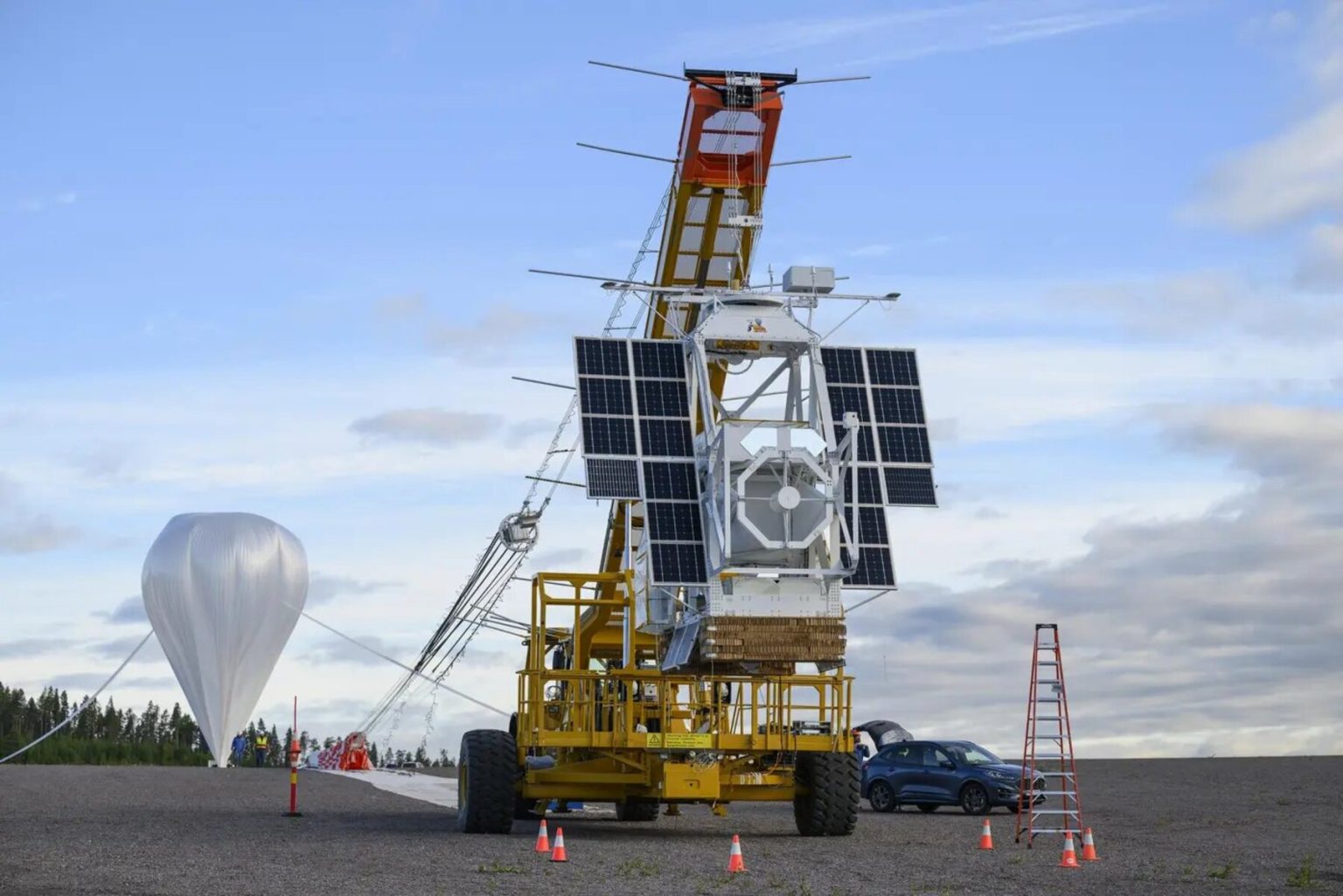
The Sunrise III Observatory has been observing the Sun for nearly a week straight from a height beyond the reach of ground-based telescopes. The equipment was carried into the stratosphere by a large balloon. As a result, scientists have obtained unprecedented detail on the processes occurring in the Sun’s outer atmosphere.
Waves in the Sun’s Atmosphere
Turbulent plasma flows deep within the Sun generate wavesthat propagate through its atmosphere. The most famous of these are the five-minute oscillations—global sound waves that have long been observed in the photosphere and upper atmosphere of the Sun.
Now, the Sunrise III telescope has made it possible for the first time to observe how these waves propagate simultaneously in two neighboring layers of the solar atmosphere with a total thickness of about 2,000 km – the photosphere, that is, the visible surface of the Sun, and the chromosphere above it. An overview of the initial results has been published in the peer-reviewed journal The Astrophysical Journal Letters.
A flare during flight
During observations of the Sun, a solar flare of the second-highest intensity category occurred. Such events can cause moderate disruptions on Earth, particularly in power grids and satellite operations.
During such a flare, elongated bright structures appear in the chromosphere. They form where magnetic field lines rearrange and release energy.
The data reveal the fine structure of these regions. This helps us understand how small-scale processes control the development of large flares.
Solar Tornadoes
Magnetic field lines extending from quiet regions of the surface into the chromosphere were previously thought to have a fairly simple structure. Observations, combined with computer modeling, have revealed a different picture.
Inside the ordered magnetic filaments lie finely twisted lines. They direct flows of hot plasma and, most likely, serve as the centers of small solar tornadoes.
A View from the Stratosphere
The Sunrise III observatory remained in flight for six and a half days in July 2024. Its route stretched from the far north of Sweden to Canada’s Northwest Territories.
The spacecraft operated at an altitude of about 35 kilometers, above the densest and most turbulent layers of Earth’s atmosphere. It is precisely this turbulence that hinders ground-based telescopes, and even the most advanced compensation methods rarely provide more than a few minutes of continuous, high-quality imagery.
This is the third launch of a spacecraft in this series. The previous launches took place in 2009 and 2013, following the same flight path from Sweden to Canada.
Observatory Instruments
Data quality depended not only on altitude but also on the observatory’s optics. Light struck the telescope’s primary mirror, which had a diameter of one meter. It was then processed by three scientific instruments, including the TuMag magnetograph for measuring the magnetic field.
Images were taken at intervals of about a quarter of a second. They reveal details as small as 50 kilometers wide, despite the 150 million kilometers separating the observatory from the Sun.
Proportionally, this is equivalent to making out a one-meter-wide object from a distance equal to the distance between Kyiv and Madrid. So far, only a small portion of the collected data has been analyzed, so there is enough work to last for years to come.
