

Planetary nebulae have been studied for a long time, but their internal structure often turns out to be more complex than it first appears. New observations of NGC 6563 have shown that two small protrusions on either side of the nebula are much older than its main shell, rewriting our understanding of how it formed.
An Ancient Nebula in Sagittarius
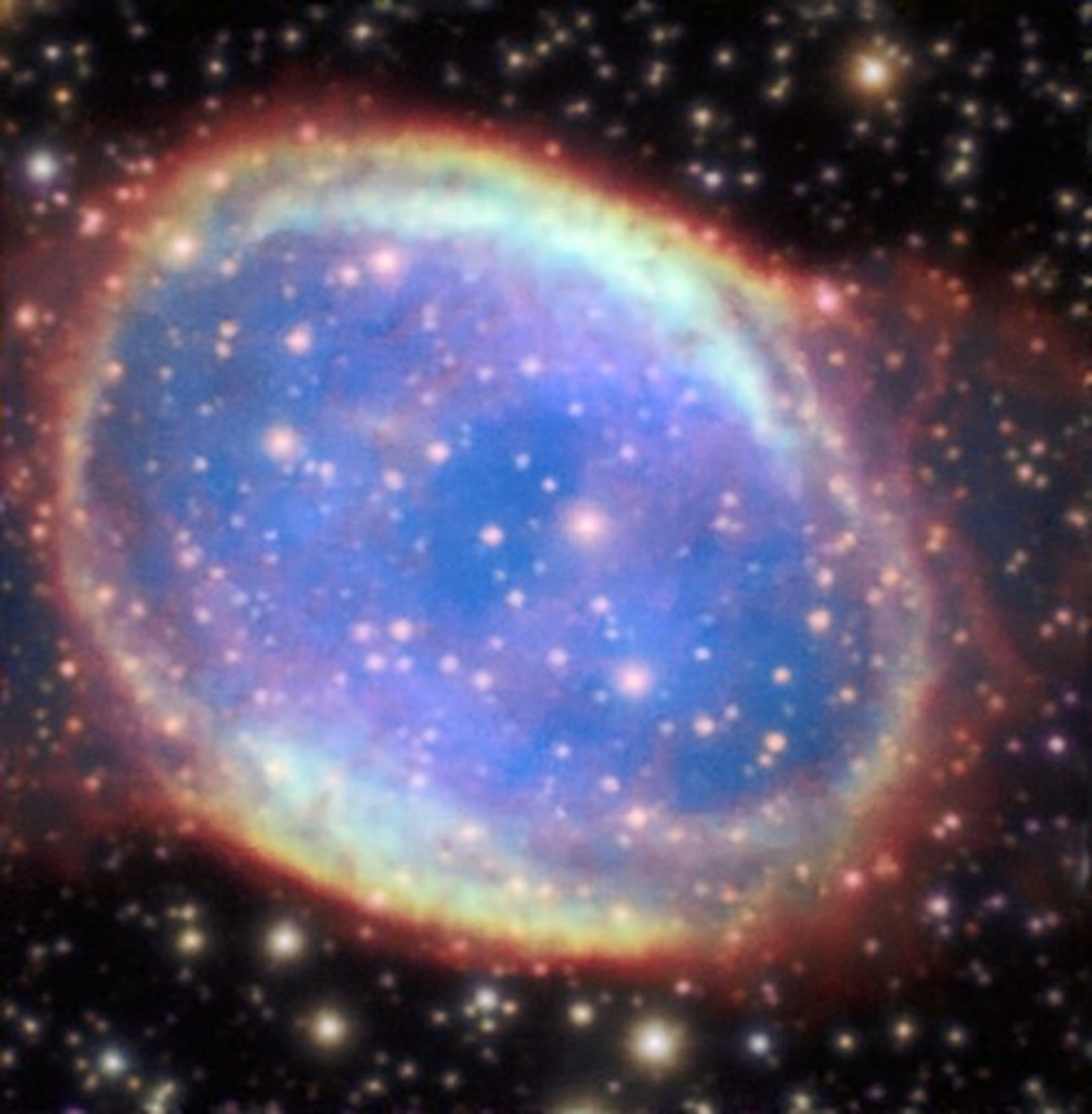
The planetary nebula NGC 6563 is located 5,400 light-years away from us in the constellation Sagittarius. It was discovered back in 1826, making it one of the oldest objects recorded in catalogs of this type.
The nebula has an ellipsoidal shape, with one side noticeably narrower than the other, giving it an egg-like appearance. On both sides of the main body are two small protrusions, which researchers in earlier studies referred to as “ears.” This structure became the main focus of the new study.
What the Two Spectrographs Measured
A team of astronomers led by Zahra Al of Istanbul University studied NGC 6563 using two instruments. The first was the integral-field spectrograph MUSE, the Multi Unit Spectroscopic Explorer, installed on the Very Large Telescope in Chile. The second was the Manchester Echelle Spectrograph, MES, mounted on the Arcadio Poveda Telescope in Mexico.
The observations made it possible to measure the nebula’s systemic velocity, which is −25 km/s relative to the Local Standard of Rest, as well as the expansion rate of the main shell, which is 22 km/s. Three-dimensional modeling confirmed the object’s complex structure, consisting of an ellipsoidal body, a thin outer shell, “ears,” and smaller internal features.
The “Ears” Are Older Than the Nebula Itself
Based on the expansion velocity, the age of the ellipsoid together with the ring is estimated at about 3,600 years. The “ears,” however, turned out to be significantly older, with an estimated age of 7,500 to 8,800 years. This difference means that they formed before the nebula’s main shell appeared.
The study’s authors note that this structure is consistent with a scenario in which the “ears” formed as a result of collimated outflows of matter during interaction in a binary star system. According to theoretical models, “ears” in planetary nebulae are produced by short-lived jets from a companion star before the main dense shell forms. This makes NGC 6563 one of the few objects where this scenario is supported by kinematic measurements.
A Non-Uniform Environment
One side of the nebula is expanding faster than the opposite side, while local enhancements in brightness indicate that NGC 6563 is evolving in a non-uniform surrounding environment. The researchers point to several mechanisms that may have shaped the object’s current form.
These include the interaction of internal stellar winds, instabilities in the thin shell, episodic mass ejection caused by the influence of a companion star, and the impact of the external environment. According to the authors, these processes operated at different epochs and on different spatial scales, and therefore require separate theoretical and observational studies to quantitatively assess their contribution.
According to phys.org
