

The rarefied upper layers of the atmosphere at very low orbits slow spacecraft so strongly that their altitude has to be constantly restored using thrust. An engineer from the University of Stuttgart has proposed powering the engine with the same air that creates this drag. His system has neither a cathode nor a neutralizer — the components that degrade the fastest at such altitudes. According to calculations, a satellite could remain there indefinitely.
Flight Without a Fuel Supply
The GOCE spacecraft measured Earth’s gravitational field from an altitude of about 260 kilometers, while a xenon ion engine kept it in orbit. When the fuel ran out, its altitude began to fall rapidly, and the probe burned up in 2013. Francesco Romano applied his model specifically to this scenario.
Calculations in the dissertation show that an atmosphere-breathing system could keep a satellite at altitudes between 190 and 250 kilometers indefinitely while consuming less than 1.6 kilowatts. Ordinary solar panels can provide that much power, so the system would not require a separate power source. The work is available as a preprint on arXiv and has not yet undergone peer review in a scientific journal.
Why Atomic Oxygen Is a Problem
At these altitudes, ultraviolet radiation breaks molecular oxygen into individual atoms. This form of gas is extremely aggressive toward metals, oxidizing the electrodes and acceleration grids of ion engines.
The most vulnerable component turned out to be the cathode of the electron gun, which removes excess charge from the spacecraft body. When it fails, the spacecraft accumulates charge and attracts the freshly expelled ions back toward itself, causing thrust to disappear. The variability of the environment adds further complexity, because gas density depends on the time of day, latitude, and solar activity.
How ion engines work. Explanation on the Fraser Cain YouTube channel
The idea of using incoming atmospheric gas instead of a xenon tank is not new. Back in 2018, ESA reported the first successful tests of a similar system developed by the Italian company Sitael, but that design used a Hall-effect thruster with a cathode-neutralizer — precisely the component that atomic oxygen destroys first.
A Mirror and Antenna for Collecting Gas
To collect the rarefied gas, Francesco Romano tested several intake designs, ranging from a funnel-shaped trap to a compact hexagonal structure made of titanium alloy. The best-performing design was a parabolic mirror with a graphite or silica coating, which reflects particles directly into the chamber. In wind-tunnel tests using atomic oxygen, argon, and nitrogen, it captured about 94.3% of the particles, while tilting it by 15 degrees reduced efficiency by only 8%, according to Universe Today.
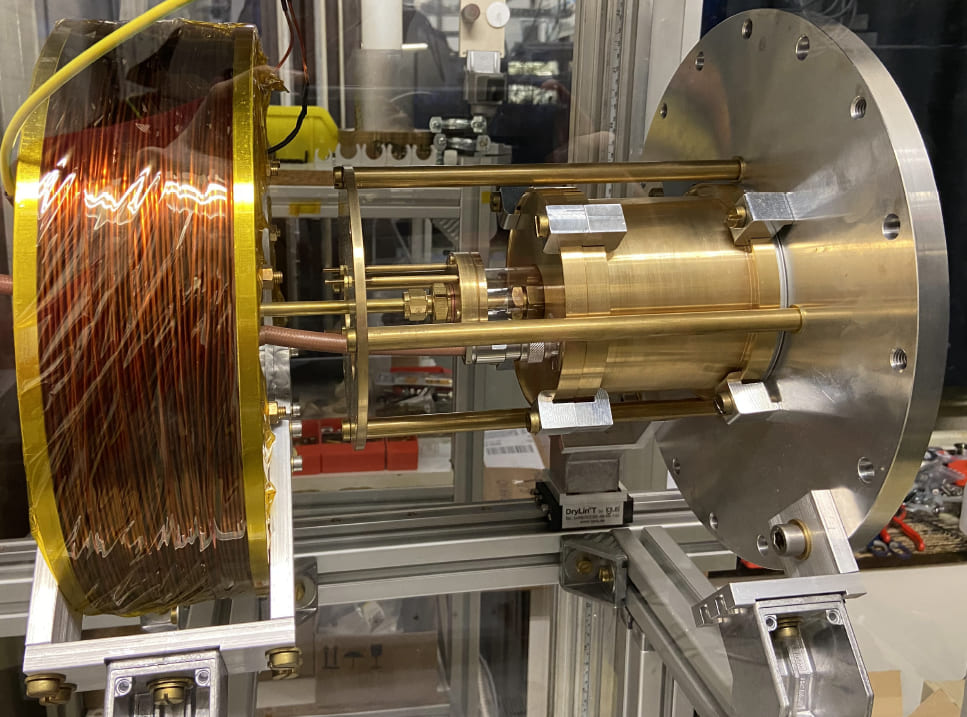
The thruster itself operates using a radio-frequency helicon discharge, excited by a “birdcage” antenna of the same type used in medical imaging systems. This configuration transfers 99% of the supplied power into the plasma, whereas conventional wire coils lose part of the energy through their own reactive resistance. A solenoid around the chamber forms a magnetic nozzle in which the flow accelerates and exits in a quasi-neutral state, because electrons leave together with the ions, eliminating the need for a separate neutralizer.
From the Vacuum Chamber to Mars
In a vacuum chamber, researchers reproduced the concentrations of the three main gases found at the target operating altitude. The plasma jet remained stable at radio-frequency power levels between 50 and 60 watts.
The Martian atmosphere consists mainly of carbon dioxide, and according to calculations, the same system could keep a spacecraft at altitudes between 120 and 160 kilometers above the surface. Current Mars research satellites generally operate above 250 kilometers, so cameras and radars at lower altitudes could capture the terrain in greater detail.
For now, the concept remains a laboratory prototype supported by calculations. Whether the design ever reaches flight will depend on operators of very-low-Earth-orbit constellations, since they are the ones who purchase xenon and retire spacecraft once their fuel reserves are depleted.