

For a long time, analysis of data on the interaction between Earth’s magnetic field and the solar wind showed a certain process of “saturation.” Scientists believed that this could mean that during a powerful solar storm, our protection might prove too weak. However, they are now confident that this was an observational error.
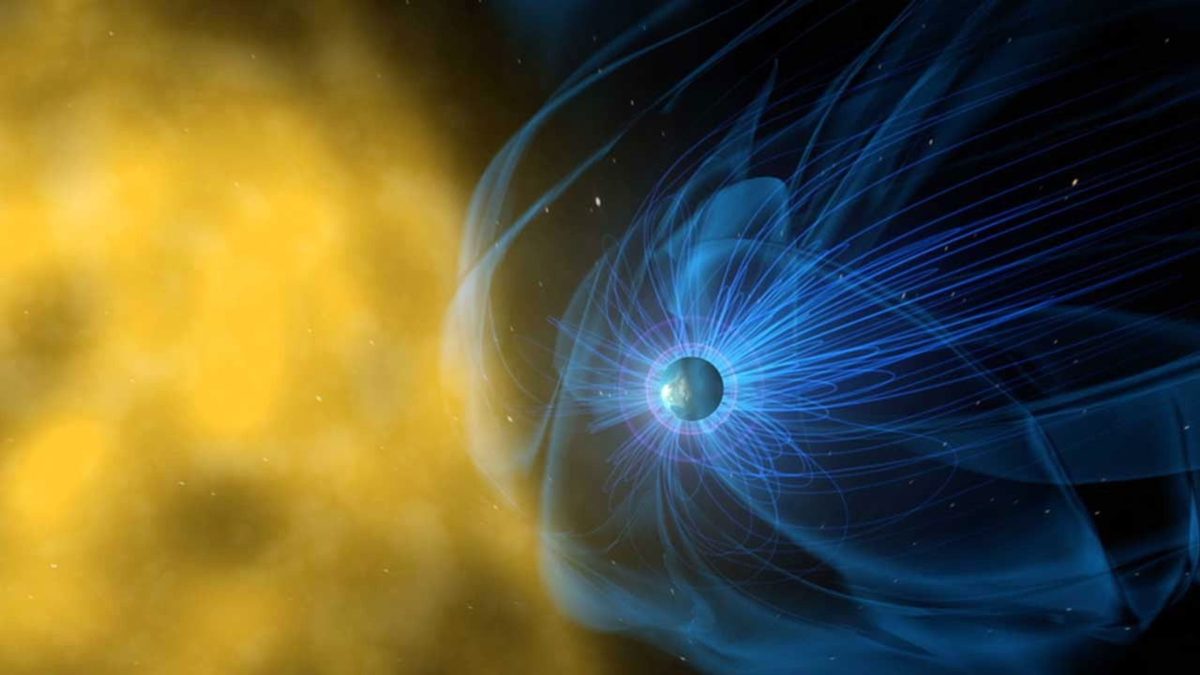
Earth’s Magnetosphere
Every second, the Sun bombards Earth with streams of high-energy particles, while our planet’s magnetic field stops them. Thanks to this, radiation does not reach the bodies of living organisms, allowing them to continue to exist. As phys.org reports, we greatly underestimate the strength of this protection.
This concerns a recently published study in the journal Nature, in which scientists tested the established view of Earth’s magnetosphere as a structure that can be “breached” by a sufficiently powerful magnetic storm. This assumption is based on many years of observations of its interaction with charged particles coming from the Sun.
At moderately high and high solar-wind intensities, the energy of the magnetic field more or less balances these particles, slowing them down and causing them to form plasma. This manifests itself in the form of auroras, temporary disruptions of radio communications, and other phenomena familiar to us.
However, during truly powerful eruptions, it appears that the magnetosphere’s response begins to lag behind, as though it is becoming saturated. This raises concerns that if an exceptionally powerful eruption occurs — one that happens once every hundred or even thousand years — most of its energy could easily pass through the protection, causing enormous problems.
Unreliable Data
In the new study, the authors questioned the reliability of the data on which the conclusion about “saturation” was based. Most of these data were obtained from spacecraft located at considerable distances from Earth, for example at the L1 Lagrange point, which is 1.5 million km from the planet.
Scientists have now compared these global data with observational results obtained on smaller scales and reached an interesting conclusion: at high solar-wind intensities, from the perspective of spacecraft located far from Earth, considerable uncertainty arises in the propagation of plasma fields. Simply put, they provide inaccurate information about the magnetic field’s response.
This uncertainty has an especially strong effect when AI is brought into the process and works with statistical data. The conclusion that “saturation” exists is precisely the result of such processing. In reality, our planet is capable of withstanding much more powerful storms.
