

Humans are explorers by nature, but wherever they go, their microbes travel with them. According to NASA scientists, terrestrial microorganisms brought by astronauts may be able to survive in protected, shaded areas near the Moon’s South Pole. The results of the study, published in the journal Science Advances, underscore the urgent need to study the resilience of these tiny “passengers.”
About 1 million bacteria live on every patch of human skin the size of an ordinary pencil eraser. During expeditions, some of them inevitably escape from habitats and spacesuits into open space. This creates a serious problem: microbial contamination may prevent scientists from distinguishing ancient lunar chemistry from biological traces brought from Earth. A similar challenge will arise during future missions searching for life on Mars.
Extreme Resilience
Uncrewed NASA spacecraft can undergo deep sterilization by being heated to temperatures above 204°C. However, such a method cannot be applied to crewed missions.
Scientists studied five types of microorganisms that are commonly associated with humans or found aboard the International Space Station: Aspergillus niger, Bacillus subtilis, Staphylococcus aureus, Deinococcus radiodurans, and several species of Fusarium. The black mold fungus Aspergillus niger demonstrated particular resilience. Although ultraviolet radiation is used in hospitals for sterilization, this fungus proved capable of withstanding exposure to sunlight even in unprotected areas. The researchers acknowledge that such organisms are not usually considered extremophiles, and their ability to avoid drying out in a vacuum came as a surprise.
Polar Shadows
Because the Moon’s rotational axis has only a slight tilt, the Sun remains very low above the horizon at the poles. Its light skims across the surface, while mountains, ridges, and crater rims cast long shadows. As a result, a mosaic of shaded regions forms where temperatures remain extremely low and fragile molecules are protected from lethal radiation.
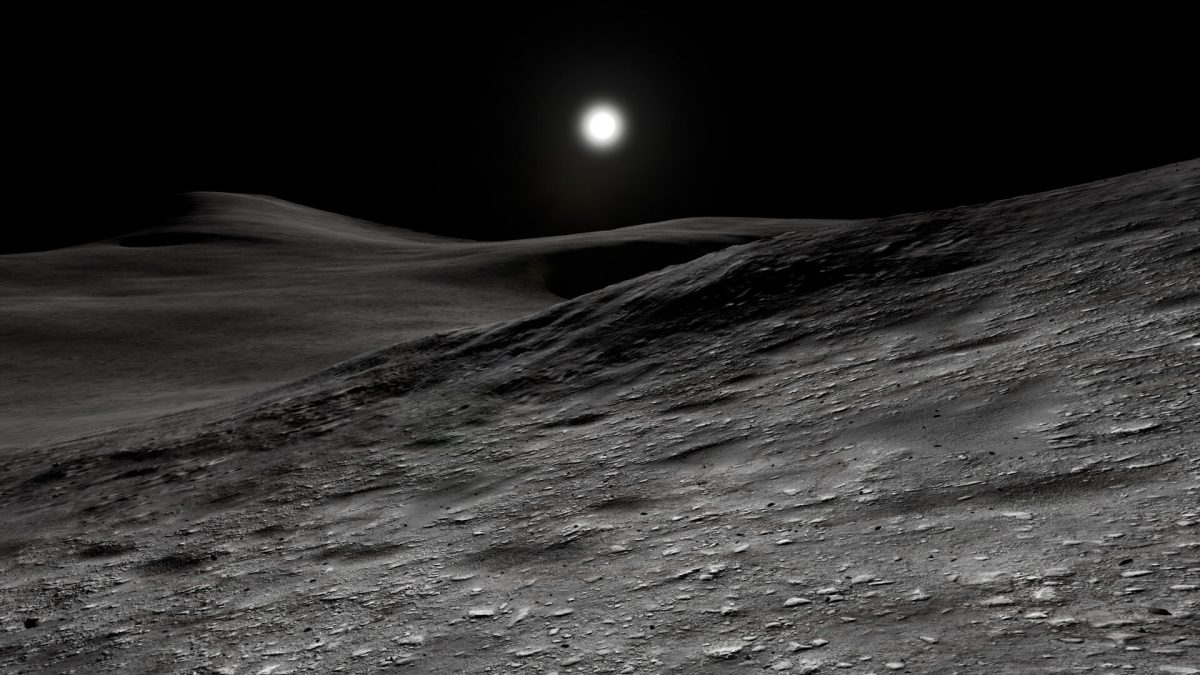
Using elevation and temperature maps obtained by the Lunar Reconnaissance Orbiter, scientists modeled conditions in three polar regions: Nobile Rim, Connecting Ridge, and De Gerlache Rim. The analysis revealed the presence of “survival niches” — from crater floors several kilometers across to shaded depressions no larger than the footprint of a space boot. In these refuges, microorganisms may remain viable for at least one Earth day.
An Open-Air Laboratory
Scientists emphasize that survival does not mean full-fledged flourishing. The Moon lacks the conditions necessary for microbial growth and reproduction because there is no atmosphere, moderate warmth, or liquid water. The organisms remain dormant, but even in this state they can distort the results of scientific analyses.
Animated view of Earth and the Sun as seen from the vicinity of the Moon’s South Pole
At the same time, the Moon could become a unique natural laboratory. Controlled experiments in its shadowed craters would make it possible to test the limits of terrestrial life’s resilience in an environment that cannot be fully reproduced on Earth. The main task for researchers now is to clearly document the Moon’s original chemical composition before an active human presence irreversibly changes its surface.
Previously, we reported on how ancient microbes may have destroyed the climate of Mars.
According to sciencedaily.com
