

Scientists have attempted to answer whether “mega-Earths” could really exist in the Universe. These are rocky worlds whose masses exceed Earth’s not merely several times over, but by more than a factor of ten. In a new study, researchers showed that their masses may be overestimated because of activity on their host stars.
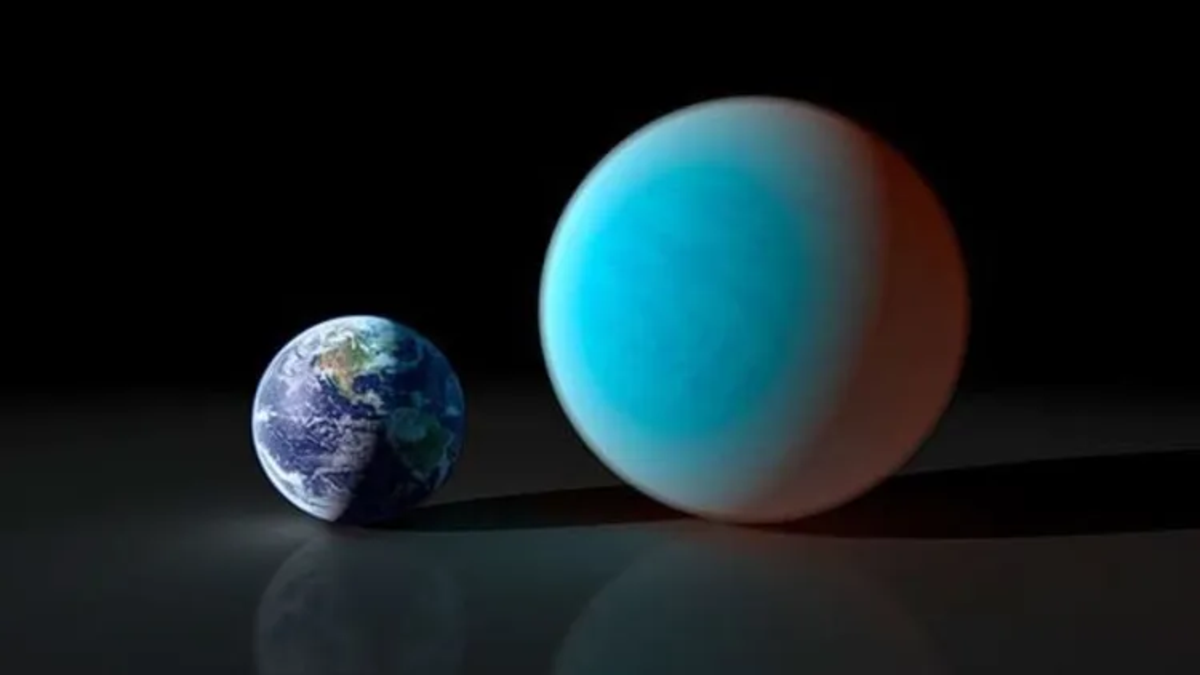
Searching for Mega-Earths
According to phys.org, scientists investigated whether so-called mega-Earths—rocky planets more than ten times as massive as our home world—are real. A paper examining this question was posted on the arXiv preprint server on October 8.
Thousands of exoplanets are already known. Many are rocky but more massive than Earth, while smaller objects remain difficult for modern telescopes to detect. These larger rocky planets are called super-Earths. However, theory predicts a particular feature of their formation: the more massive they become, the more liquid and gas they attract.
As a result, layers of these materials form around them and grow rapidly. Such a world gradually becomes an ocean planet and then a gas giant. Observations broadly support this picture. However, there are some examples whose densities suggest that they are almost entirely rocky, with no sign of water or gas envelopes, yet their masses approach that of Neptune. These are the objects whose existence the researchers sought to assess.
Changes in Stellar Activity
A planet’s radius and mass are generally estimated using different methods. The radius is determined primarily from the characteristics of its transit—the dimming of its star’s light. Mass is most often inferred from changes in radial velocity: shifts in spectral lines caused by the fact that the star’s gravity affects the planet’s motion, while the planet’s gravity also causes the star to move. Together, these measurements yield the planet’s density, from which its composition can be inferred.
The researchers examined 333 objects whose properties had been thoroughly studied and checked how many qualified as mega-Earths. They found eight: WASP-84 c, TOI-1347 b, TOI-2322 c, HD 63433 b, GJ 523 b, TOI-815 c, HD 18599 b, and GJ 143 b. Scientists do not know exactly what these objects are, but until now the most plausible explanation was that they were exposed cores of gas giants whose outer envelopes had been stripped away by radiation from their host stars.
However, the researchers proposed another explanation: these planets might simply appear more massive because their stars’ brightness varies. They examined the host stars and concluded that some of the planets have orbital periods very close to their stars’ rotation periods. Other host stars showed signs of instability. A substantial proportion of “mega-Earths” may therefore be an illusion.
