

For the first time, the distance to an asteroid was measured by laser from aboard a spacecraft passing it at a speed of several kilometers per second. Japanese specialists detected the return signal twice at the moment of closest approach. Until now, this had only been achieved when a probe remained near an object for a long time. Now it is possible during a high-speed flyby as well.
Two Seconds to Hit the Target
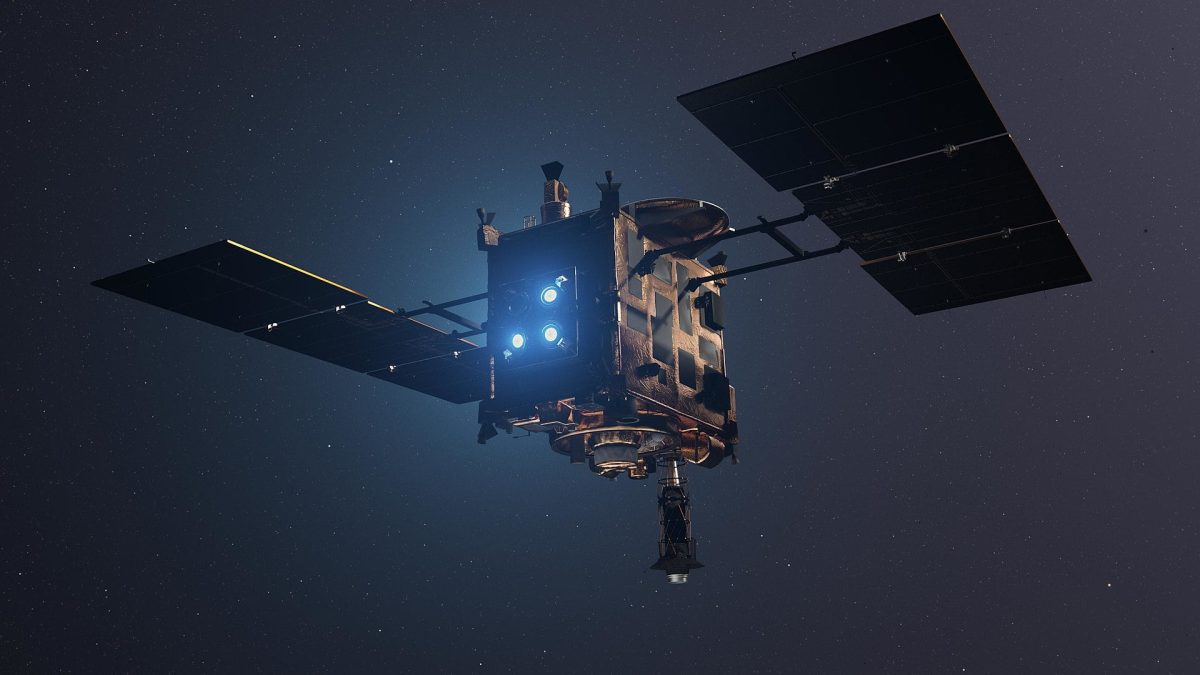
The flyby of asteroid Torifune took place on July 5, 2026. It was the first target of Japan’s extended Hayabusa2 mission, according to JAXA.
The reflected beam was detected twice, one second apart, approximately four seconds before closest approach. At those moments, the distance to the asteroid was about 20 and 15 km.
The LIDAR laser rangefinder emitted one pulse per second, starting four minutes before closest approach. Calculations showed that the beam would be able to strike the surface for less than two seconds during that interval.
The spacecraft passed the asteroid at a speed of about 5 km/s, while the minimum distance to the body’s center was approximately 744 m.
A Narrow Beam at Great Distance
The beam is very tightly focused, so it illuminates only a tiny area of the surface. From 20 km away, the illuminated spot was about 30 m in diameter; from 15 km, it shrank to 23 m.
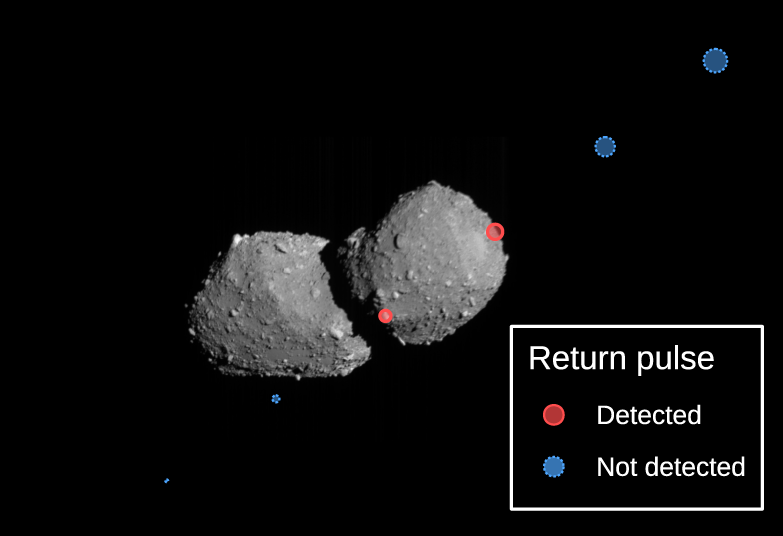
The specified range of this altimeter is 25 km, so the first successful hit occurred almost at the upper limit of an instrument designed for slow measurements near Ryugu. The team is now determining the exact point on the surface where the signal struck.
Why Measure Distance with a Laser
There are no dense gases in space, so distant objects do not lose sharpness the way they do in Earth’s atmosphere. At the same time, there is no reference point for comparison, and from images alone it is difficult to distinguish a large distant body from a small nearby one.
Range measurements add scale to images, allowing the size of an object to be determined with high accuracy, according to Universe Today.
If several such measurements are made and combined with spacecraft-tracking data, scientists can calculate the body’s position and velocity and thereby improve predictions of its orbit.
Benefits for Planetary Defense
Reliable orbits of near-Earth asteroids are necessary for assessing the risk of collision with Earth. This is where laser ranging provides the kind of information that photographs alone cannot.
A laser can obtain data regardless of illumination, including in areas that remain completely dark in images. With more powerful equipment, flybys along trajectories with poor viewing conditions will become possible, while still allowing scientists to determine the body’s shape and motion.
