

The weather on a brown dwarf 20 light-years from Earth turned out to be surprisingly orderly. Behind all the variability in its atmosphere are just two main processes: temperature changes and the vertical structure of the cloud layer. Scientists were able to work this out thanks to a statistical method that identifies the main patterns directly in James Webb data, without requiring complex assumptions about the structure of the atmosphere itself.
Three Weather States
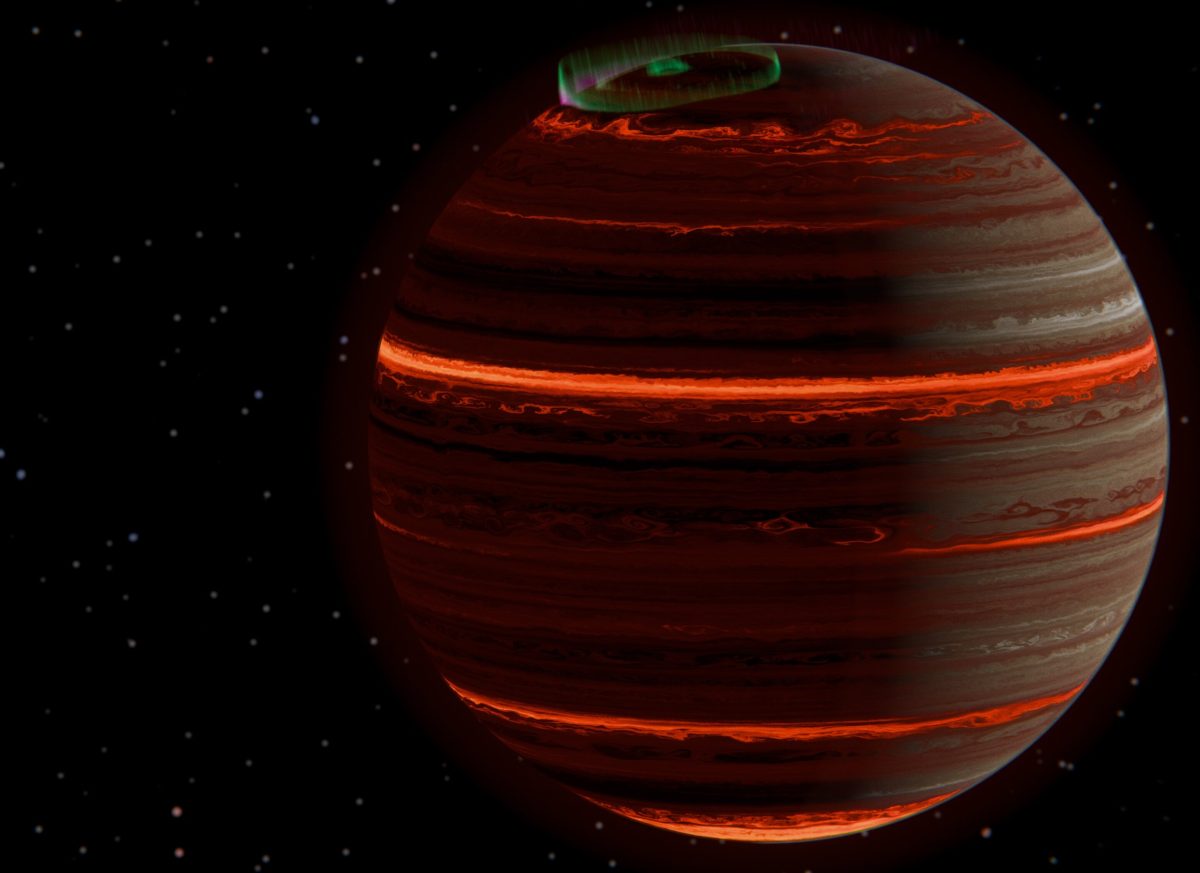
The object known as SIMP 0136 has been known to astronomers for a long time. Its light takes two decades to reach us, a distance of about 189 trillion kilometers. As it rotates, its brightness changes only slightly, and these variations consist of just three repeating states. Some regions are hotter and covered by a thinner cloud layer, while others are cooler and have thick, vertically developed clouds.
This pattern persists for a long time. The drivers of the weather changes remain the same over more than a dozen rotations, even though the detailed appearance of the cloud cover changes during that period. This was pointed out by the study’s first author, Merle Schrader, a PhD student at the School of Physics at Trinity College Dublin. The data were collected with James Webb back in 2023, as reported by Phys.org.
Principal Component Analysis
Previously, interpreting such data required relying on complex assumptions about atmospheric structure. The Irish team took a different approach. The astronomers used principal component analysis (PCA), a statistical procedure that identifies changes in a dataset that occur in a coordinated way.
Using this approach, genuine atmospheric signals could be separated from small fluctuations and noise. The vast majority of the variability was explained by only two components. These correspond to temperature and cloud altitude. The results were published in the peer-reviewed journal Astronomy & Astrophysics.
The signal from such a distant object is extremely faint. Detecting it was possible only because of the exceptional sensitivity of the James Webb instruments, since the entire atmosphere is available for study as a single point stretched out into a spectrum.
Between a Planet and a Star
Brown dwarfs are larger and hotter than gas giants, but they do not have enough mass to sustain the hydrogen burning that powers stars. The atmosphere of SIMP 0136 is filled with enormous cloud systems that reorganize rapidly. In terms of weather, it is closer to an extreme version of Jupiter than to anything Earth-like.
This object is often classified among planetary-mass bodies because it lies near the boundary of about 13 Jupiter masses. Below that threshold, even deuterium burning cannot begin in the interior. In terms of temperature and cloud cover, such worlds are indeed not very different from young giant planets that are directly imaged around other stars.
A Laboratory for Giant-Planet Atmospheres
Most exoplanets are lost in the glare of their host stars, so their gaseous envelopes are studied indirectly. Brown dwarfs do not face this obstacle, because many of them drift through space alone without a bright nearby companion. In their origin they resemble stars, while in temperature and atmospheric composition they resemble gas giants. Scientists use them to test ideas about cloud formation, circulation, and heat transport under extreme conditions.
Johanna Vos, an associate professor at the School of Physics at the same university, expects the approach to become a quick first step before resource-intensive modeling. The team now plans to apply it to other brown dwarfs and giant planets that have been studied in much less detail. Determining whether the weather on other isolated worlds is similarly orderly will be a task for the next generation of observing programs.
