

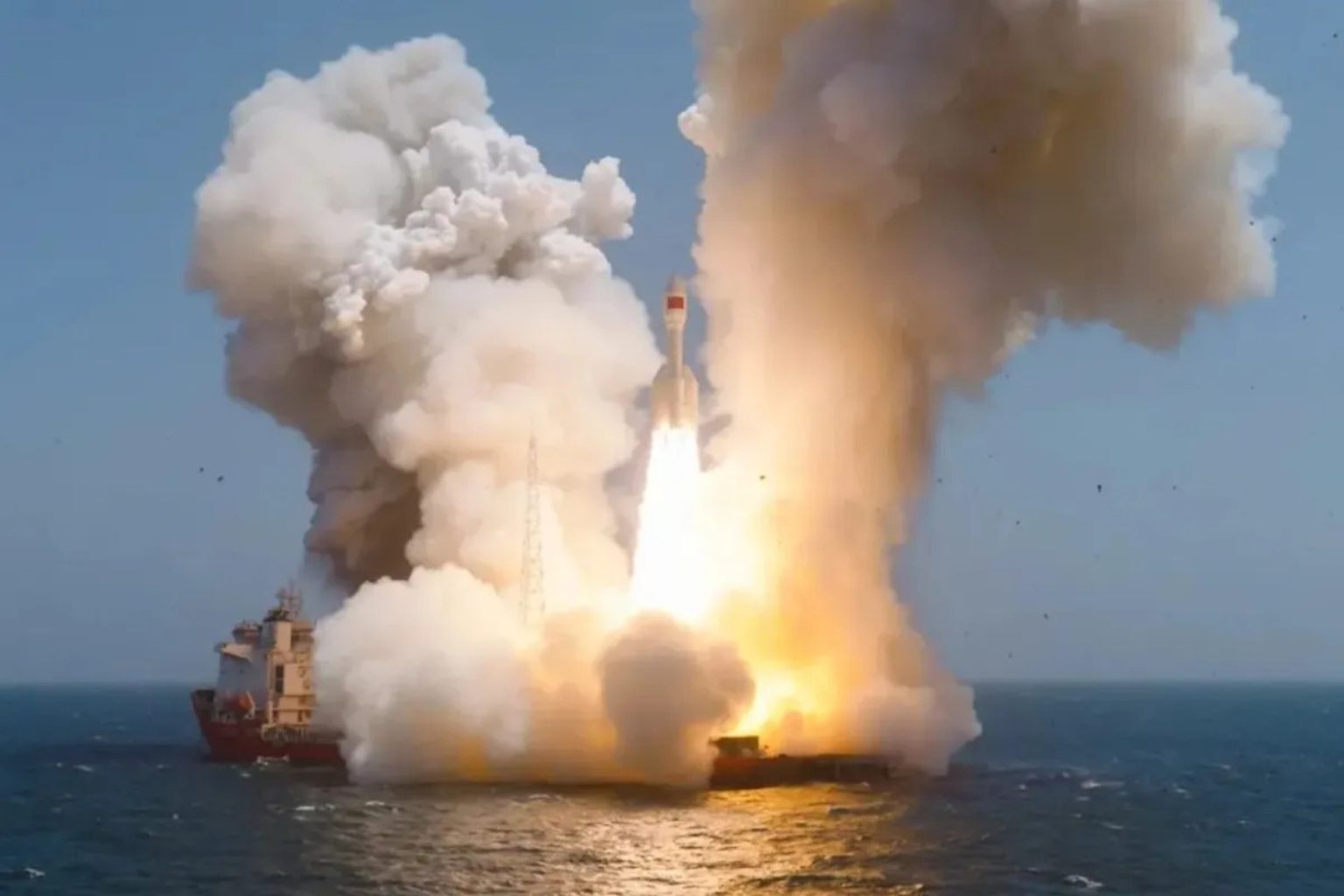
A rocket launch from a vessel at sea near Shanghai placed a group of satellites into orbit. One of them is the first in China’s space program to process images directly on board instead of transmitting them to Earth in raw form. The sea launch also confirmed that such a rocket can remain on standby aboard a vessel for an extended period.
A Record Among Solid-Fuel Rockets
Orienspace’s Gravity-1 rocket was launched from a mobile vessel in the East China Sea near Shanghai. The launch vehicle is 30 meters tall, weighs 405 tons, and produces 600 tons of thrust at liftoff. Among rockets powered exclusively by solid-fuel engines, none in the world is more powerful, and this flight marked the model’s third successful orbital launch.
Nine spacecraft were placed into their designated low-Earth orbits. Six of them belong to the Dongpo series and carry optical cameras and synthetic-aperture radars for regional mapping and emergency response. The remaining payloads consisted of two Earth remote-sensing satellites and the Lilac-3 demonstration platform.
The launch was coordinated by the Oriental Aerospace Port and the Taiyuan Satellite Launch Center. Both organizations are responsible for preparing the launch vehicle and ensuring the safety of the launch area in the open sea.
Image Processing in Orbit
The Xiguang-2 01 spacecraft became the first Chinese satellite equipped with onboard artificial intelligence capable of analyzing space images during flight, according to Asia Times. Processed data can be delivered to users almost in real time.
Carrying out calculations directly in space removes dependence on ground-based centers. Normally, raw material must be transmitted to Earth, processed, and only then distributed to end users, which can take hours. Images taken several hours earlier are of little use against moving objects such as ships or aircraft, so traditional orbital imaging is primarily suitable for stationary targets.
What a Mobile Platform Provides
Sea-based platforms offer several advantages over fixed spaceports. They do not require waiting for access to busy ground launch sites, and the launch trajectory can be selected to reduce fuel consumption. This increases the payload mass that can be carried on each flight.
The latest mission confirmed another point. Solid fuel can withstand long-term storage aboard a vessel under open-sea conditions, allowing the launch vehicle to remain ready for launch for months. For the rapid replenishment of satellite constellations, this is more important than the rocket’s power alone.
At the same time, this very design places limits on such plans. Solid-fuel engines cannot be shut down or adjusted after ignition, so Gravity-1 is fundamentally unsuitable for recovering its first stage. China is testing reusability on entirely different rockets, including the liquid-fueled Long March 10B.
Lagging Behind in Numbers
Despite its technical achievements, China remains far behind in the number of spacecraft in orbit. Simon Gwozdz cites data showing that the United States operates 78% of all satellites, while China accounts for only 8%. In low-Earth orbit, the contrast is even sharper—86% versus 4%.
Part of the gap is explained by Washington’s reliance on commercial launch-service providers. Chinese launches are still carried out mainly by state organizations. Increasing satellite production is considerably easier than expanding launch capacity, which is constrained by geographical limitations, the need to manage airspace, and a shortage of suitable launch sites.
A Bet on the Orbital Economy
The American advantage also has a vulnerable point. Andy Young notes that satellite launches in the United States are too heavily dependent on SpaceX. Over time, the reliance of a critical national capability on a single company could become a strategic risk.
Meanwhile, China is developing several state-backed satellite constellation projects, including Xingwang and Qianfan, while also supporting private companies working on reusable launch vehicles. Once they master stage recovery, the deployment of low-orbit networks may accelerate significantly.
According to Ahmad Hanan, the outcome of the competition will be determined not by high-profile crewed missions such as the first human flight to Mars, but by the ability to maintain the largest network of spacecraft at the lowest cost while controlling digital services and data transmission.
