

The largest simulation to date of the early Universe to account simultaneously for gas, dark matter, and radiation recreates the era when the first galaxies emerged. It was developed to test whether astronomers are correctly interpreting images of the earliest objects. The calculations show how radiation from these galaxies transformed the gas between them. For the first time at this scale, they reveal changes in both hydrogen and helium.
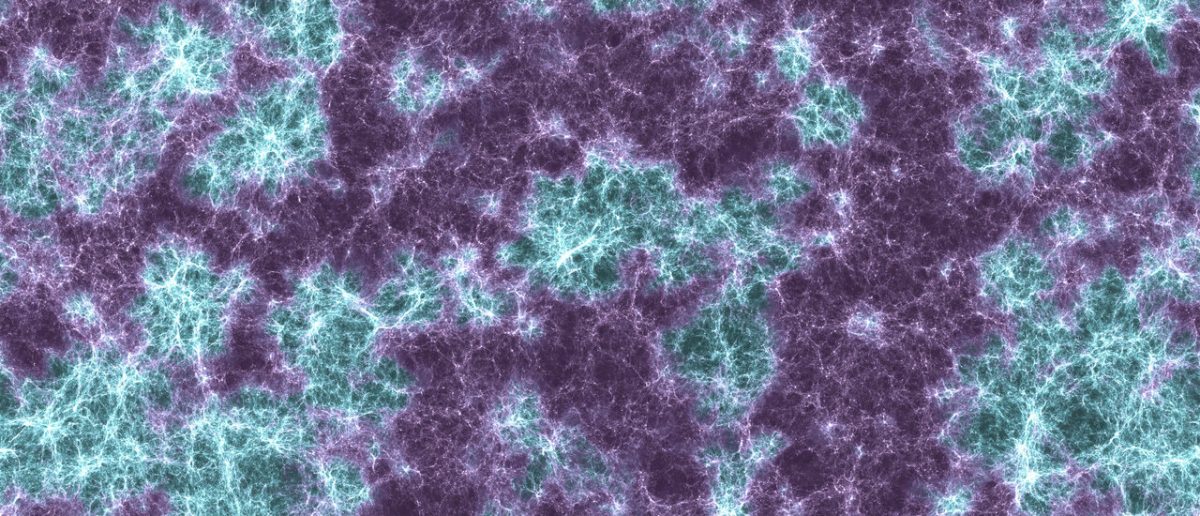
One and a Half Billion Light-Years
The Lumina simulation was developed at the Center for Astrophysics | Harvard & Smithsonian. It recreates a cube-shaped region approximately 1.5 billion light-years on each side. That is 600 times the distance to the Andromeda Galaxy, which lies approximately 2.5 million light-years away. Previous simulations of this kind covered volumes at least 100 times smaller.
A few hundred thousand years after the Big Bang, protons and electrons first combined into atoms, filling the Universe with neutral gas, mostly hydrogen and helium. When the first stars and galaxies began to shine, their ultraviolet radiation started stripping electrons from atoms again. The gas became ionized and heated up. This is why the process is called reionization.
Recreating it is difficult because a simulation must cover an enormous portion of the Universe while resolving individual galaxies that emit ultraviolet light. This required more than 15,000 graphics processors on Frontier, one of the world’s fastest supercomputers, at Oak Ridge National Laboratory. According to Phys.org, the simulated volume is comparable to regions observable with today’s most powerful telescopes.
Helium’s Later Reionization
Hydrogen and helium underwent reionization at different times. Why did helium’s occur later? Helium lost its first electron alongside hydrogen, but its second electron is held much more tightly. Removing hydrogen’s sole electron requires 13.6 electron volts, whereas stripping helium’s second electron requires 54.4 electron volts—four times as much. Such high-energy radiation comes primarily from quasars, the bright nuclei of galaxies containing supermassive black holes. Helium reionization therefore ended approximately a billion years after hydrogen reionization.
Lumina is the first simulation to recreate helium reionization as it unfolded, with changes in the gas immediately affecting the simulated Universe’s subsequent evolution. Heated gas is harder to compress under gravity, so its condition influences how new galaxies form. Co-author Aaron Smith of the University of Texas at Dallas emphasizes that, for the first time, the transformations of hydrogen and helium have been traced across such an enormous volume while still resolving the individual galaxies and other light sources responsible. The findings were published in the peer-reviewed journal Monthly Notices of the Royal Astronomical Society.
Putting Theories to the Test
The James Webb Space Telescope has allowed astronomers to examine the early Universe in unprecedented detail. Lead author Oliver Zier of the Center for Astrophysics | Harvard & Smithsonian explains that interpreting these images requires translating theories into concrete predictions. This is precisely what the simulation is designed to do. If observations match its calculations, confidence in current ideas grows; discrepancies will reveal where those ideas need to be revised.
The team spent several years developing the model. Lumina will now serve as a platform for further research, beginning with the movement of gas between galaxies and the evolution of regions undergoing intense star formation.
