

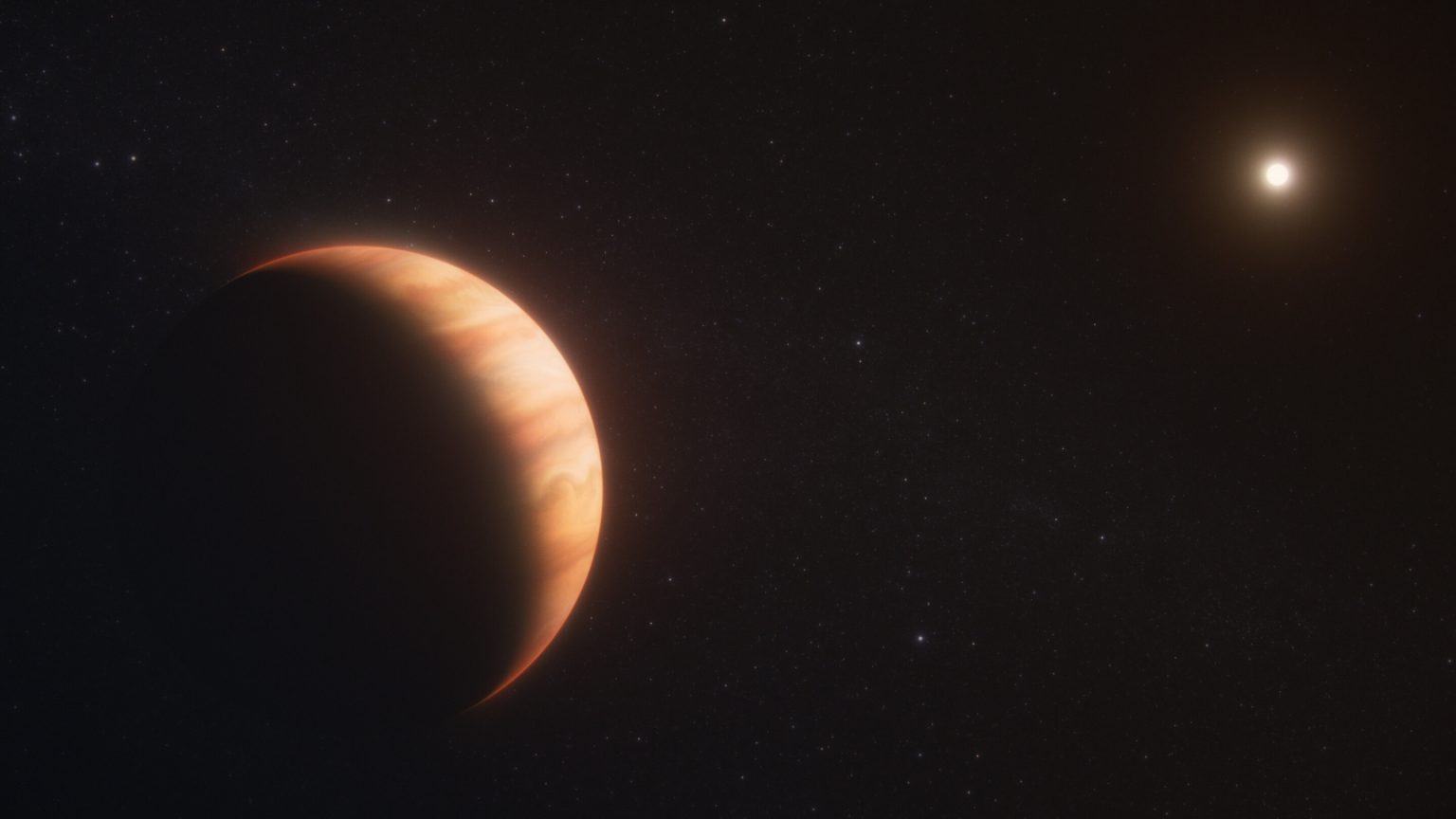
Astronomers have, for the first time, peered into the atmosphere of a planet larger than its own star and reconstructed its incredible journey. The gas giant not only survived the death of its star, but billions of years later also moved into an extremely close orbit around it.
Methane, Haze, and Traces of the Past
A team led by Ryan MacDonald of the University of St Andrews used the James Webb Space Telescope to investigate, for the first time, the chemical composition of the atmosphere of a planet orbiting a dead star, Phys.org reports. The data revealed methane and haze particles. This combination gives the gas giant a color similar to that of Saturn’s moon Titan.
The planet WD1856b remains the only planet orbiting a white dwarf with a detailed atmospheric characterization, since the rest of such systems are known only from transit signals or debris disks without spectral analysis.
A temperature anomaly was also detected. The object is heated to approximately 127 degrees Celsius, which is 240 degrees hotter than can be explained by the radiation of the white dwarf alone. Christopher O’Connor of Northwestern University used cooling models of giant planets to trace the thermal history of WD1856b back in time.
Migration After the Catastrophe
The data point to late migration. The gas giant remained at a safe distance during the destructive red giant phase and moved closer to the star only 3 to 5.5 billion years after it had turned into a white dwarf. Most white dwarfs with planetary material are “polluted” stars, whose atmospheres contain metals from destroyed asteroids rather than surviving giant planets. But WD1856b is a rare exception that opens a direct window into the physics of planetary survival after the death of a star.
The planet’s increased temperature is likely a result of its migration to the white dwarf. “As the planet gradually approached the stellar remnant, tidal interactions with its powerful gravitational field could have caused significant heating,” O’Connor explains. After this migration was complete, WD 1856 b is expected to gradually cool, the researchers calculated. The planet’s approach to the white dwarf was likely due to the gravitational influence of its external companions, since WD 1856 is a triple system.
The Future of Our System
The discovery, published in Nature, makes it possible to look into the distant future of our own planetary system. In about 5 billion years, the Sun will undergo its transformation into a white dwarf, and the fate of the outer planets remains unknown. In 2025, WD1856b was described as the only detected cold Jupiter outside the Solar System, underscoring its uniqueness for studying the atmospheres of giant planets in the late stages of evolution.
“We are used to looking back in time with telescopes, but for the first time we were able to look forward, to what may happen to planets around the remnant of a Sun-like star,” MacDonald noted. The WD1856b system shows that the death of a star does not necessarily mean the end for its planets. Some of them not only survive, but also begin a new, dynamic stage of existence.
