

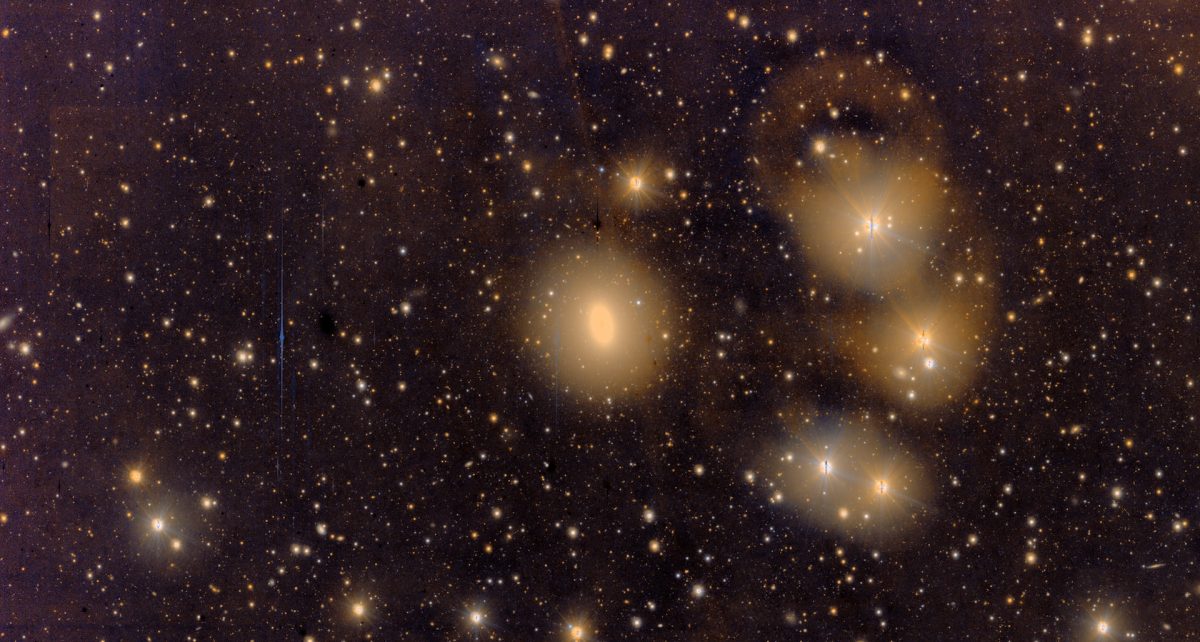
Nearly fifty faint satellites that had never been seen before have been found around three galaxies in the southern sky. Most of them shine so weakly that automated search programs simply fail to detect them. The resulting images of this region are the deepest ever obtained in the optical range. Long-standing discrepancies between theory and observations can now be tested beyond the Milky Way.
Forty-Seven New Objects
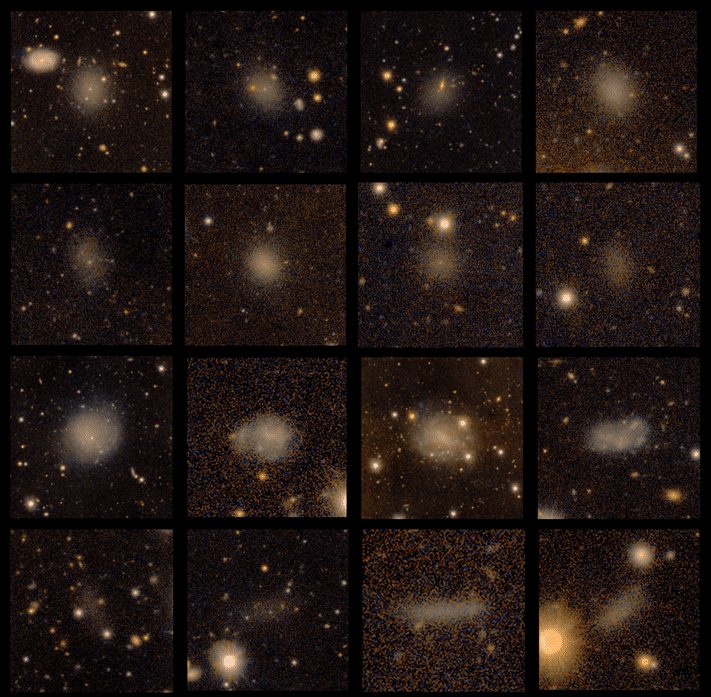
The catalog contains 47 candidates for dwarf galaxies. Only four of them were previously known. The surveyed area of the sky covers about six square degrees, which is roughly twelve times the area of the full Moon in the sky, about 0.2 square degrees. The mass of each detected object is estimated to range from one million to one billion solar masses.
All of them lie near three more massive galaxies. The spiral galaxy NGC 5068 is located 17 million light-years away, the lenticular galaxy NGC 5084 is 80 million light-years away, and the elliptical galaxy NGC 5087 is 100 million light-years away. The work was carried out by an international team led by Italy’s National Institute for Astrophysics, and the results were published in the peer-reviewed journal Astronomy & Astrophysics.
The Debate Over Satellites
Dwarf galaxies are the most numerous galaxies in the Universe, yet they are the hardest to detect because of their low luminosity. They have been at the center of debate for decades because observations do not match the predictions of the standard cosmological model.
At first, it seemed that there were too few satellites in the observational data compared with numerical simulations. Later, the picture shifted in the opposite direction, and some studies even indicated an excess of them. The spatial distribution of dwarf galaxies is also debated, because around the Milky Way they are arranged almost in a single plane perpendicular to the Galactic disk.
There is only one way to understand whether this is a special feature of our Local Group: astronomers need to search for similar satellites much farther away, around other large galaxies.
Searching by Eye Instead of With Algorithms
Automated algorithms miss objects this faint, so the images were inspected manually. Three co-authors did this independently of one another. The light from foreground stars had to be masked, otherwise it would have been impossible to measure the dwarf galaxies’ own emission.
The data were collected with the VST telescope at ESO’s Paranal Observatory in Chile. Using the OmegaCam camera, each of the three fields was observed continuously for more than two hours. The Vera C. Rubin Observatory, which operates in the same country, will reach such depth only after several years.
What proved decisive here was not the size of the mirror, but the exposure time and the width of the field of view. The VST’s primary mirror is about 2.6 meters across, compared with 8.2 meters for the neighboring VLT telescopes, but for objects with low surface brightness, hours of observation of the same region provide more than a large aperture.
What the Brightness Profiles Showed
The brightness of these galaxies decreases from the center toward the edge rather gradually, not as sharply as in massive elliptical galaxies. In terms of profile shape, they are closer to disk systems. Their color also changes with distance from the center, where it is redder, becoming less red toward the outskirts.
The preliminary results are consistent with the monolithic collapse scenario, in which a galaxy forms from a single cloud of gas. Rossella Ragusa, a researcher at Italy’s National Institute for Astrophysics and a co-author of the paper, explained to Media INAF that the deep observations made it possible to map the faintest outer regions of these systems more accurately.
The Final Word Belongs to Spectroscopy
These objects will retain candidate status until spectroscopy provides their distances and velocities. Without such measurements, it is impossible to prove that they are actually orbiting the three large galaxies. In the surroundings of NGC 5084, a distribution resembling the Milky Way’s plane of satellites is already beginning to emerge.
The VST-SMASH survey was designed so that the entire sample would fall within the field of view of the Euclid space telescope. The first public release of its data is expected in a few months. The fate of the current list will largely depend on those observations, after which it will either be confirmed or substantially revised.
