

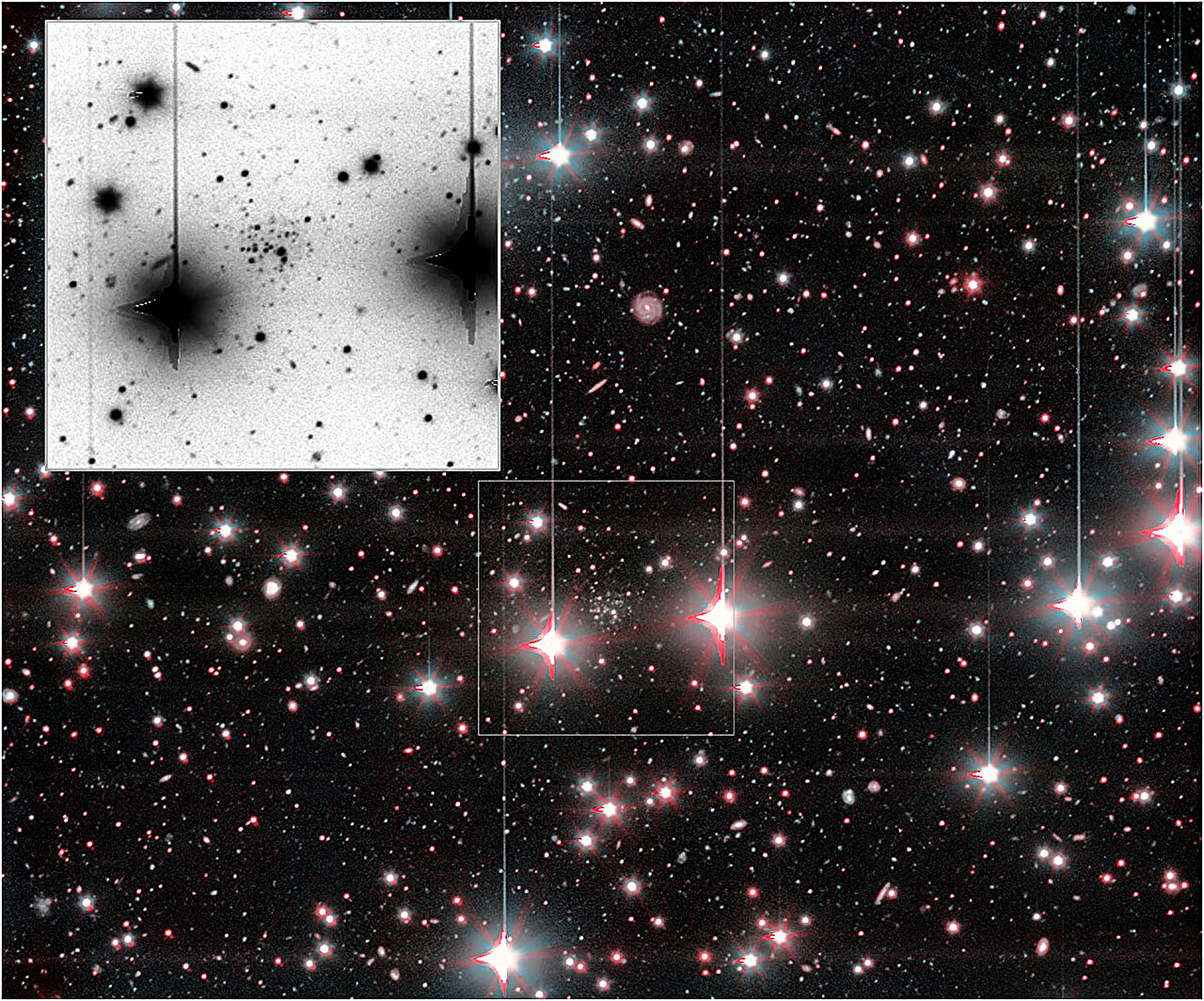
Andromeda XXXVI is an extremely faint dwarf galaxy that was recently discovered near its giant neighbor, the Milky Way. Scientists believe it is a relic from ancient times and that it is 12.5 billion years old.
“Fossils” of the First Galaxies
A new ultra-faint dwarf galaxy has been discovered in the vicinity of Andromeda, also known as M31, the large neighboring galaxy of the Milky Way. A new study published in Astronomy & Astrophysics indicates that the galaxy, named Andromeda XXXVI, is one of the faintest satellite galaxies discovered around Andromeda to date. This was reported by phys.org.
Ultra-faint dwarf galaxies are among the smallest and dimmest known galaxies. Most of them formed during the earliest stages of the universe and are considered as peculiar “fossil” records of the first galaxies. Furthermore, their mass is likely almost entirely determined by dark matter, making them useful for studying galaxy formation in the early Universe and testing dark matter models.
“Our study shows that Andromeda XXXVI is an extremely old galaxy, about 12.5 billion years old, and remarkably poor in heavy elements,” says Joanna Sakowska, a researcher at the Institute of Astrophysics of Andalusia (IAA-CSIC) and the lead author of the study. “However, observations with space telescopes such as Hubble will be needed to determine its distance, age, and chemical composition with greater precision.”
Invisible Satellites Around the Andromeda Galaxy
The Andromeda Galaxy, located approximately 2.5 million light-years from Earth, is the closest giant spiral galaxy to the Milky Way. Like our own galaxy, it is surrounded by numerous dwarf satellite galaxies that orbit under its gravitational influence.
“The discovery of Andromeda XXXVI provides a new perspective on the smallest galaxies in the universe. Within the standard cosmological model, known as the Lambda Cold Dark Matter model (ΛCDM), we expect galaxies like Andromeda to be surrounded by hundreds of such small satellites, yet many of them have remained invisible until now because of their low brightness,” says Isabel Santos-Santos of the Leibniz Institute for Astrophysics Potsdam (AIP), a co-author of the study. “Each newly discovered ultra-faint dwarf galaxy helps us explore the limits of galaxy formation and test our cosmological models in practice.”
At present, we know of approximately 40 dwarf satellite galaxies around Andromeda, of which only about 15 are classified as ultra-faint. Each new discovery, such as Andromeda XXXVI, is important because it suggests that we may be seeing only the tip of the iceberg of a much larger population of extremely dim galaxies.
From Survey Images to Deeper Observation
Andromeda XXXVI was first identified by astrophotographer and amateur astronomer Giuseppe Donatiello while examining images from the Pan-Andromeda Archaeological Survey (PAndAS), conducted using the Canada-France-Hawaii Telescope (CFHT). The object appeared as a faint, diffuse feature in which individual stars could already be distinguished. It was later added to the list of galaxy candidates for further study.
The team obtained Director’s Discretionary Time on the Gran Telescopio Canarias (GTC), where they used the OSIRIS+ instrument to acquire significantly deeper images. These observations allowed them to distinguish individual stars within the galaxy’s faint, diffuse light. However, Andromeda XXXVI proved to be an extremely dim object: the research team was able to detect only about 46 stars associated with it.
