

The use of long-term observational data has made it possible to identify the hidden “companion” of a well-known nebula. This discovery is of crucial importance for astrophysics because it provides an opportunity to study in practice the processes of evolution and death in massive multiple-star systems.
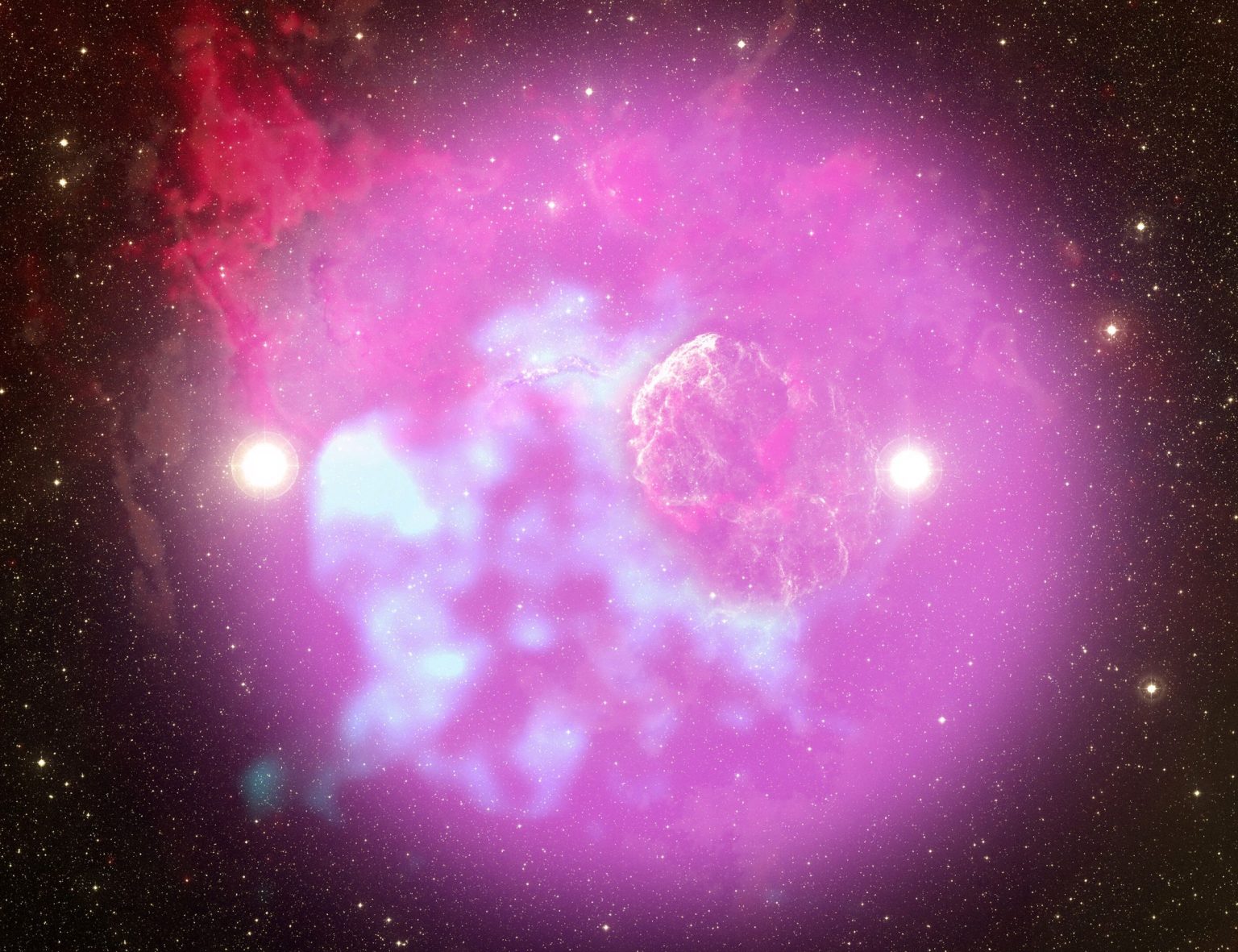
The vast majority of massive stars destined to end their existence in spectacular supernova explosions are members of binary or even multiple-star systems. Despite this fact, astronomers had never previously succeeded in finding a pair of supernova remnants that belonged to the same such system. According to a new study published in Nature Communications, one of the most extensively studied supernova remnants in our Galaxy had been concealing its companion all this time.
The object in question is IC 443. By analyzing a dataset collected over 16 years by the Fermi space telescope, scientists detected another supernova remnant, G189.6+3.3, hidden behind its bright emission. The researchers suggest that these two objects are, in a sense, the “ghosts” of a former binary star pair.
Lifting the Veil: How G189.6+3.3 Was Found
The IC 443 nebula is located in the constellation Gemini, approximately 6,000 light-years from Earth. It is an extremely complex region of space, where the supernova remnant lies next to a giant cloud of ionized gas and other astronomical structures. Because of the region’s high brightness and crowded environment, detecting other objects there was exceptionally difficult.
The first indications that another remnant might exist appeared in 1994 during an X-ray sky survey conducted by the ROSAT project. However, its nature has only now been conclusively confirmed. Since 2008, the Fermi telescope has scanned the sky every three hours, recording gamma radiation. The volume of data accumulated over more than a decade allowed scientists to filter out background noise and confidently isolate the signal from G189.6+3.3, proving that it is an independent gamma-ray source.
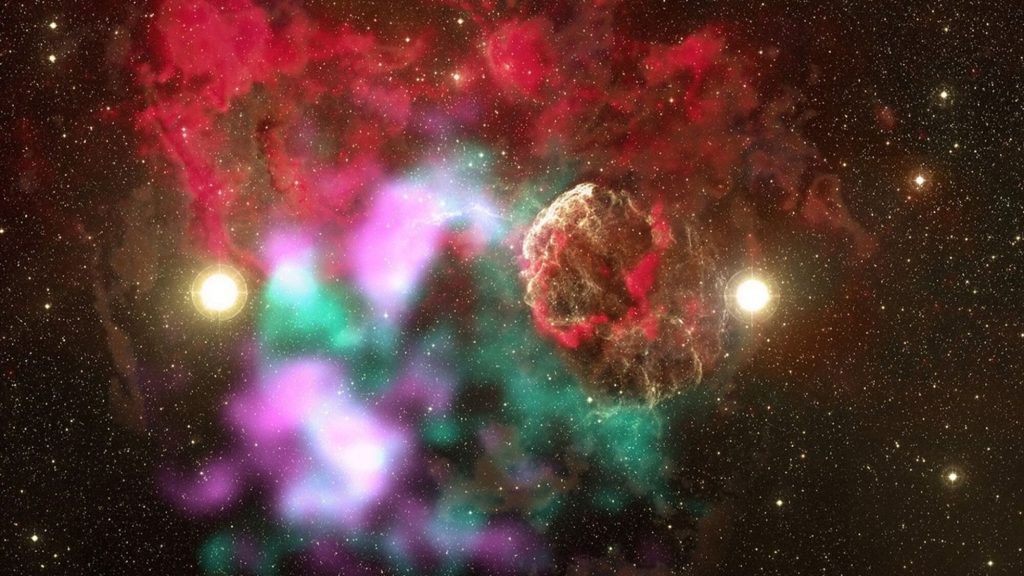
To confirm that the find is indeed a supernova remnant, astrophysicists needed to record the process of particle acceleration. The explosion of a massive star generates a powerful shock wave that rapidly propagates through interstellar space. Like circles on the surface of water after a drop falls, it expands in all directions. Moving at a speed of thousands of kilometers per second, such a wave accelerates protons and electrons to extremely high energies.
Detailed analysis of the gamma-ray emission revealed that G189.6+3.3 is indeed the source of such particle acceleration, providing strong evidence that the object is a supernova remnant—a gaseous shell that continues to expand after a star explodes.
Cosmic Neighbors or Family Ties?
The most interesting result was the spectral analysis of gamma-rays. It showed that different mechanisms of its formation dominate in different parts of G189.6+3.3. In particular, gamma rays generated by high-energy protons come from the region where the shock wave of the supernova remnant collides with the same giant molecular cloud with which IC 443 interacts.
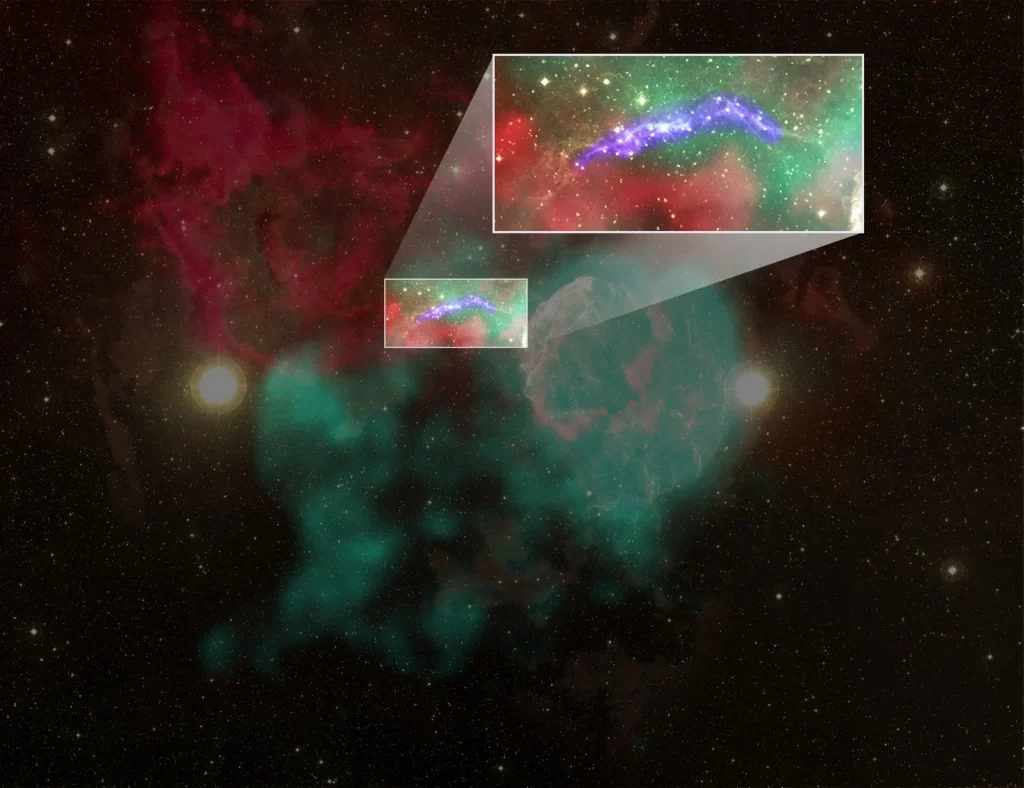
This indicates that both remnants are located in the same region and at the same distance from Earth. According to Miltiadis Michailidis, a physicist at Stanford University and lead author of the study, there remains a very small possibility that two entirely unrelated stars merely happened to overlap in space. However, statistical analysis showed that the probability of such a coincidence is only 1 in 1,000. Therefore, the objects were almost certainly once companions in a binary system.
Why This Matters for Science
The first-ever discovery of a potential binary supernova system is more than an interesting fact; it is a powerful tool for modern astrophysics. Scientists now have an actual observable model for studying the final stages in the lives of massive stars.
Thanks to this discovery, researchers will be able to calculate the interval between the two stellar explosions more accurately and understand the mechanisms through which binary systems either survive or are completely disrupted after the deaths of their companion stars. As Michailidis emphasized, the existence of such an object makes it possible to perform measurements and establish constraints that were previously considered entirely impossible.
Earlier, we reported on interesting facts about supernovae.
According to Phys
