

A team of researchers has modeled how rocky bodies break apart in debris disks around white dwarfs. They concluded that these asteroids do not disintegrate into dust immediately, but instead undergo a delay that can last a very long time.
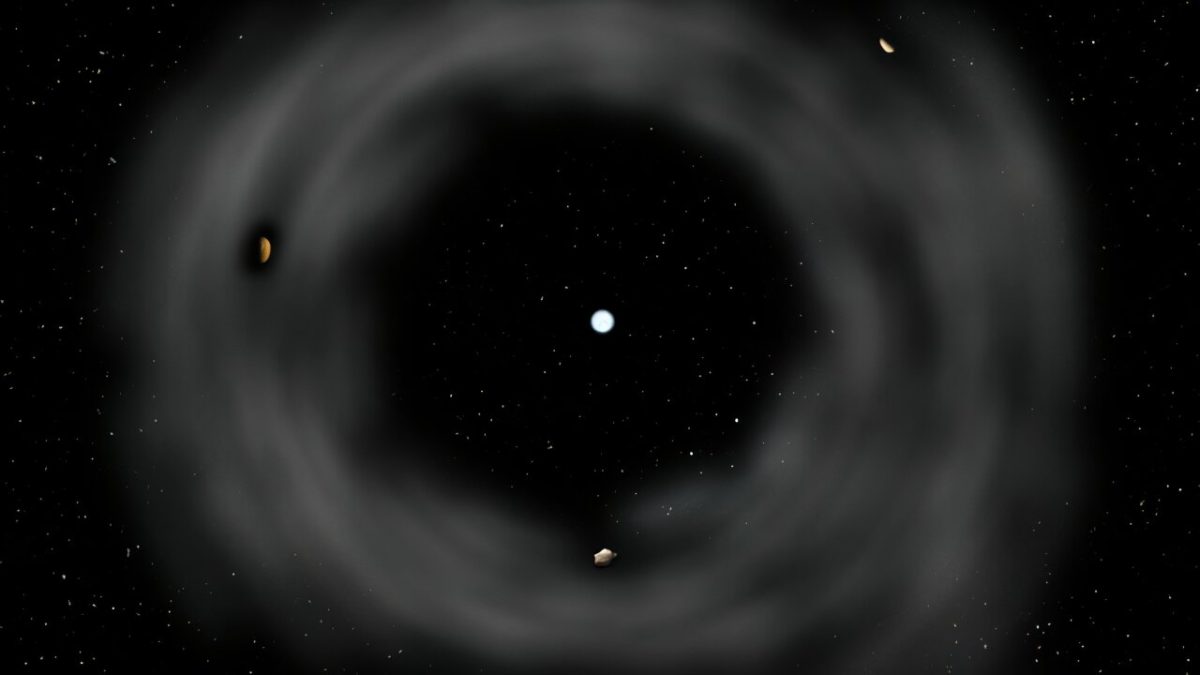
Asteroids Near White Dwarfs
Astronomers from the Planetary Science Institute and the University of Warwick have investigated what happens inside debris disks around white dwarfs. They focused on the processes that lead to the complete destruction of large bodies within them. These processes were previously thought to be extremely intense, but scientists have now begun to question that assumption, according to phys.org.
The study, published in The Astrophysical Journal Letters, notes that scientists have long known that disks containing various fragments orbit white dwarfs. These are mostly remnants of the planetary systems of these dead stars, having survived the red giant phase and the shedding of the stars’ outer layers.
Given this history, researchers expected all these bodies to have a “rubble pile” structure, meaning their components were not firmly bound together and would therefore turn into dust immediately under any mechanical disturbance. Like fine snow, that dust would gradually settle onto the dead star’s surface.
The Kilometer Barrier
However, the researchers point out that previous studies overlooked the fact that interactions between fragments in a rubble pile cannot be zero. At the very least, atomic forces always act to hold the particles together. As a result, most fragments remain between 0.1 millimeters and 1 kilometer in size and do not readily break down further. Moreover, radiation from the star strongly slows the particles, forcing them to follow spiraling paths.
Consequently, they should form fairly dense rings around the white dwarf without rapidly disintegrating completely or falling onto it. In practice, this means that bodies reaching a kilometer in size can continue orbiting the star in this state for a long time.
The existence of such dense belts containing large asteroids fits poorly with older models but agrees very well with the latest observations, particularly the discovery of two belts around J1328−1450. White dwarfs may therefore lead very interesting lives indeed.
