

Most black holes in our Galaxy have yet to be detected because they emit no light. Now, volunteers with no formal astronomy training are being invited to help search for some of them. Using artificial intelligence, British astronomers have selected the most promising data from a space telescope and sent it for manual review. Participants need to spot weak, recurring increases in a star’s brightness that occur when an invisible black hole orbiting it passes in front of the star.
Only a Few Dozen Are Known
According to models of stellar evolution, there should be hundreds of millions of black holes in the Galaxy. Astronomers know the locations of only about 70 of them, according to Universe Today.
The reason is that light cannot escape a black hole. X-ray and radio emissions appear only when matter from a neighboring star or planet falls into it. An isolated black hole is effectively invisible to conventional observation methods.
The nearest known “quiet” black holes in binary systems were discovered using data from the European Gaia spacecraft, which was designed to measure the positions and movements of stars. In 2022, this approach revealed Gaia BH1 at a distance of about 1,560 light-years from Earth, and in 2024 Gaia BH3, with a mass of approximately 33 solar masses. Both black holes were detected not through their light, but through the periodic movement of their companion stars across the sky.
Gravity as a Lens
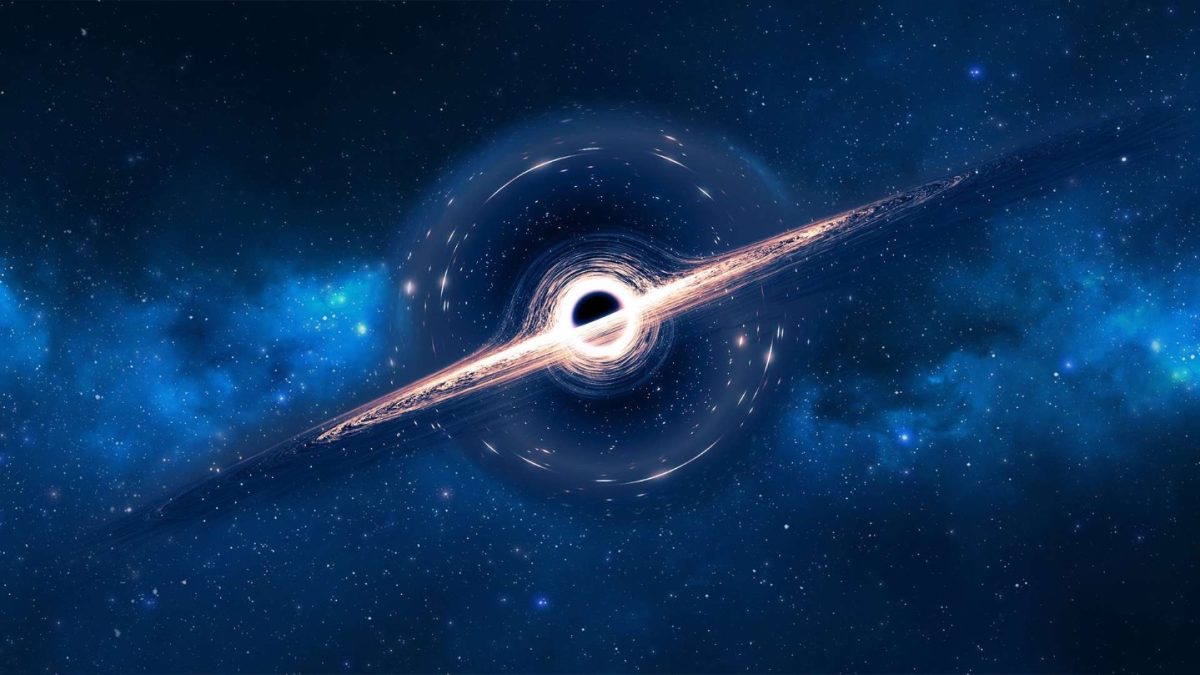
A black hole can be detected through its gravitational influence. According to Albert Einstein’s general theory of relativity, a massive object warps space, causing light from a source behind it to bend. When a black hole passes between Earth and a star, the star briefly appears brighter. This phenomenon is known as microlensing.
Usually, such an alignment happens only once. It is different when a black hole orbits a star without drawing matter from it. In that case, the increase in brightness repeats with every orbit, producing what is known as gravitational self-lensing. This recurring signal is what participants in the Black Hole Hunters project are looking for.
Millions of Light Curves
The project was launched on the Zooniverse platform in 2021. Initially, volunteers reviewed data from the ground-based SuperWASP wide-field survey for planets, but noise and weather-related interruptions significantly reduced its quality. Black Hole Hunters creator and astrophysicist Adam McMaster began the work as a student at the Open University. He later moved to the University of Southampton and redesigned the data-processing system.
The project now relies on observations from NASA’s Transiting Exoplanet Survey Satellite (TESS). Every few minutes, its data produce light curves for hundreds of thousands of stars — graphs showing how their brightness changes over time. Such graphs are used to search for planets that slightly block their host stars as they pass in front of them.
The light curves were divided into “interesting” and “boring” categories using a machine-learning algorithm. According to the University of Southampton, millions of records were reviewed within a few days, a task that would previously have taken years. However, star spots, variable-star pulsations, and glitches in TESS itself can be mistaken for self-lensing, so humans perform the final verification.
Work for Volunteers
No specialized training is required. Grace Clark, a 20-year-old University of Southampton student and project participant, explained that the task essentially involves recognizing patterns in graphs. Before they begin, volunteers are shown examples of the signals they should look for.
According to the project page, about 43% of the work has been completed. Since October 2021, nearly 23,000 volunteers have made almost 12 million classifications. Astronomers plan to examine the stars flagged by volunteers using more powerful telescopes. Adam McMaster estimates that there could be thousands of new discoveries.