

For several years, scientists have understood that Mars is not entirely geologically inactive. Seismometers operating on its surface have detected numerous marsquakes. However, it has since emerged that these events were also recorded by spacecraft that operated on the planet’s surface much earlier, including Viking 2.
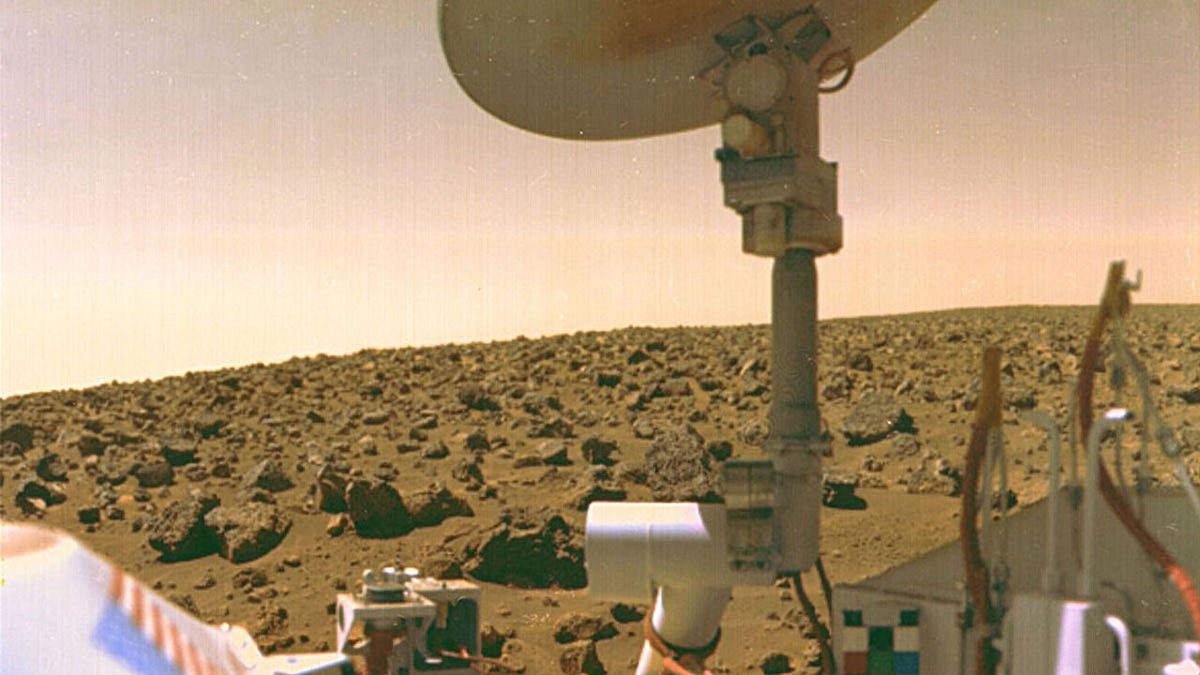
A possible Marsquake recorded 50 years ago
Earthquakes and the seismic waves they generate provide valuable insights into Earth’s internal structure. To extend this approach to other planets, scientists installed seismometers during the Apollo missions to the Moon and aboard the Viking landers, which reached Mars in 1976. Although the Apollo sensors proved highly successful, the results from Mars were less conclusive: the Viking 1 seismometer failed to deploy properly, while Viking 2 recorded only two ambiguous events.
According to the website phys.org, a group of scientists led by Wanbo Xiao reviewed these events and compared them with data collected by NASA’s InSight lander, which studied Mars’s internal structure through seismic surveys, geodesy, and heat-transfer measurements and operated on the planet’s surface from 2018 to 2022. The authors demonstrated that one event recorded by Viking 2 may have been a genuine marsquake, occurring in the same region where InSight recorded nearly 1,000 marsquakes decades later. The findings were published in the journal AGU Advances.
However, because the Viking 2 seismometer was mounted on the lander’s deck, it was susceptible to substantial wind noise. It remains unclear whether the two questionable events it recorded were genuine marsquakes or merely wind noise.
A study of seismic activity on Mars
The InSight seismometer, positioned directly on the surface, subsequently detected more than 1,300 seismic events. A new study suggests that one of the Viking events may, in fact, have been a marsquake originating in the same region where InSight later recorded nearly 1,000 marsquakes, indicating that this region was seismically active both during the Viking era and nearly 50 years later.
The Viking mission was primarily intended to search for life on Mars; however, this objective is closely connected to the planet’s geological evolution. Seismology can provide insights into Mars’s internal structure and tectonic activity, enabling scientists to reconstruct the history that shaped the planet’s habitability.
