

Magnetars are a special type of neutron star with the most powerful magnetic fields in the Universe. Scientists recently suggested that these objects could form when two ordinary, ultradense remnants of supernova explosions merge.
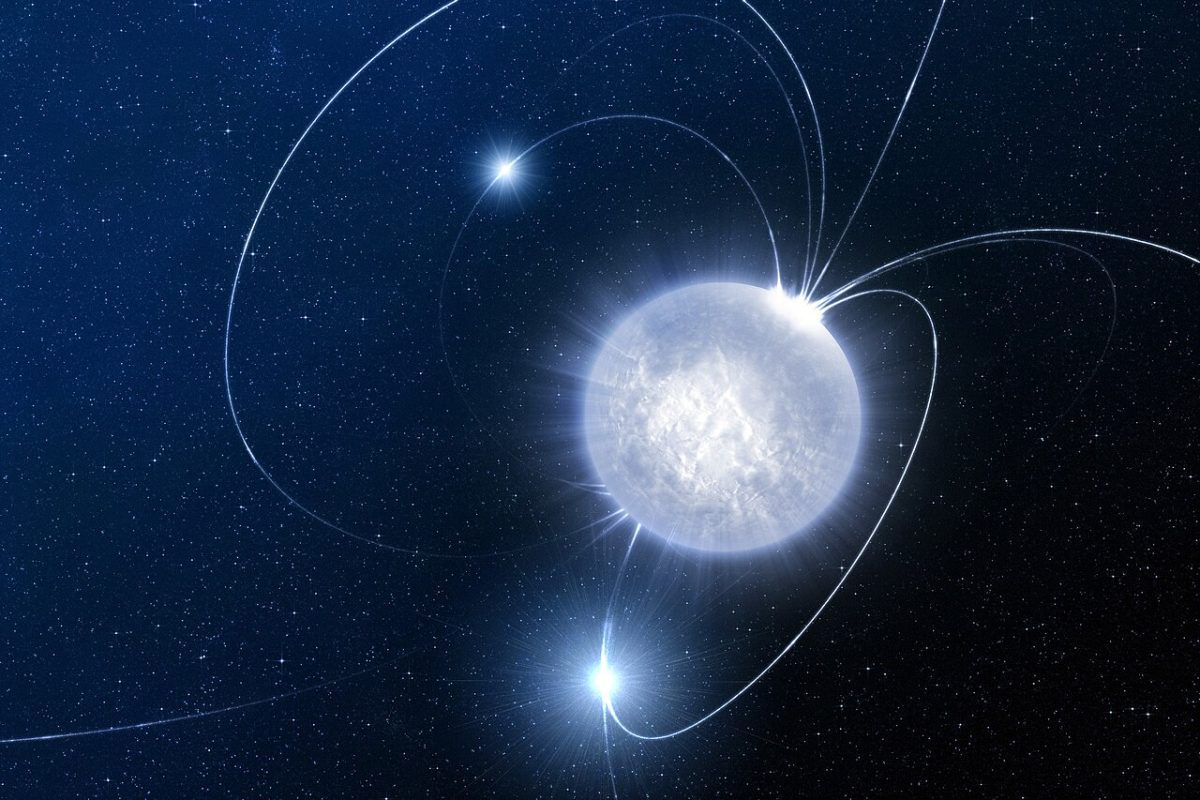
The Most Mysterious Neutron Stars
According to phys.org, Japanese scientists have proposed an intriguing explanation for how magnetars may be born. These are a special type of neutron star, accounting for approximately 1% of the total population. They possess the most powerful magnetic fields in the Universe, typically 1,000 times stronger than… [sentence incomplete in the original]
Magnetars have long fascinated scientists because many mysterious radio transients—short-lived events or bursts—may be associated with them. These include fast radio bursts, among the most powerful phenomena in the Universe, whose energy travels for billions of years before reaching us.
A paper exploring how magnetars form has already appeared on the arXiv preprint server. Its authors proposed that magnetars could result from the merger of two ordinary neutron stars. They decided to test this hypothesis using Japan’s FUGAKU supercomputer.
How Magnetars Form
In general, theory suggests that when two neutron stars merge, the result should be a black hole. This follows, at least, from the expectation that the resulting object would exceed the Tolman–Oppenheimer–Volkoff limit of 2.6 solar masses. However, this applies only if we assume that all neutron stars are heavier than another threshold: the Chandrasekhar limit of 1.4 solar masses.
The Chandrasekhar limit, however, is simply the maximum mass a supernova remnant can have while remaining a white dwarf. In practice, a substantial proportion of neutron stars are lighter than this. Consequently, when they merge, the resulting object may remain a neutron star. The hypothesis is that it would be a magnetar.
Computer simulations fully support this theory. They showed that within just a few milliseconds of the two stars making contact, a Kelvin–Helmholtz instability develops in the neutron matter. In physical terms, this means that the flow of matter becomes turbulent. We encounter this phenomenon in everyday life as well: if you carefully extinguish a candle, a smooth stream of smoke initially rises from the wick, but it then begins to swirl and becomes chaotic. The instability occurs at this transition.
The Instability That Creates Magnetars
A distinctive feature of the Kelvin–Helmholtz instability is its ability to cause extremely intense mixing of matter. In the simulations, neutron matter mixes so thoroughly and rapidly that the magnetic field becomes significantly stronger. The mixing spreads through the remaining material, carrying the magnetic field along with it. As a result, the merged neutron star’s magnetic field can become more than 300 times stronger than the original fields.
This is already very close to the strengths observed in magnetars. The magnetic field may well continue to grow stronger. However, FUGAKU’s capabilities are not yet sufficient to determine whether this happens, so the scientists are continuing their research.
