

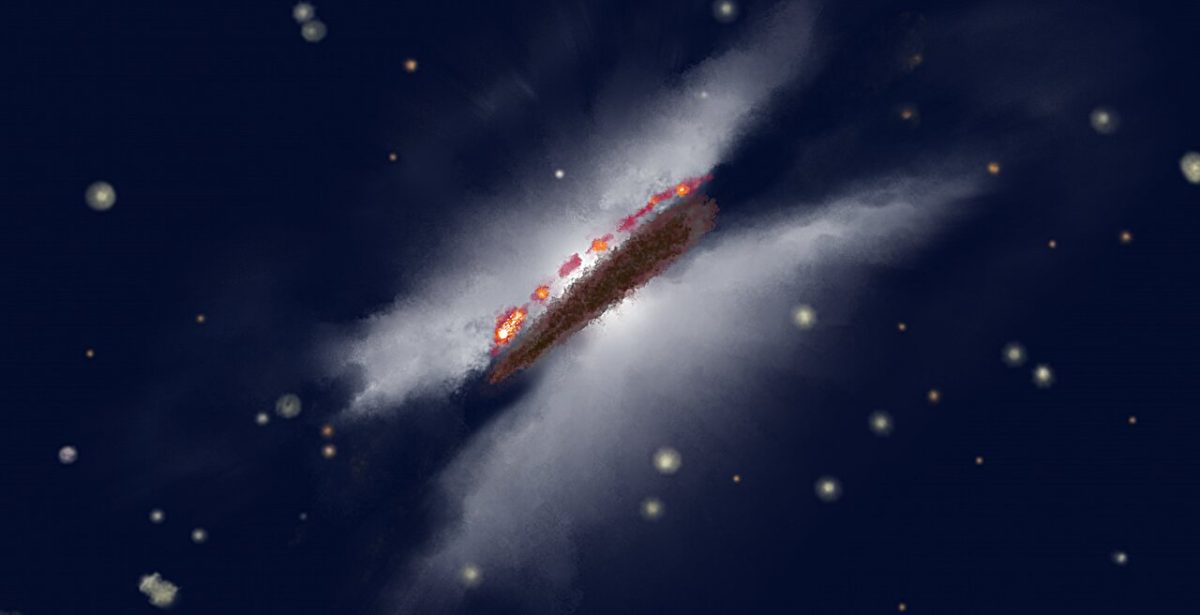
Astronomers have spotted signs that a gas giant may be forming in the protoplanetary disk around a young star. The disk is viewed almost edge-on, so its layers of gas and dust appear stacked like a hamburger. The clue was a narrow arc of sulfur monoxide glowing on only one side. This chemical signature may be caused by localized heating near a dense clump of material.
A Giant Disk
The system is called Gomez’s Hamburger, or GoHam for short. Gas in its disk extends approximately 900 astronomical units from the star—30 times farther than Neptune’s orbit, which lies 30 AU from the Sun. Above and below the midplane, it reaches heights of up to 350 AU.
The disk contains at least 180 Earth masses of dust, five times the average for disks around similar stars. The star itself is 2.2 times more massive than the Sun. Its distance has been refined using three-dimensional maps of interstellar dust and is now estimated at approximately 450 light-years. Previously, the star was thought to lie almost twice as far away, at roughly 815 light-years.
Layers of Gas and Dust
Most protoplanetary disks are viewed at moderate inclinations, causing their layers to overlap in images. GoHam’s disk has an inclination of approximately 85 degrees, allowing astronomers to observe its vertical structure almost directly from the side. According to study leader Charles Law of the University of Minnesota, this makes the system a benchmark for testing models of planet formation.
The observations were conducted using the Atacama Large Millimeter/submillimeter Array (ALMA), reports Phys.org. Emission from ordinary carbon monoxide comes from the highest layers, while a form containing a heavier carbon isotope emits from lower down. Carbon monosulfide glows closest to the midplane. This arrangement is expected. Ordinary carbon monoxide is so abundant that only emission from the upper, more diffuse layers reaches us, while carbon monosulfide emits only in denser gas closer to the disk’s center.
Millimeter-sized dust grains have gathered into a thin layer in the disk’s plane. Large grains gradually settle toward the midplane, while the gas extends far above and below it.
A Sulfur Signature
Sulfur monoxide behaves differently. It forms an arc only on the side facing us, near the edge of the dust layer, although it rotates along with the rest of the gas. The brightest part of the arc lies near GoHam b, a dense gas clump approximately 280 AU from the star. First spotted in 2009, this clump likely has a mass at least several times that of Jupiter.
But why does sulfur glow in only one place? In cold regions of the disk, sulfur compounds become trapped in ice on dust grains. Around the dense clump, gas is compressed and heated, the ice evaporates, and sulfur in the gas forms sulfur monoxide. As the disk’s rotation carries the molecules away from the heat source, they settle back onto dust over a period of roughly 100 to 1,000 years.
The clump itself may have formed when part of the massive disk collapsed under its own gravity. If so, GoHam reveals one of the earliest stages of giant-planet formation in a distant orbit. The paper has been accepted by the peer-reviewed journal The Astrophysical Journal, and a preprint is available on arXiv.
However, the authors do not rule out other explanations. The sulfur could have been released by ultraviolet radiation, which penetrates the edge of the dust layer more easily, or by material falling onto the disk from outside. The new data do not yet establish whether GoHam b is truly a planet in the making.
Open Questions
The dust layer is also asymmetric. Its southern portion extends farther than its northern portion, potentially because of the same clump or an elongated shape of the disk as a whole. The revised distance complicates the picture: a smaller, less massive disk is less likely to fragment under its own gravity, although this scenario remains possible in its distant outer regions.
To the north, diffuse gas moves differently from the rest of the disk, resembling a wind carrying material into space. Such a wind could be driven by radiation from nearby massive stars or by the disk’s own magnetic field. The authors propose distinguishing between these possibilities using the James Webb Space Telescope’s Near-Infrared Spectrograph (NIRSpec) and Mid-Infrared Instrument (MIRI).
