

Astronomers have discovered an exceptionally small core that may represent an early stage in the formation of a massive star. Located in an infrared-dark region known as the Dragon Cloud, the core has been nicknamed the “dragon’s egg.”
A Candidate Prestellar Core for a Massive Star
How giant stars eight times more massive than the Sun form remains a subject of debate within the scientific community. There are two main ideas. The first holds that a dense gas cloud initially condenses into a massive “prestellar” core, which then collapses to form a single giant star. The other suggests that a star grows gradually by drawing material from a larger surrounding clump, according to phys.org.
Researchers believe that directly observing a compact, massive concentration of material at an early stage could help favor one of these explanations. However, such cores are difficult to detect, and when they are found, nearby star formation and stellar activity can complicate their interpretation.
Astronomers observed a promising candidate called C2c1a in the C2c1 region of the infrared dark cloud known as the Dragon Cloud, approximately 16,300 light-years away. Nicknamed the “dragon’s egg,” the core likely contains 20–30 times the Sun’s mass. The surrounding clump of gas and dust is approximately 1,061 times more massive than the Sun but emits little energy for its size. According to the researchers, this indicates a very early stage of massive star formation. Earlier data could not establish whether C2c1a was a single compact object containing most of the mass or whether a protostar had already formed within it.
In this study, a team led by Ashley Thomas Barnes of the European Southern Observatory (ESO) used new observations from the ALMA radio telescope to obtain a detailed image of the “dragon’s egg.” “These data are among the most sensitive ALMA Band 6 observations of objects of this kind and offer some of the highest spatial resolution currently available,” the researchers write in their paper.
The Components of the “Dragon’s Egg”
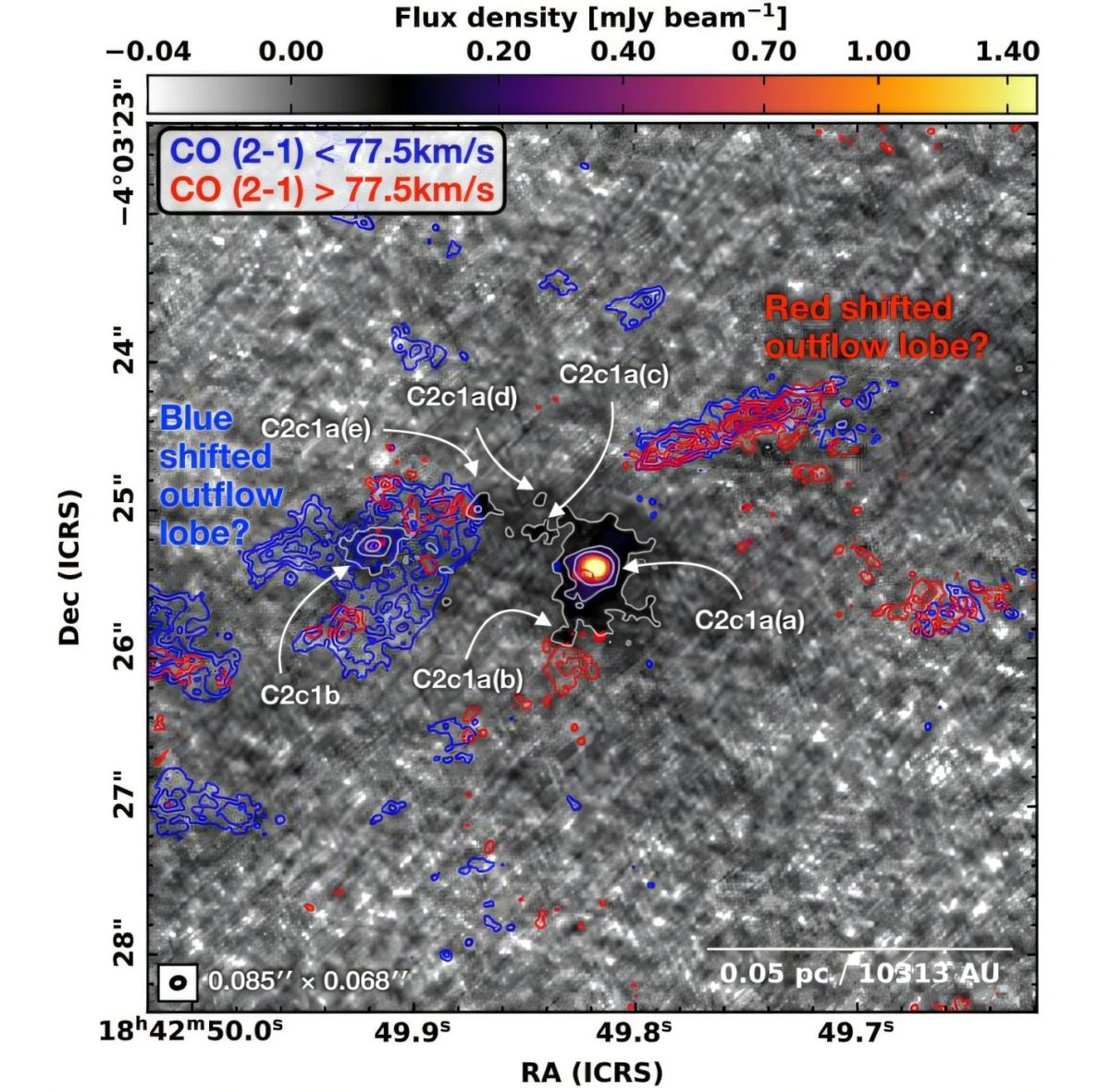
The high-resolution data revealed that the main region itself contains six components: C2c1a(a), C2c1b, and four fainter structures within the intermediate envelope. Emission was dominated by the central component, C2c1a(a), indicating that most of it originates in a centrally concentrated region. The core is embedded in a much larger reservoir of cold gas and dust containing at least approximately 110 solar masses. This could supply the material needed to form a massive star.
Spectral analysis revealed almost no gas emission at the center of C2c1a(a), although some faint, diffuse emission is present. The researchers suggest that this could indicate a relatively low core temperature. However, a large amount of dust may be blocking the light. A weak, deeply embedded, or unfavorably oriented outflow cannot be ruled out, but the available data show no clear signs of an outflow from the compact source.
The Earliest Stages of Formation
The researchers also compared the clump’s luminosity with its mass. A low ratio of less than 1 generally indicates that a clump is young. The parent clump, the Dragon Cloud, has a ratio of approximately 0.5, placing it among young clumps.
The researchers say its properties, even without strong stellar activity, match the initial conditions of monolithic core-accretion models. However, they caution that these observations are insufficient to distinguish this scenario from pathways in which the source continues to gain mass from its surroundings. The dust temperature is not precisely known, leaving the core’s nature uncertain. It could be a cold, high-mass core or a warmer, less massive object within a larger reservoir of cold gas and dust.
The researchers suggest that C2c1a(a) offers a rare opportunity to observe the earliest stages of collapse and mass accumulation in what is likely a cold cloud.
