

In late August, the Main Astronomical Observatory of the National Academy of Sciences of Ukraine convened a scientific school focused on astrophysics and cosmology, entitled “Through the Milky Way into the Universe.” During the event, Polish astrophysicist Agnieszka Pollo delivered a lecture on the evolution of galaxies and elucidated why maps depicting the structure of the universe are constructed using only a minute fraction of its total content.

Agnieszka Pollo, a professor at the Polish National Center for Nuclear Research and Jagiellonian University in Kraków, is the center’s deputy director for scientific research. She founded the astrophysics department there, which is now headed by Katarzyna Małek. Her research focuses on observational cosmology, the statistics of the large-scale structure of the universe, the evolution of galaxies, and astroinformatics.

Agnieszka Pollo oversees the Polish LSST consortium, which is engaged in the development of databases for the Vera Rubin Observatory and the Decadal Survey of the Southern Sky. Ukrainian astronomers will also collaborate with this data, and a partnership between the Main Astronomical Observatory of the National Academy of Sciences of Ukraine and Pollo’s team is already established. In her lecture, she consistently emphasizes that the majority of the work remains to be accomplished and must be carried out in conjunction with Ukrainian colleagues.
0.5% of the universe
All astronomical knowledge regarding the large-scale structure of the universe is derived from less than 0.5% of its total content. Concerning the remaining portion, either no data exists or the available information is insufficient to formulate definitive conclusions.

Contemporary cosmology employs the well-established ΛCDM model to describe the universe, integrating cold dark matter with the cosmological constant. This model is effective despite the fact that the intrinsic nature of most of its constituents remains elusive. Dark energy, represented by the cosmological constant, constitutes the largest proportion of the mass-energy content; however, preliminary data from the DESI collaboration suggest that its density exhibits temporal variation, indicating it is not a constant. Dark matter accounts for approximately one-quarter of this balance. Ordinary matter — the substance constituting planets, stars, and ourselves — comprises less than 5%. As Agnieszka Pollo emphasizes, an inherent trade-off of possessing a consistent model is that the proportions of constituents are precisely known, whereas the nature of these constituents remains unidentified. While it is possible to quantify the quantities of dark energy and dark matter within the universe, their fundamental characteristics continue to be unknown.
Even this 5% cannot be detected in its entirety. Most ordinary matter exists as a rarefied gas that fills the space within galaxy clusters and between the clusters themselves. Measurements of the cosmic microwave background indicate how much of it should exist in the present-day universe, and this amount is significantly greater than what has been detected. The problem is known as the missing baryons. One hypothesis explains the shortfall with hot gas, whose radiation is too faint for current instruments to detect. Scientists hope to detect it using the NewAthena X-ray observatory, which is scheduled to launch in the late 2030s. Until then, the question of what form the rest of the ordinary matter takes remains open.

Dark matter does not participate in electromagnetic interactions and manifests itself solely through gravitational effects; therefore, the structure of the universe is deduced from sources that emit light. Galaxies have become the principal source of information regarding both the contemporary and ancient universe, and they — including the matter they contain — constitute approximately 7% of all ordinary matter. Maps depicting the large-scale structure, estimations of its evolution, and a significant portion of cosmological parameters are derived from observations of this minuscule fraction. Collectively, these two figures account for less than half a percent of the universe’s total content.

Hence, Agnieszka Pollo’s primary caveat is that if we evaluate the organization of the universe predominantly through galaxies, it is essential to comprehend the extent to which they accurately represent that structure. The pursuit of an answer commences with the understanding that galaxies themselves are arranged in very different manners.
A hypothesis that was not confirmed
Edwin Hubble proposed that galaxies evolve from simple to complex structures, and contemporary terminology persists based on this hypothesis. The classification he introduced organizes galaxies along a diagram resembling a tuning fork. On one side are elliptical galaxies, characterized by their smooth appearance and lack of distinct structure. On the other side are spiral galaxies, which feature a disk, arms, and a central bulge. Hubble postulated that an indeterminate shape becomes more complex over time; thus, he regarded elliptical galaxies as the initial stage, referring to them as “early types,” while spiral galaxies were designated as “late types.” Current understanding indicates that evolution follows a different trajectory. Various types generally possess unique histories; furthermore, scientists suggest that, under specific conditions, a spiral galaxy can evolve into an elliptical galaxy, although the reverse transformation has not been observed. In essence, the directional implication of the terminology contradicts observed reality; nonetheless, the nomenclature has remained unchanged. Agnieszka attributes this to a conservative approach in terminology and suggests that, fortunately, astronomers exhibit greater flexibility concerning other matters.

The distinction between the two classifications extends beyond mere morphological differences. Spiral galaxies are characterized by the presence of gas and dust, facilitating continuous star formation. Young stars within these galaxies are hot and predominantly emit light in the blue spectrum, imparting a blue hue to the entire system. Conversely, elliptical galaxies lack gas and dust, resulting in an absence of new star formation; their stellar populations are predominantly old, cooler, and consequently exhibit a redder appearance. This disparity is also reflected in their masses. Spiral galaxies are predominantly among the less massive systems, whereas elliptical galaxies encompass the full spectrum of mass — from dwarf formations to the most substantial known galaxies. It is primarily the mass that accounts for the observed differences in gas depletion, with some systems exhausting their gas reserves within the initial few billion years, while others continue to sustain star formation to the present day.

On the tuning-fork diagram, certain galaxies do not conform to the conventional classifications. Lenticular galaxies possess a disk structure similar to that of spiral galaxies, yet they exhibit a red coloration and host older stellar populations, akin to elliptical galaxies. Although they appear to constitute a minor intermediate subtype, they are in fact more numerous than the combined total of all elliptical galaxies. Furthermore, the spatial distribution of this intermediate group diverges from that of the two primary categories.
Galaxies of various types are unevenly distributed throughout the large-scale structure. Elliptical galaxies predominantly aggregate in dense regions and at cluster centers, whereas spiral galaxies are typically located in the sparsely populated outskirts. Lenticular galaxies are found in an intermediate zone at the peripheries of these clusters. This distribution is most effectively demonstrated in a diagram from the Sloan Digital Sky Survey, wherein each point denotes a distinct galaxy. The red and blue points form a prominent network of matter filaments and the voids between them, which astronomers refer to as voids. This pattern is immediately discernible, requiring no computational analysis. Consequently, the particular galaxies observed at any given time significantly influence the structural representation perceived by researchers.
“Nature or nurture”
Astronomers initiated a focused investigation into the reasons behind the disparate formation of galaxies in the early 1990s, utilizing the longstanding “nature or nurture” debate, a concept borrowed from the social sciences. Originally, this debate addresses whether an individual’s characteristics are primarily shaped by innate traits or by environmental factors during upbringing. Remarkably, this framework is equally applicable to galaxies, as their properties are influenced both by internal conditions during their formation and evolution, as well as by external environmental factors.

The fundamental characteristic of a galaxy is chiefly determined by the mass of the dark matter halo in which it originated. Such a halo develops at a location where sufficient matter has accumulated for its gravitational pull to surpass the general expansion of the universe. Consequently, the space surrounding the cluster locally ceases to expand and begins to contract, while the contents within reach an equilibrium state. Dark matter then remains in this state, as it does not engage in any interactions other than gravitational ones. Ordinary gas behaves differently; its particles collide with each other, lose energy through radiation, and settle deeper, reaching the very center. Accordingly, the halo is large and diffuse, whereas the galaxy enclosed within it is small and dense. The mass of the halo precisely determines the nature of the galaxy that will form.
Within a substantial halo, gas descends rapidly toward the center from all directions simultaneously. Flows from opposing directions cancel each other out, preventing the accumulation of angular momentum, thereby resulting in an ellipsoidal configuration of the system. Stars emerge rapidly from this gas in large quantities. The lighter stars will continue to emit light for billions of years, whereas the most massive stars will deplete their fuel within a few million years and conclude their lives as supernovae. When numerous stars explode in a brief period, a formidable galactic wind is generated, which expels the remaining gas not only from the galaxy but also from its immediate environment. Consequently, there is no material left to support future star formation. This process delineates the formation of an elliptical galaxy, whose stellar population ages over time without being replenished by new stars.

In a luminous halo, phenomena occur differently. Matter gradually converges toward the center, predominantly from a single direction along a local filament of the large-scale structure. This flow possesses its own angular momentum, causing the matter to spiral rather than fall directly into the center, thereby forming a disk. Gas inflows are slow and in small quantities, resulting in star formation that extends over ten billion years or more and continues in many galaxies to this day. This process precisely describes the formation of the Milky Way and analogous spiral systems. Such galaxies emerged no later than elliptical galaxies; rather, they deplete their gas reserves at a much slower pace.
The explanation appears refined until one contemplates the concept of “upbringing” or, within an astrophysical framework, the environment of galaxies. Galaxies do not exist in isolation; the Milky Way is gravitationally bound to the Andromeda Galaxy. Both are constituents of the Local Group, which also includes dozens of dwarf satellite galaxies. This entire system is situated within a relatively sparse region of the universe. In galaxy clusters, where the distances are considerably smaller, neighboring galaxies are in constant proximity, leading to frequent interactions, including some that culminate in mergers.

It is estimated that the Milky Way has experienced at least four or five significant mergers with galaxies of comparable mass, in addition to numerous minor mergers with satellite galaxies. Nevertheless, a merger is not the sole possible consequence of such encounters. Frequently, galaxies diverge, dispersing matter through tidal forces induced by gravitational irregularities, which subsequently modify their morphology and rotational dynamics.
A galaxy is subjected to an even greater influence from the cluster. The intergalactic space within a cluster is permeated by hot gas, sufficiently dense to strip cold matter from any galaxy that enters the cluster from external regions. Concurrently, the gravitational forces exerted by the entire system change the conditions in such a way that cold gas no longer accretes into the galaxy from outside sources, leading to a gradual cessation of star formation within it.
If the Milky Way and the Andromeda Galaxy were to eventually merge, there remains a possibility that a singular large spiral galaxy might be formed; however, it is more probable that such a merger would culminate in an elliptical galaxy.
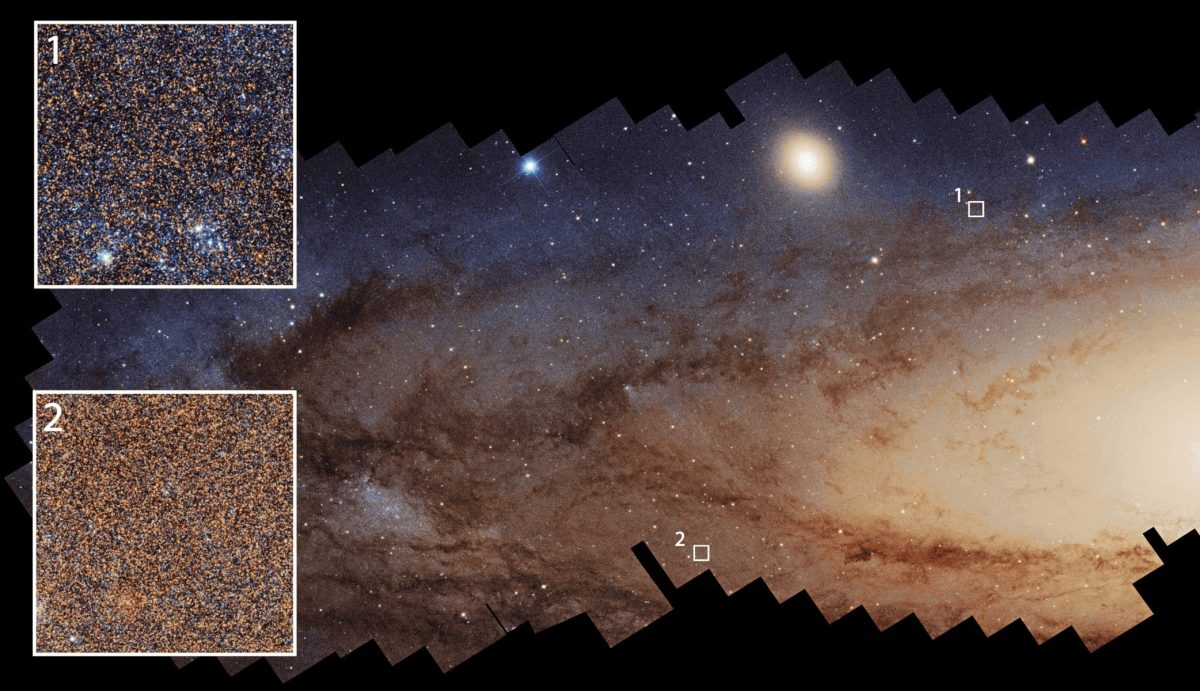
The dilemma of “nature versus nurture”—or, in our context, “nature versus environment”—is addressed in the same manner as in the social sciences: through an integration of both elements. Generally, the predominant influence remains the mass of the halo, which is why it is often stated that the evolution of galaxies is predominantly dictated by mass. The environment functions concurrently as a secondary, independent factor; consequently, galaxies with identical mass can exhibit divergent evolutionary paths. It emerges that the conceptual framework of the universe’s structure is constructed from entities whose characteristics are inherently determined by that very structure.
The ‘cosmic conspiracy’ of two effects
Two historical instances of measurement have demonstrated the substantial impact such factors can have on results. In the early 2000s, the most extensive surveys of the nearby universe measured an identical quantity and yielded incompatible outcomes. The Sloan Digital Sky Survey and the Two-Degree Redshift Survey operated under similar conditions and assessed the degree of galactic clustering. The discrepancy was considerable enough that the cosmological parameters derived from each dataset did not concur even within the margin of error. The investigation into the cause was prolonged, but the explanation proved to be straightforward. Galaxies were selected using filters of different colors — one slightly redder, the other slightly bluer. Red galaxies emit more strongly in the red spectrum, resulting in a significantly greater inclusion of such galaxies in the first sample. Given that these galaxies tend to be concentrated in dense regions, the measured clustering in this survey appeared more pronounced.

Pollo’s second narrative concerns her own experiences. During the corresponding years, she contributed to the VVDS deep survey, which acquired spectra of 6,000 galaxies and was regarded as the most comprehensive of its kind at that time. Although this figure appears modest by contemporary standards, it was deemed substantial at the time. The researcher was tasked with quantifying the evolution of galaxy clusters over time.
The expectations were explicitly defined. Gravity exerts an attractive force on matter, leading to the hypothesis that, over time, galaxies would have aggregated into increasingly dense conglomerates. Pollo analyzed graphs across different epochs — from the current universe to approximately ten billion years prior — and observed that the curves were, for all practical purposes, indistinguishable. Despite the theoretical prediction that gravity would have caused galaxies to form more compact clusters over such a timespan, the graphs revealed no evidence of this phenomenon. She reported spending numerous sleepless nights examining the code for potential errors; however, no faults were identified.
The explanation was identified not within the code but within the data itself. The clustering of galaxies indeed exhibited an increase over time, and this phenomenon behaved precisely as anticipated. However, the sample encompassed all galaxies in a sequence, without any constraints regarding brightness; at considerable distances, only the most luminous galaxies are observable. Such objects are situated in the densest regions of the structure, consequently rendering their distribution consistently more concentrated. Astronomers refer to this phenomenon as a luminosity shift. As a result, the distant universe within that sample appeared denser than its actual density. The two factors exerted opposing effects on the same curve, nearly nullifying each other. Pollo describes this coincidence as a “cosmic conspiracy.”

Both cases demonstrate that identical results do not necessarily indicate identical underlying mechanisms. Conversely, it is also possible that a processing artifact may be mistaken for a genuine phenomenon. Galaxies are classified as either red or blue, with an intermediate zone termed the “green valley” situated between the two groups. It is within this region that researchers aspire to identify galaxies undergoing a transition from active star formation to dormancy. Agnieszka highlights that the boundary separating these two categories depends on both the galaxy’s mass and the epoch it resides in. When galaxies of varying masses and from different epochs are aggregated into a single sample, a universal boundary must be employed for classification, despite each subgroup having its own distinct boundary. Consequently, some typical red and blue galaxies may be classified within the green valley. In this context, the green valley may represent a statistical artifact rather than a region indicative of a genuine evolutionary transition.
Galaxies beyond the catalog listings
A sample distorts the true picture not only by what it includes, but also by what it completely omits. Approximately fifty percent of all galaxies are absent from the catalogs. These are objects characterized by low surface brightness, which emit such faint light per unit area that they are nearly indistinguishable from the empty sky in an image. These objects have been recognized for an extended period; however, it is only recently that they have begun to be discovered in significant numbers. The standard detection thresholds for such objects are excessively high; therefore, current estimates suggest that as much as half of the Universe’s galactic population remains unobserved.

Searching for such objects manually within millions of images is impractical; therefore, neural networks are employed for this purpose. Even a well-trained model finds this task challenging, and each new catalog demands significant effort. Pollo and colleagues have compiled the initial extensive collections of faint galaxies, discovering the presence of both red and blue varieties. Analyzing their spatial distribution has provided additional insights. In terms of clustering strength, these galaxies are markedly distinct from others. The researchers propose that such objects have not yet been incorporated into the existing understanding of large-scale structure, and further study of them will enhance our comprehension of the influence of environmental interactions and the characteristics of dark matter.
Neural networks have profoundly transformed not only the exploration of galaxies but also our comprehension of the diversity of galactic types. A decade ago, Pollo and her team employed unsupervised learning techniques on the VIPERS survey — an approach wherein models are not supplied with pre-labeled examples but instead autonomously identify clusters of similar objects within the dataset. This survey encompassed nearly 100,000 galaxies and remains, to this day, the most extensive spectroscopic survey of such depth. Consequently, the dataset was categorized into several subclasses: five among the blue galaxies, three among the red galaxies, and additional subclasses among the intermediate types. The identification of further subclasses was hindered by the limited set of characteristics used for comparative analysis.
Everyone who presents the results of such a classification is asked the same question: What gives you the confidence that this division reflects physical reality, rather than simply following an instruction for a neural network to split the sample into groups? Pollo and his team tested this using neighborhood density, since this characteristic was not incorporated into the classification; therefore, a correlation with it would indicate that the division was based on a real physical phenomenon. Overall, the subclasses behaved as expected: the blue ones tended toward sparse areas, while the red ones were more tightly clustered. However, among the blue subclasses, only one — the most numerous — showed a strong correlation with density, while the rest were almost entirely independent of their surroundings.

Source: Wikipedia
The findings concerning the red galaxies were even more compelling. Among these was a subgroup identified with equal frequency in both dense and sparse regions, and the sizes of these objects are markedly smaller than typical. Pollo posits that star formation in these galaxies ceased rapidly, and that they have not undergone mergers in their history. Such galaxies are termed red dwarfs, and they facilitate the tracing of their evolution independent of environmental influences. Furthermore, Agnieszka considers them as potential candidates to function as cosmic chronometers for independently measuring the Hubble parameter, which reflects the rate of cosmic expansion during various epochs. Future surveys are required to diminish measurement uncertainties.
The initial program is already operational. The Vera Rubin Observatory commenced observations in 2025, and in 2026, the ten-year Legacy Survey of Space and Time (LSST) was inaugurated. Prior initiatives were either in-depth or wide-field; however, this program uniquely amalgamates both attributes and introduces the dimension of time. The entire southern celestial hemisphere is surveyed approximately every three days, resulting in a sequence of images that depict changes over time rather than a single static image. Over a decade, the LSST is projected to catalog approximately 37 billion sources — individual objects within the images — excluding faint galaxies from this count. The processing of such an extensive dataset cannot be achieved through conventional methodologies.

Source: rubinobservatory.org
Machine learning is indispensable in this context; however, according to Agnieszka Pollo, algorithms alone will not suffice. Citizen science initiatives such as Galaxy Zoo, where volunteers categorize the shapes of galaxies within images, will assist in data classification. It remains to be determined which methodology produces superior results in model training: extensive datasets from thousands of contributors or more concise datasets curated by seasoned astronomers.
Approximately fifty percent of the galaxy’s population remains uncataloged, and the initial tens of billions of sources from the Vera Rubin Observatory are anticipated to become accessible in the forthcoming years. Currently, there is no established methodology for managing such an extensive data volume, and Pollo anticipates that this methodology will be developed in collaboration with Ukrainian astronomers.