

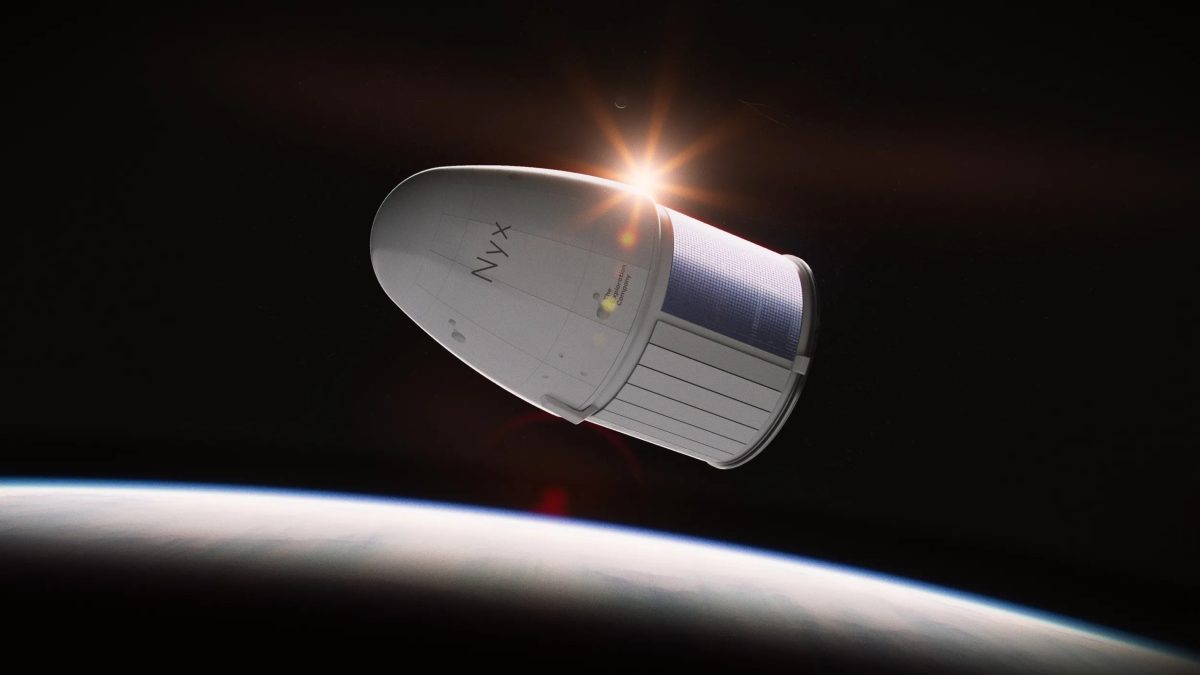
The reusable cargo spacecraft, which is eventually expected to carry people into orbit as well, has received record funding for the European space industry. The Exploration Company says its round is the largest ever among the continent’s space startups. The money will go toward the Nyx capsule and development of the company’s own rocket engine. The first flights have already been contracted, with European and U.S. space agencies among the customers.
What Is Being Built First
The immediate priority remains the Nyx capsule, a reusable spacecraft designed first for cargo and later for crew. According to the plan, docking with the ISS and a safe return to Earth are to take place by November 2028. By then, the station will already be approaching the end of its operational life.
Part of the funding will go to Storm, the rocket engine program. Reusability here will rely on full-flow staged combustion, in which all fuel and oxidizer pass through turbopumps before burning in the combustion chamber. The company calls this configuration the most complex, but also the most efficient, and adds that no one in Europe has yet built such an engine. Only one engine of this type has been flight-proven so far — SpaceX’s Raptor.
The Investor Lineup
The total amount raised is $450 million. The company has divisions operating in Germany, France, Luxembourg, Spain and Italy, and is headed by Hélène Huby, who previously spent two decades working at Airbus and ArianeGroup.
The round was co-led by Atomico and the Scaleup Europe Fund managed by EQT, together with U.S.-based Bessemer Venture Partners. Bessemer partner Alex Ferrara will join the board of directors. A similar situation is developing in the United States, where competitor Stoke Space is raising a billion-dollar round, as TechCrunch reports.
According to Hélène Huby, the funds raised will also be enough for the engine, at least at the initial stage. The launch pad and the rocket itself will require separate financing.
A Queue for Orbit
The amount of cargo that needs to be placed into orbit is growing faster than the capacity available to launch it. According to existing reports, Falcon rockets are increasingly being reserved for Starlink satellites, while it remains unclear what will happen after they are replaced by Starship.
According to Atomico, ten Nyx missions have already been booked, while the portfolio of contracts and commitments exceeds $2 billion. Some of these agreements come from institutional partners, including ESA and NASA. Even under an optimistic schedule, it will not be possible to meet all of this demand within the next few years.
The Limits of Private Investment
The company’s success was noted by French President Emmanuel Macron and European Commission President Ursula von der Leyen. The news was announced on the eve of the International Space Summit in Paris, where related announcements are expected.
Hélène Huby would like to see a European crewed-spaceflight program included in the roadmap, but considers it beyond the reach of private capital. Convincing venture investors to put $4 billion into a crew capsule and then wait ten years is simply impossible.
