

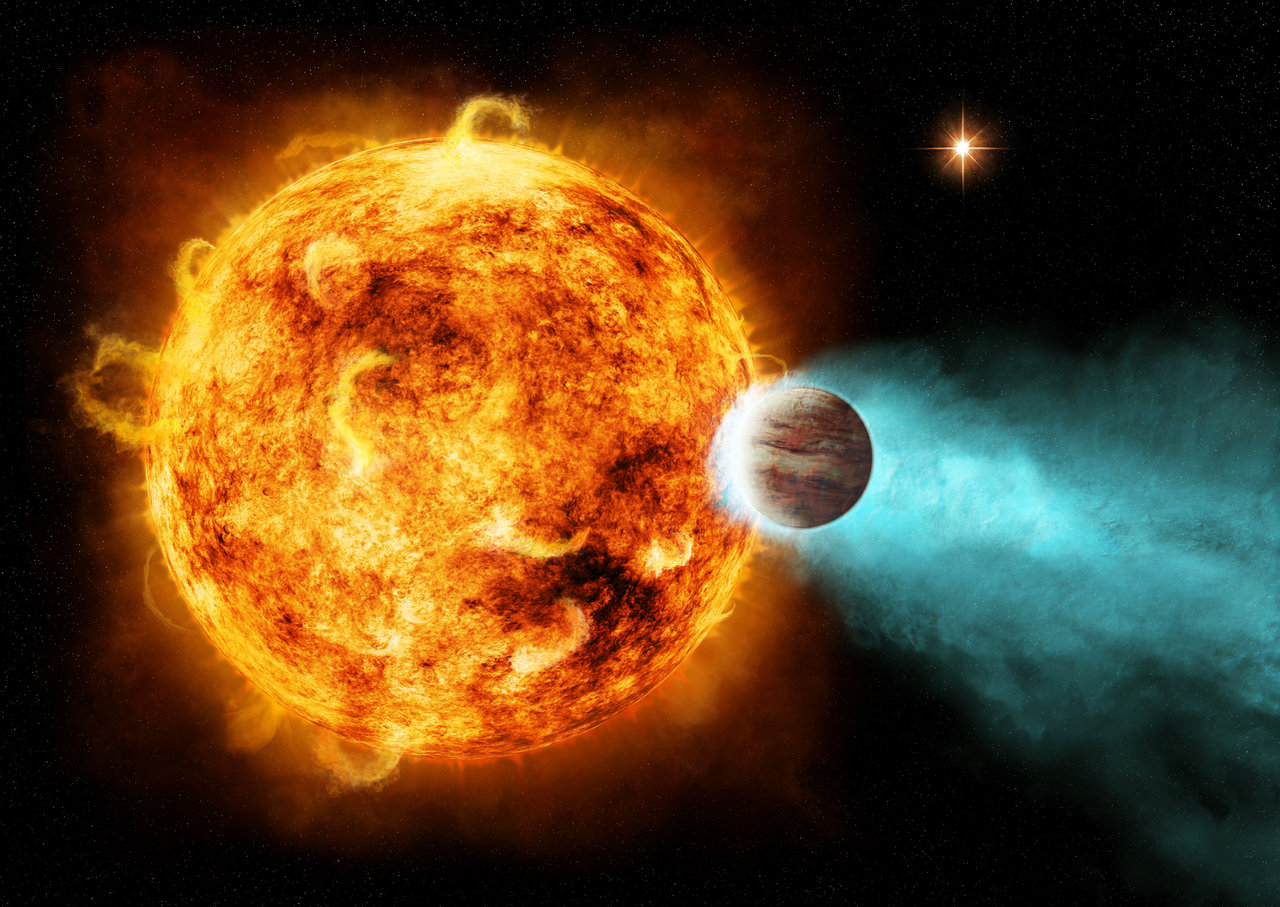
Astronomers have obtained the first convincing indirect evidence that hot Jupiters outside the solar system may have magnetic fields similar in scale to those of planets in our own system. They made the conclusion by analyzing the behavior of extremely strong atmospheric winds on these red-hot worlds, known as “hot Jupiters”. The observations offer the strongest evidence to date for the existence of magnetic fields beyond our solar system, a topic that has long eluded scientists.
Key role of magnetic fields
“It’s the first time we can compare the magnetic environments of other worlds—a key step toward ultimately understanding which planets can stay alive, keep their water and perhaps even, one day, host life as we know it,” said astronomer Julia Seidel of the Nice Observatory on the French Riviera. This was reported by the website phys.org.
By deflecting charged particles that bombard planets, magnetic fields play”very complex role in atmospheric retention,” Seidel, the lead author of the new study in Nature Astronomy.
In our solar system, Earth, Jupiter, and Saturn have active magnetic fields, while Venus and Mars do not. However, it is difficult to accurately measure what is happening on distant worlds known as exoplanets.
Studying the weather on “hot Jupiters”
Seidel and her colleagues had not originally planned to measure magnetic fields; instead, they intended to study the wind. The team studied seven “hot Jupiters,” gas giants where temperatures can reach nearly 2,000 degrees Celsius. They have “compositions completely unknown in our solar system,” Seidel explained.
These planets are so close to their stars that they are tidally locked. This means that one side always faces its star—just as the same side of the Moon always faces Earth. As a result, one side of these planets is always scorching hot, while the other side is in perpetual darkness.
Scientists have discovered that this extreme contrast creates very strong winds, with speeds ranging from 7,200 to 25,000 kilometers per hour. To measure these winds, they used the European Southern Observatory’s Very Large Telescope in Chile and the Gemini North telescope in Hawaii.
Unexpected pattern pointing to magnetic fields
They also discovered something unexpected: the hotter the planet, the weaker the wind.
“”This is totally counterintuitive,” study co-author Vivien Parmentier in a statement. “Because, all things being equal, hot planets have more energy to accelerate the winds!”
The only plausible explanation is the presence of a magnetic field around these planets, which slows down the movement of charged particles in their atmospheres. The intensities of the magnetic fields were similar to those observed in our Solar System, ranging from about four times stronger than Saturn’s to half the strength of Jupiter’s.
“This is the first study with such strong evidence of magnetic fields on exoplanets because it covers several worlds with the same traits,” said Seidel.
Scientists now know that exoplanets can have magnetic fields that are, in order of magnitude, similar to those of Jupiter or even Earth.
Previously, models had predicted exoplanets could have magnetic fields 100 times more intense than those in our solar system. By understanding the impact of magnetic fields in the “extreme laboratories” of hot Jupiters, “we are getting close to a comprehensive understanding of their role in planetary atmospheres,” Seidel concluded.
